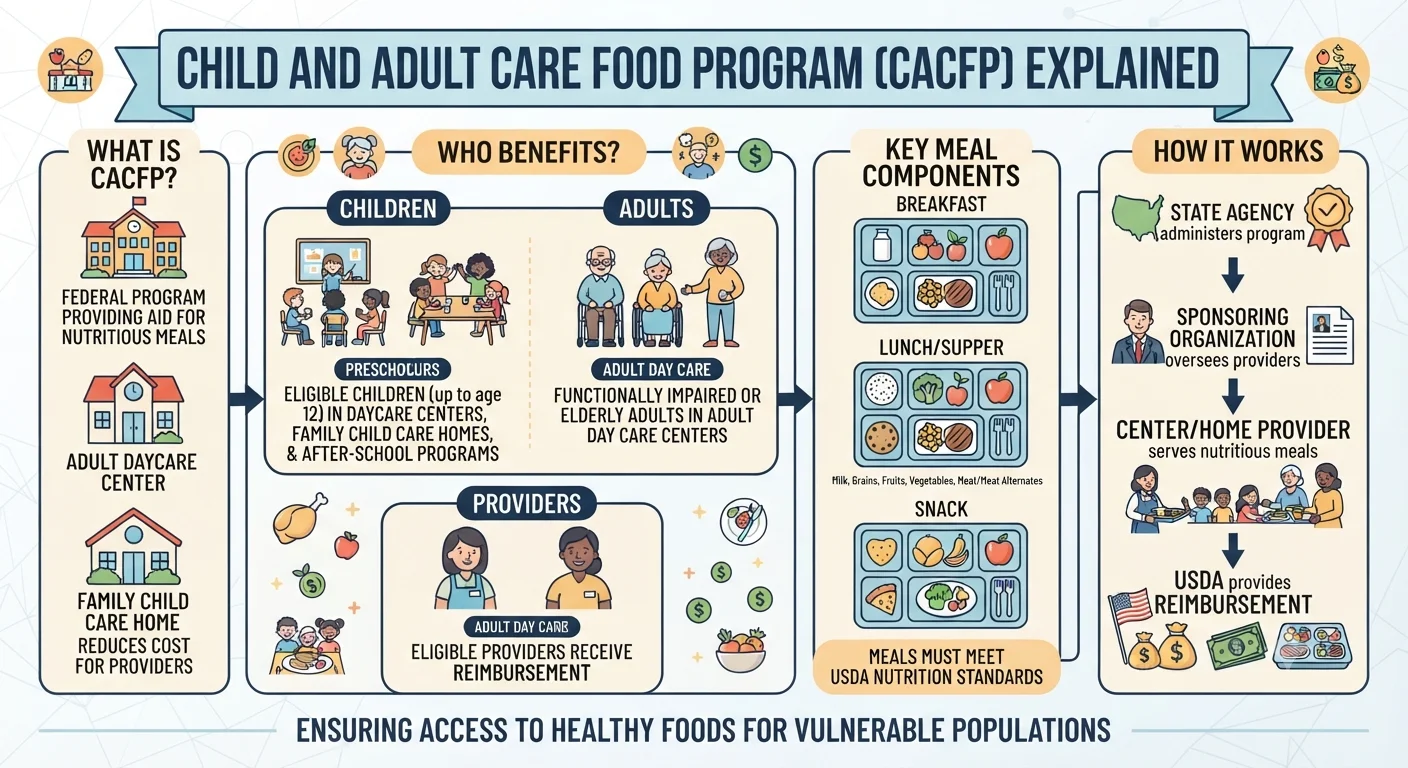
The Child and Adult Care Food Program, known as CACFP, provides federal reimbursement to licensed child care centers, family child care homes, afterschool programs, homeless shelters, and adult day care facilities for serving nutritious meals and snacks. In fiscal year 2023, CACFP reached over 4.4 million participants on an average day, and while CACFP reimbursement goes directly to the care provider rather than to families, it plays a significant role in keeping quality child care more affordable.
This guide is independently written and is not affiliated with USDA, OPM, or the official federal Feds Feed Families campaign.
Who CACFP Serves
CACFP covers several distinct groups:
- Children up to age 12 enrolled at participating child care centers and family child care homes
- Children and teenagers in school-based afterschool enrichment programs, in areas where at least 50 percent of children qualify for free or reduced-price meals
- Children age 18 and younger living in emergency or homeless shelters
- Adults age 60 and older, or adults living with a disability, enrolled in nonresidential adult day care facilities
Most CACFP participants are preschool-aged children attending licensed child care, since this is where the majority of the program's daily meal volume is concentrated.
How Eligibility Works for Care Providers
- Who CACFP Serves
- How Eligibility Works for Care Providers
- What Meals Are Covered
- How This Affects Families Directly
- Medical and Dietary Accommodations
- How to Find Out If Your Child Care Provider Participates
- FAQ
- What is CACFP and who does it help?
- Does CACFP pay families directly?
- How many meals can a child care center claim through CACFP?
- How do I know if my child's day care participates in CACFP?
To participate, a provider must be a licensed or state-approved child care provider, or a public or nonprofit organization running an organized child care program. For-profit centers can also participate if at least 25 percent of enrolled children qualify for free or reduced-price meals or receive a child care subsidy. Eligibility for CACFP reimbursement itself is based either on the individual enrolled child's household income, similar to the free and reduced-price school meal scale, or on the overall income level of the surrounding geographic area, depending on the type of facility and how it's structured.
What Meals Are Covered
Meal and snack limits vary by facility type. Child care centers and family child care homes can generally claim reimbursement for up to two meals and one snack, or two snacks and one meal, per child per day. At-risk afterschool centers can claim one meal and one snack per child per day. Emergency shelters can claim up to three meals, or two meals and one snack, per child per day. All meals must meet USDA nutrition standards covering five components: grains, vegetables, fruit, a meat or meat alternate, and fluid milk.
Recommended Articles
 SCHOOL CHILD NUTRITION PROGRAMS
 SCHOOL CHILD NUTRITION PROGRAMS
 SCHOOL CHILD NUTRITION PROGRAMS
 SCHOOL CHILD NUTRITION PROGRAMS
How This Affects Families Directly
Because CACFP reimbursement flows to the provider rather than to individual families, most parents never interact with CACFP paperwork directly beyond potentially reporting household income when enrolling their child, similar to a school meal application. The direct benefit to families is largely indirect but meaningful: participating child care providers are required not to charge a separate fee for meals on top of tuition, and CACFP funding helps many centers keep overall costs lower and food quality higher than they could otherwise sustain.
Medical and Dietary Accommodations
If a child has a medical condition requiring a modified meal, such as a food allergy, the care provider can still receive reimbursement for that modified meal, but only if a licensed physician or other authorized health care professional provides a written medical statement describing the condition and what dietary accommodation is required. Without this documentation, a meal that doesn't meet the standard CACFP meal pattern generally is not eligible for reimbursement.
How to Find Out If Your Child Care Provider Participates
Not every licensed child care provider participates in CACFP, since enrollment is voluntary for the provider. Asking directly whether a prospective or current child care center or family day care home participates in CACFP is the most reliable way to know, and it can be a useful factor to consider when evaluating child care options, since participation often correlates with more consistent nutrition standards for meals served during the day.
Read More Articals
FAQ
What is CACFP and who does it help?
CACFP is a federal program that reimburses licensed child care centers, family day care homes, afterschool programs, homeless shelters, and adult day care facilities for serving nutritious meals and snacks to eligible children and adults.
Does CACFP pay families directly?
No. Reimbursement goes to the care provider, not directly to families, though participation helps keep overall child care costs and meal quality more consistent for enrolled children.
How many meals can a child care center claim through CACFP?
Generally up to two meals and one snack, or two snacks and one meal, per child per day, though this varies by facility type.
How do I know if my child's day care participates in CACFP?
Ask the provider directly, since CACFP participation is voluntary and not every licensed child care center or family day care home is enrolled.
Sources: USDA Food and Nutrition Administration, Food Research and Action Center, National CACFP Association.