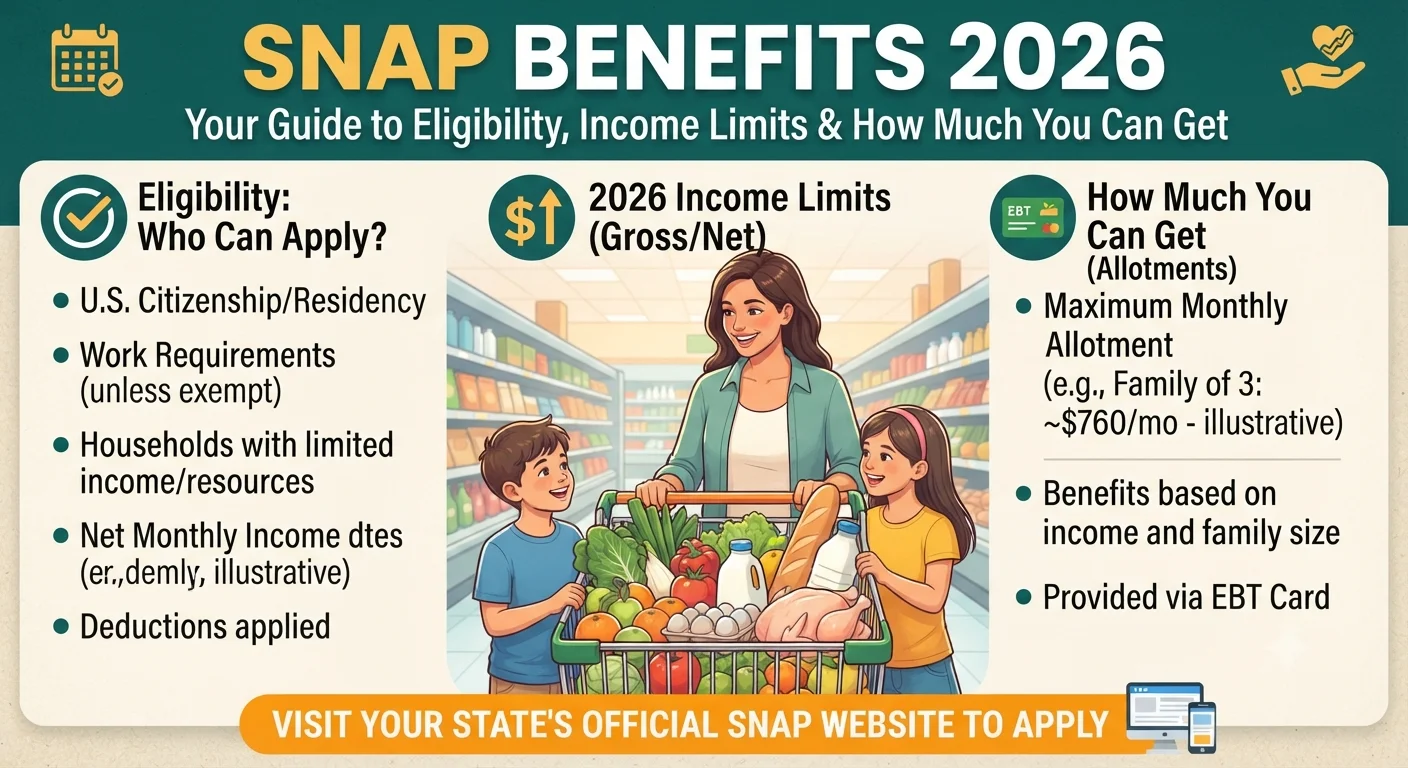
The Supplemental Nutrition Assistance Program (SNAP) provides monthly food benefits loaded onto an EBT card to help low-income households buy groceries. For fiscal year 2026 (October 1, 2025 through September 30, 2026), the maximum monthly SNAP benefit ranges from $298 for a one-person household to $994 for a family of four in the 48 contiguous states, with most households receiving less than the maximum based on their income.
This page is independently researched and is not affiliated with the USDA, OPM, or the official government "Feds Feed Families" campaign.
What Is SNAP?
SNAP, formerly known as food stamps, is a federal nutrition assistance program administered by the U.S. Department of Agriculture's Food and Nutrition Administration (FNA) renamed from the Food and Nutrition Service (FNS) as of June 1, 2026. States run the day-to-day application and distribution process, but eligibility rules and benefit amounts are set at the federal level and updated every October.
Benefits are issued electronically via an EBT (Electronic Benefit Transfer) card, which works like a debit card at authorized grocery stores, some farmers markets, and select online retailers.
FY2026 Income Limits (Gross & Net)
- What Is SNAP?
- FY2026 Income Limits (Gross & Net)
- Maximum Monthly Allotment by Household Size (FY2026)
- Asset Limits Explained
- How Your Benefit Is Calculated (With a Worked Example)
- Who's Automatically Eligible (Categorical Eligibility)
- FAQ
- What is the maximum SNAP benefit for 2026?
- Does everyone who qualifies get the maximum amount?
- Do SNAP income limits change every year?
- Are SNAP rules the same in every state?
To qualify for SNAP, most households must pass two income tests:
- Gross income test: Total household income before deductions must be at or below 130% of the federal poverty level.
- Net income test: Income after allowable deductions must be at or below 100% of the federal poverty level.
Households with a member who is elderly (60+) or disabled only need to meet the net income test. In states that use Broad-Based Categorical Eligibility (BBCE) which includes California, New York, Texas, Florida, Illinois, Massachusetts, Michigan, Washington, and more than 35 others the gross income limit can rise to around 200% of the federal poverty level, meaning significantly more working households qualify.
Maximum Monthly Allotment by Household Size (FY2026)
These figures apply to the 48 contiguous states and Washington, D.C., effective October 1, 2025 through September 30, 2026:
| Household Size | Maximum Monthly Allotment |
|---|---|
| 1 person | $298 |
| 2 people | $546 |
| 3 people | $785 |
| 4 people | $994 |
| 5 people | $1,183 |
| 6 people | $1,421 |
| 7 people | $1,571 |
| 8 people | $1,789 |
| Each additional person | +$218 |
Alaska, Hawaii, Guam, and the U.S. Virgin Islands have separate, higher maximum allotments because the USDA calculates food costs for those areas separately. For example, Hawaii's maximum for a family of four is $1,689 per month. The minimum SNAP benefit for FY2026 is $24 per month for eligible one- and two-person households; households of three or more do not receive a guaranteed minimum.
Recommended Articles
 SNAP EBT
 SNAP EBT
 SNAP EBT
 SNAP EBT
Asset Limits Explained
Most households must also meet a resource (asset) test:
- $3,000 in countable resources for most households
- $4,500 in countable resources if at least one household member is age 60 or older, or has a disability
Countable resources include cash and money in bank accounts. A home, one vehicle, and most retirement accounts are generally excluded. States that use BBCE often waive the asset test entirely another reason it's worth checking your specific state's rules rather than assuming you're over the limit.
How Your Benefit Is Calculated (With a Worked Example)
SNAP assumes your household will spend about 30% of its net income on food. Your benefit is calculated as:
Maximum Allotment (Net Monthly Income × 0.30) = Monthly SNAP Benefit
Example: A family of four with $800 in net monthly income: $994 ($800 × 0.30) = $994 −$240 = $754 per month
Common deductions that lower your countable net income include a standard deduction ($209/month for households of 1–3 people, $223 for a household of 4, $261 for 5, and $299 for 6+ in FY2026), a 20% deduction on earned income, and an excess shelter deduction for housing costs above half your income (capped at $744/month unless a household member is elderly or disabled).
Who's Automatically Eligible (Categorical Eligibility)
Some households skip the standard income test entirely. If every member of your household receives Temporary Assistance for Needy Families (TANF) or Supplemental Security Income (SSI), you may be categorically eligible for SNAP.
FAQ
What is the maximum SNAP benefit for 2026?
The maximum monthly SNAP benefit for FY2026 is $298 for a one-person household and $994 for a family of four in the 48 contiguous states, effective October 1, 2025 through September 30, 2026.
Does everyone who qualifies get the maximum amount?
No. Most households receive less than the maximum. The full amount only goes to households with little or no net income; your actual benefit is the maximum minus 30% of your net monthly income.
Do SNAP income limits change every year?
Yes. The USDA updates income limits, maximum allotments, and deductions annually on October 1, based on the cost of the Thrifty Food Plan and cost-of-living adjustments.
Are SNAP rules the same in every state?
No. While federal law sets the baseline, many states use Broad-Based Categorical Eligibility to raise income limits or waive the asset test.
Sources: USDA Food and Nutrition Administration (fna.usda.gov), FY2026 SNAP Cost-of-Living Adjustment memo.