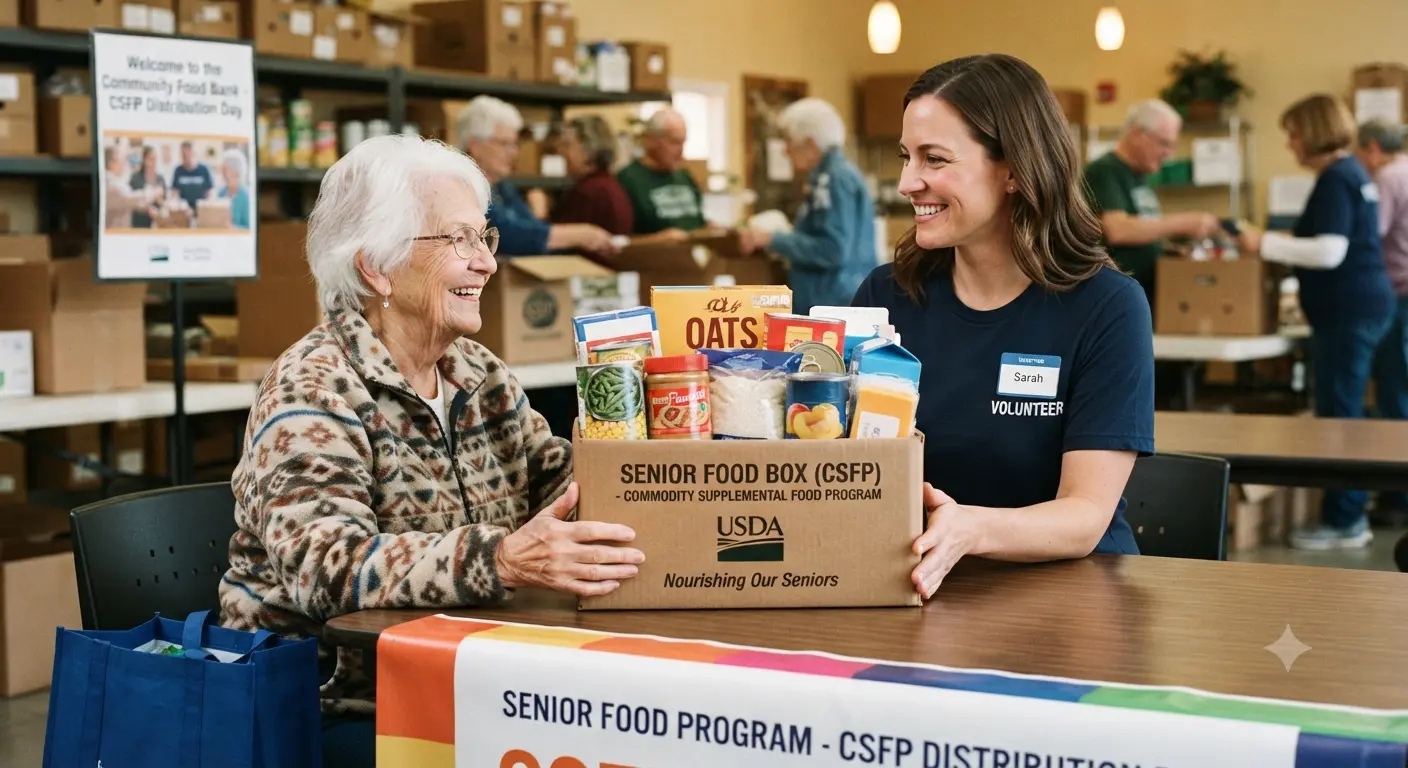
The Commodity Supplemental Food Program, often called the senior food box program, provides a free monthly box of USDA foods to low-income adults age 60 and older. As of 2026, income eligibility is generally set at 130 percent of the federal poverty level in most states, with several states now using a higher 150 percent threshold, working out to roughly $1,632 per month for a one-person household at the lower figure.
This guide is independently written and is not affiliated with USDA, OPM, or the official federal Feds Feed Families campaign.
Who Qualifies for CSFP
To qualify for CSFP, you generally must meet three requirements:
- Age: You must be at least 60 years old
- Residency: You must live in a state, territory, or tribal area that participates in CSFP, which as of 2026 includes approximately 47 states, Washington D.C., Puerto Rico, and several tribal nations, though not every county within a participating state necessarily has an active distribution site
- Income: Your household income must fall at or below your state's limit, generally 130 percent of the federal poverty level, though some states, including Illinois as of state fiscal year 2026, now use a higher 150 percent threshold
Eligibility is typically based on self-attested income rather than requiring formal proof of income documents at application, though you will usually need to show proof of age and residency, such as a driver's license, birth certificate, or utility bill.
Automatic Eligibility Through Other Programs
- Who Qualifies for CSFP
- Automatic Eligibility Through Other Programs
- What's in the Monthly Food Box
- How to Apply
- Recertification and Ongoing Participation
- What If You Can't Pick Up Your Box Yourself
- Can You Get CSFP and SNAP at the Same Time
- FAQ
- Who qualifies for the CSFP senior food box program?
- Do I need to prove my income to get a senior food box?
- Can I get CSFP and SNAP benefits at the same time?
- What happens if I can't pick up my box in person?
If you already receive Supplemental Security Income or another qualifying federal or state assistance program, many states automatically consider you income-eligible for CSFP regardless of your specific income figure, since dual eligibility rules recognize that participation in one means-tested program typically indicates you meet another program's income standard as well.
What's in the Monthly Food Box
A typical CSFP package weighs around 30 to 40 pounds and includes a rotating selection of:
- Canned fruits and vegetables
- Fruit or vegetable juice
- Cereal, oats, pasta, rice, or grits
- Dry beans, lentils, or peanut butter
- Canned meat, poultry, or fish
- Dry milk or shelf-stable dairy
- Cheese, when available
The package is meant to supplement, not replace, a senior's overall diet, and is specifically designed to provide nutrients commonly lacking in older adults' diets, including calcium, iron, and vitamins A and C.
How to Apply
- Confirm CSFP is available in your area by calling 211 or searching "CSFP" plus your state name, since availability can be limited by county even within a participating state
- Contact your state's CSFP agency or a local distributing partner, such as a regional food bank, to complete a brief application
- Bring proof of age and residency to your first pickup, such as a driver's license, birth certificate, or utility bill; income documentation is typically not required at application in most states
- Pick up your box monthly at your assigned distribution site, such as a food shelf, community center, or senior center
Recertification and Ongoing Participation
CSFP certification periods vary by state, with some recertifying participants annually and others, like Illinois, using a three-year certification cycle as of 2026. Most programs also require picking up your box on a regular basis to remain enrolled. Missing pickups for several consecutive months, often three, can result in removal from the program, though most agencies will send a notice first and allow you to contact them to remain enrolled if you respond promptly.
Recommended Articles
 FOOD BANKS PANTRIES
 FOOD BANKS PANTRIES
 FOOD BANKS PANTRIES
 FOOD BANKS PANTRIES
What If You Can't Pick Up Your Box Yourself
Many CSFP sites allow homebound participants to designate a proxy, such as a family member, friend, or volunteer, to pick up the box on their behalf. This typically requires completing a simple proxy form in advance, and the designated person will usually need to bring the participant's photo ID to the distribution site.
Can You Get CSFP and SNAP at the Same Time
Yes. CSFP and SNAP are separate programs, and receiving one does not disqualify you from the other. Many low-income seniors participate in both, using SNAP's flexible monthly benefit for regular grocery shopping while CSFP's fixed monthly box supplements specific nutrients that can be harder to afford consistently on a tight budget.
Read More Articals
FAQ
Who qualifies for the CSFP senior food box program?
Adults age 60 or older living in a participating state or tribal area, with household income generally at or below 130 percent of the federal poverty level, though some states use a higher 150 percent threshold.
Do I need to prove my income to get a senior food box?
In most states, no. Eligibility is typically based on self-attested income, though proof of age and residency is usually required.
Can I get CSFP and SNAP benefits at the same time?
Yes. The two programs are separate, and many low-income seniors participate in both without either affecting the other's eligibility.
What happens if I can't pick up my box in person?
Most CSFP sites allow you to designate a proxy, such as a family member or friend, to pick up the box on your behalf after completing a simple proxy form.
Sources: USDA Food and Nutrition Administration, BenefitsUSA CSFP eligibility guidance, Illinois Department of Human Services, Care and Share Food Bank, ACCESS NYC.