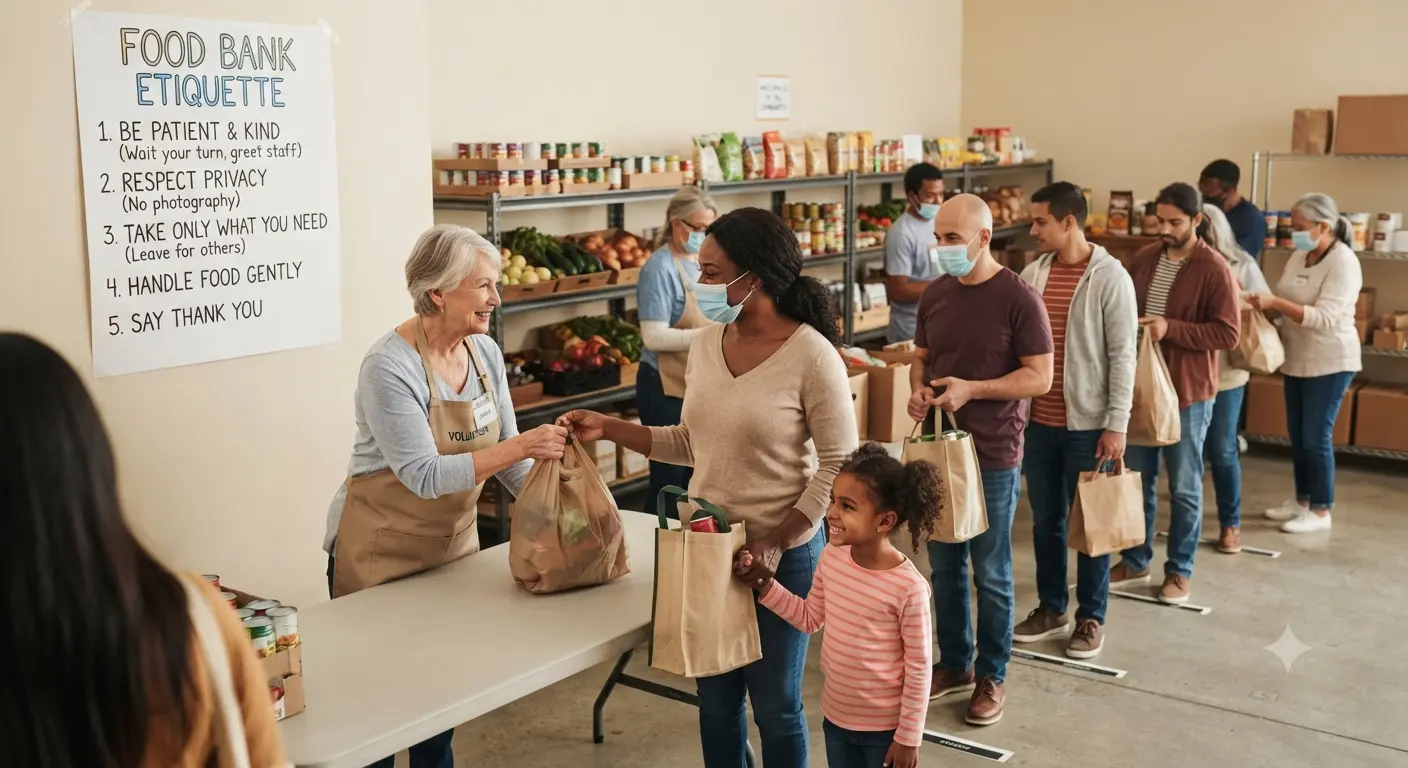
Visiting a food pantry for the first time is nothing to feel embarrassed about. Millions of Americans use food pantries every year, eligibility at most pantries is based on self-attested need rather than proof of income, and volunteers are there specifically to help, not to judge. Knowing a few basic expectations ahead of time, such as bringing bags, respecting posted hours, and being patient in line, can make a first visit feel far less intimidating.
This guide is independently written and is not affiliated with USDA, OPM, or the official federal Feds Feed Families campaign.
Before You Go
Call ahead or check the pantry's website if possible, since hours, required documentation, and whether an appointment is needed can vary significantly from one pantry to another. Some pantries operate a walk-in, shop-style model, while others have switched to pre-packed boxes with a scheduled pickup window, a shift that became common at many pantries in recent years and has stuck around at some locations for efficiency. Knowing which model your pantry uses ahead of time helps you show up prepared rather than caught off guard.
What to Bring
- Before You Go
- What to Bring
- What Happens When You Arrive
- During Your Visit
- Simple Courtesies That Go a Long Way
- If You Receive an Unfamiliar Item
- You Are Not Taking From Someone Else
- FAQ
- Do I need to prove I qualify to use a food pantry?
- What should I bring to my first food pantry visit?
- Is there a limit on how much food I can take?
- Is it okay to be a first-time visitor without knowing the process?
- Reusable bags, boxes, or a cart to carry food home, since many pantries do not provide bags
- A form of photo ID, even though many pantries do not strictly require one
- Proof of address, such as mail or a utility bill, if the pantry serves a defined service area
- A general sense of your household size, since staff use this to determine how much food to provide
What Happens When You Arrive
Look for a check-in table or a volunteer who appears to be greeting visitors, and simply let them know it's your first visit. You do not need to explain your full situation or justify your need beyond basic registration information. Most pantries will ask you to complete a short form, sometimes just your name, address, and household size, and some larger food banks may follow up with a brief conversation about any specific dietary needs so they can better match what they offer to what your household can actually use.
During Your Visit
If the pantry operates on a shopping model, you may have a limited time window to select items, sometimes as short as ten to fifteen minutes at larger or high-traffic locations, so it helps to have a general sense of what you need before you start browsing. Many pantries set per-category limits, such as a maximum number of canned goods or a certain number of proteins per household, to make sure supplies stretch across everyone being served that day. If you are unsure about a limit or how a particular station works, it is completely fine to ask a volunteer directly.
Recommended Articles
 FOOD BANKS PANTRIES
 FOOD BANKS PANTRIES
 FOOD BANKS PANTRIES
 FOOD BANKS PANTRIES
Simple Courtesies That Go a Long Way
- Arrive within the posted hours rather than significantly early or after closing
- Be patient during busy periods, especially at the start of the month, when lines tend to be longest
- Take only what your household will realistically use, leaving the rest for others who also need it
- Say thank you to volunteers, who are almost always donating their own time
- Keep conversation friendly but brief if the line is moving, since volunteers are often serving a large number of people in a limited window
If You Receive an Unfamiliar Item
Food pantry selection depends heavily on what has been donated that week, so you may occasionally receive an item you don't recognize or don't normally cook with. Rather than leaving it behind, it is often worth asking a volunteer if they have a simple recipe suggestion, since many pantries keep basic recipe cards on hand specifically for less common items like unusual grains or vegetables.
You Are Not Taking From Someone Else
A common hesitation among first-time visitors is a feeling that they might be taking food away from someone who needs it more. Food pantries plan their distributions based on expected turnout, and unclaimed food often goes to waste rather than being saved for a hypothetically more deserving visitor. If you meet the pantry's basic guidelines, whether that's a stated income limit or simply self-attested need, you are exactly who the pantry exists to serve.
Read More Articals
FAQ
Do I need to prove I qualify to use a food pantry?
Most food pantries operate on self-attested need, meaning you generally do not need to provide proof of income or a referral. Some ask for basic information like household size or address for reporting purposes.
What should I bring to my first food pantry visit?
Reusable bags or a cart to carry food, a form of ID if you have one, and a general sense of your household size. Requirements vary by pantry, so calling ahead can help you know exactly what to expect.
Is there a limit on how much food I can take?
Many pantries set per-category limits to ensure fair distribution across all visitors that day. Ask a volunteer if you're unsure about a specific limit.
Is it okay to be a first-time visitor without knowing the process?
Yes, completely. Simply let a volunteer or staff member know it's your first visit, and they will walk you through the process. There is no need to explain your full situation beyond basic registration.
Sources: Feeding America, PantryPath food pantry visitor guidance, University of California Irvine Basic Needs Center pantry guidelines.