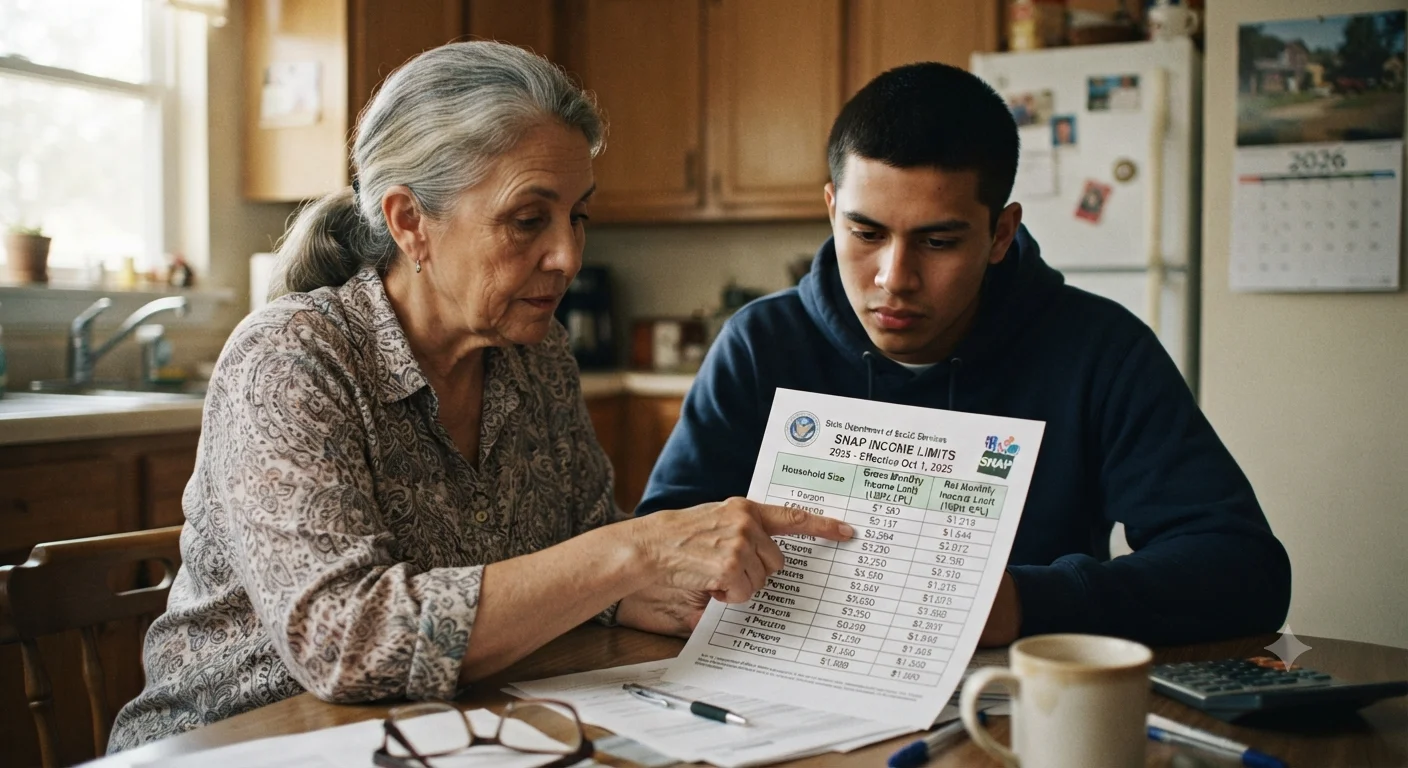
For fiscal year 2026, a household's gross monthly income generally must fall at or below 130% of the federal poverty level, and net income must be at or below 100% of the federal poverty level, to qualify for SNAP. A two-person household can have net monthly income up to roughly $1,763 and still qualify. Limits are higher in Alaska, Hawaii, Guam, and the U.S. Virgin Islands.
This guide is independently written and is not affiliated with USDA, OPM, or the official federal "Feds Feed Families" campaign.
Gross vs. Net Income Explained
Gross income is your household's total income before any deductions. Net income is your gross income minus allowable deductions such as the standard deduction, a 20% earned income deduction, dependent care costs, and excess shelter costs. Households with an elderly (60+) or disabled member only need to meet the net income test.
2026 Income Limit Table (48 States + D.C.)
- Gross vs. Net Income Explained
- 2026 Income Limit Table (48 States + D.C.)
- Broad-Based Categorical Eligibility (BBCE) States
- Deductions That Lower Your Countable Income
- Example Calculation
- FAQ
- What is the income limit for food stamps for a family of 4?
- Do deductions really make a difference in qualifying?
- Are income limits the same in every state?
- Should I apply even if I think my income is too high?
| Household Size | Gross Monthly Income Limit (130% FPL) | Net Monthly Income Limit (100% FPL) |
|---|---|---|
| 1 | ~$1,696 | ~$1,304 |
| 2 | ~$2,292 | ~$1,763 |
| 3 | ~$2,888 | ~$2,222 |
| 4 | ~$3,483 | ~$2,679 |
| 5 | ~$4,079 | ~$3,138 |
| 6 | ~$4,675 | ~$3,596 |
| 7 | ~$5,271 | ~$4,054 |
| 8 | ~$5,867 | ~$4,513 |
Figures are approximate and adjust annually each October. Always confirm exact current figures with your state SNAP agency.
Broad-Based Categorical Eligibility (BBCE) States
More than 40 states and D.C. use BBCE, which raises the gross income limit often to around 200% of the federal poverty level and frequently eliminates the asset test. States using BBCE include California, New York, Texas, Florida, Illinois, Massachusetts, Michigan, and Washington, among others.
Recommended Articles
 SNAP EBT
 SNAP EBT
 SNAP EBT
 SNAP EBT
Deductions That Lower Your Countable Income
- Standard deduction: $209/month (households of 1–3), $223 (4), $261 (5), $299 (6+)
- Earned income deduction: 20% off job income
- Dependent care deduction: costs for child/dependent care needed to work
- Excess shelter deduction: housing costs above half your income, capped at $744/month unless elderly/disabled
- Medical expense deduction: for elderly/disabled members with costs over $35/month
Example Calculation
A single mother of two (household of 3) earns $2,400/month gross.
- Gross income $2,400 under the ~$2,888 limit. Passes gross test.
- 20% earned income deduction: $2,400 − $480 = $1,920
- Standard deduction: $1,920 − $209 = $1,711
- Shelter deduction (assume $200): $1,711 − $200 = $1,511
- Net income $1,511 under the ~$2,222 net limit. Passes net test. Likely qualifies.
FAQ
What is the income limit for food stamps for a family of 4?
Roughly $3,483 gross and $2,679 net per month for FY2026, though BBCE states may allow higher.
Do deductions really make a difference in qualifying?
Yes many households above the gross limit still qualify after deductions bring net income under the limit.
Are income limits the same in every state?
No. BBCE states and Alaska/Hawaii/Guam/USVI use different tables.
Should I apply even if I think my income is too high?
Generally yes there's no cost or penalty for applying and being denied.
Sources: USDA Food and Nutrition Administration (fna.usda.gov), HHS Federal Poverty Guidelines.