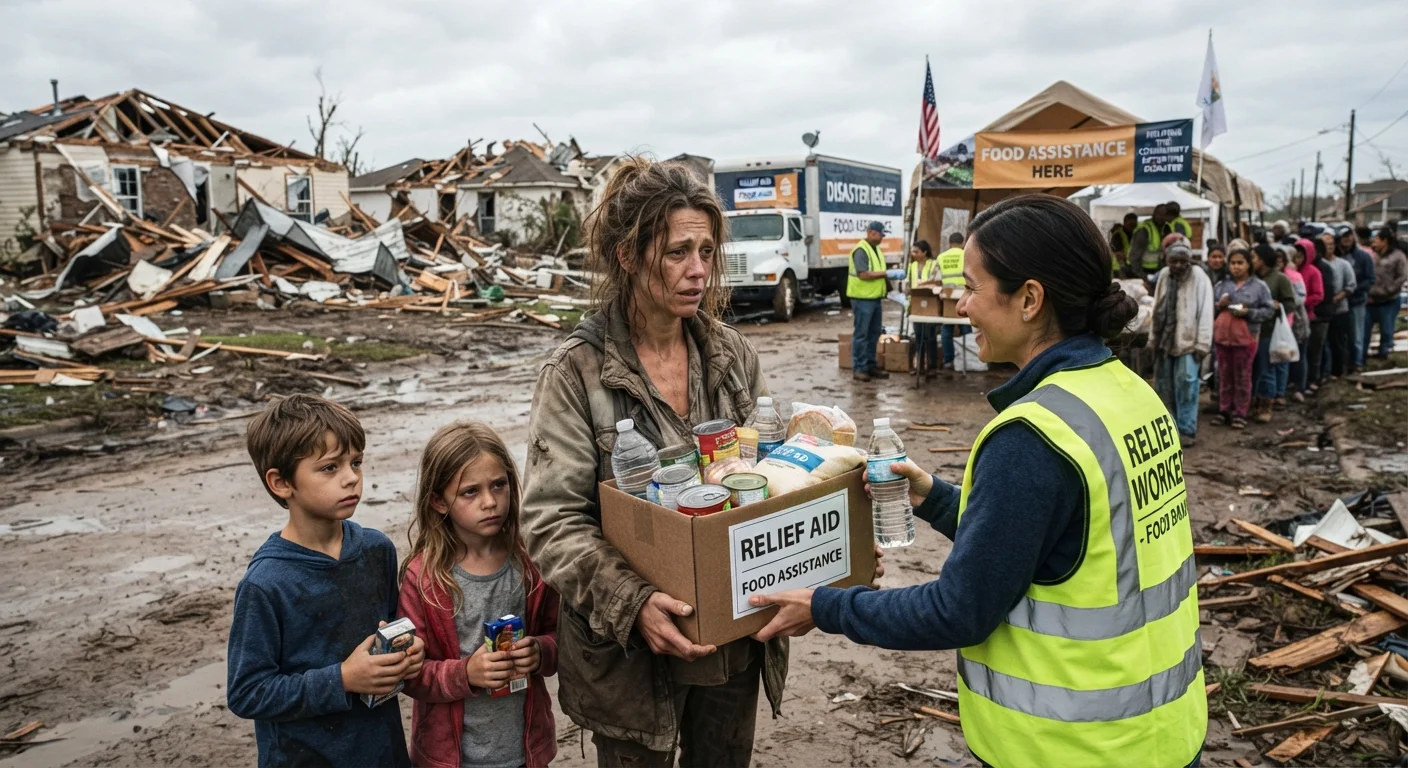
The Disaster Supplemental Nutrition Assistance Program, D-SNAP, provides emergency food benefits to households affected by a federally declared disaster, including many households that don't normally qualify for regular SNAP, using a separate eligibility test built around disaster-related losses and expenses rather than standard monthly income.
This guide is independently written and is not affiliated with USDA, OPM, or the official federal Feds Feed Families campaign.
Who Can Qualify for D-SNAP
Homeowners and renters whose property has been damaged or destroyed in a federally declared disaster area are generally eligible to apply, along with people who were visiting or passing through the area when the disaster happened, if they experienced damages themselves. You generally must have lived or worked in one of the affected areas during the disaster period and be able to show a disaster-related loss, such as property damage, incurred expenses, or lost income or assets.
What Counts as a Disaster-Related Expense
- Who Can Qualify for D-SNAP
- What Counts as a Disaster-Related Expense
- How Much D-SNAP Provides
- How Fast D-SNAP Benefits Arrive
- Replacement Benefits for Existing SNAP Households
- Temporary Hot Food Purchases
- How to Apply
- Coordinating With FEMA
- FAQ
- Can I get food assistance after a disaster even if I don't normally qualify for SNAP?
- How quickly does D-SNAP provide benefits?
- Can I still get regular SNAP food replaced without D-SNAP being active?
- Can I use SNAP for hot food after a disaster?
D-SNAP eligibility considers a range of costs beyond just lost food, including expenses related to replacing necessary personal and household items such as clothing, appliances, tools, and educational materials, along with home repair costs, temporary shelter expenses, and other disaster-related financial impacts during the designated disaster period.
How Much D-SNAP Provides
If eligible, you can generally receive up to a full month's maximum SNAP allotment for your household size, calculated using the same federal maximum allotment table used for regular SNAP. If you already receive regular SNAP and your current benefit is less than the maximum for your household size, you may still be able to receive a supplemental amount bringing you up to that maximum during a D-SNAP period.
How Fast D-SNAP Benefits Arrive
D-SNAP is specifically designed for speed, with benefits generally arriving within about three days of approval, and applications submitted during an authorized D-SNAP period following a short, intensive application window announced by your state. Because this window is often limited to just a few days, monitoring your state's SNAP agency website and local news closely in the aftermath of a declared disaster is important if you believe you might qualify.
Replacement Benefits for Existing SNAP Households
If you already receive regular SNAP and lost food due to a disaster, such as spoilage from a power outage, a flood, or a fire, you can separately request replacement benefits for the value of that lost food, generally by reporting the loss within 10 days of the misfortune. This replacement process is distinct from D-SNAP itself and can be pursued whether or not a formal D-SNAP period has been authorized for your area, since it applies to any household misfortune, not just a large-scale declared disaster.
Recommended Articles
 LIFE SITUATIONS & SPECIAL CIRCUMSTANCES
 LIFE SITUATIONS & SPECIAL CIRCUMSTANCES
 LIFE SITUATIONS & SPECIAL CIRCUMSTANCES
 LIFE SITUATIONS & SPECIAL CIRCUMSTANCES
Temporary Hot Food Purchases
In the event of a Presidential Disaster Declaration for individual assistance, a state can request and receive a waiver allowing SNAP households to temporarily use their EBT card to buy hot, prepared foods, recognizing that many affected households may not have a working kitchen in the immediate aftermath of a disaster.
How to Apply
Because D-SNAP is administered by each state individually following federal approval, the application process, required documents, and access points, such as designated in-person stations, vary by state and specific disaster event. You can typically expect to need proof of identity, proof of residency or presence in the affected area, verification of income for a defined recent period, and documentation of your disaster-related resources and expenses. Applicants unable to apply in person themselves can generally name an authorized representative to apply on their behalf.
Coordinating With FEMA
D-SNAP often operates alongside separate FEMA disaster assistance, and in some states, applying for or being approved by FEMA is a component of accessing broader disaster relief. It's worth understanding that D-SNAP and FEMA assistance address different needs, food versus broader recovery costs like housing, and pursuing both, where eligible, is generally appropriate rather than choosing one over the other.
Read More Articals
FAQ
Can I get food assistance after a disaster even if I don't normally qualify for SNAP?
Yes, potentially, through D-SNAP, which uses a separate eligibility test based on disaster-related losses and expenses rather than standard monthly income limits.
How quickly does D-SNAP provide benefits?
Generally within about three days of approval, though the application window itself is often limited to just a few days following a disaster, so applying promptly matters.
Can I still get regular SNAP food replaced without D-SNAP being active?
Yes. If you already receive SNAP and lost food due to any household misfortune, including a power outage or fire, you can request replacement benefits by reporting the loss within 10 days, independent of whether D-SNAP has been formally activated.
Can I use SNAP for hot food after a disaster?
In some cases, yes. States can request a temporary waiver allowing SNAP households to buy hot, prepared food following a Presidential Disaster Declaration, recognizing many households may lack a working kitchen.
Sources: USDA Food and Nutrition Administration, Louisiana Department of Health, Texas Health and Human Services Commission, National Council on Aging.