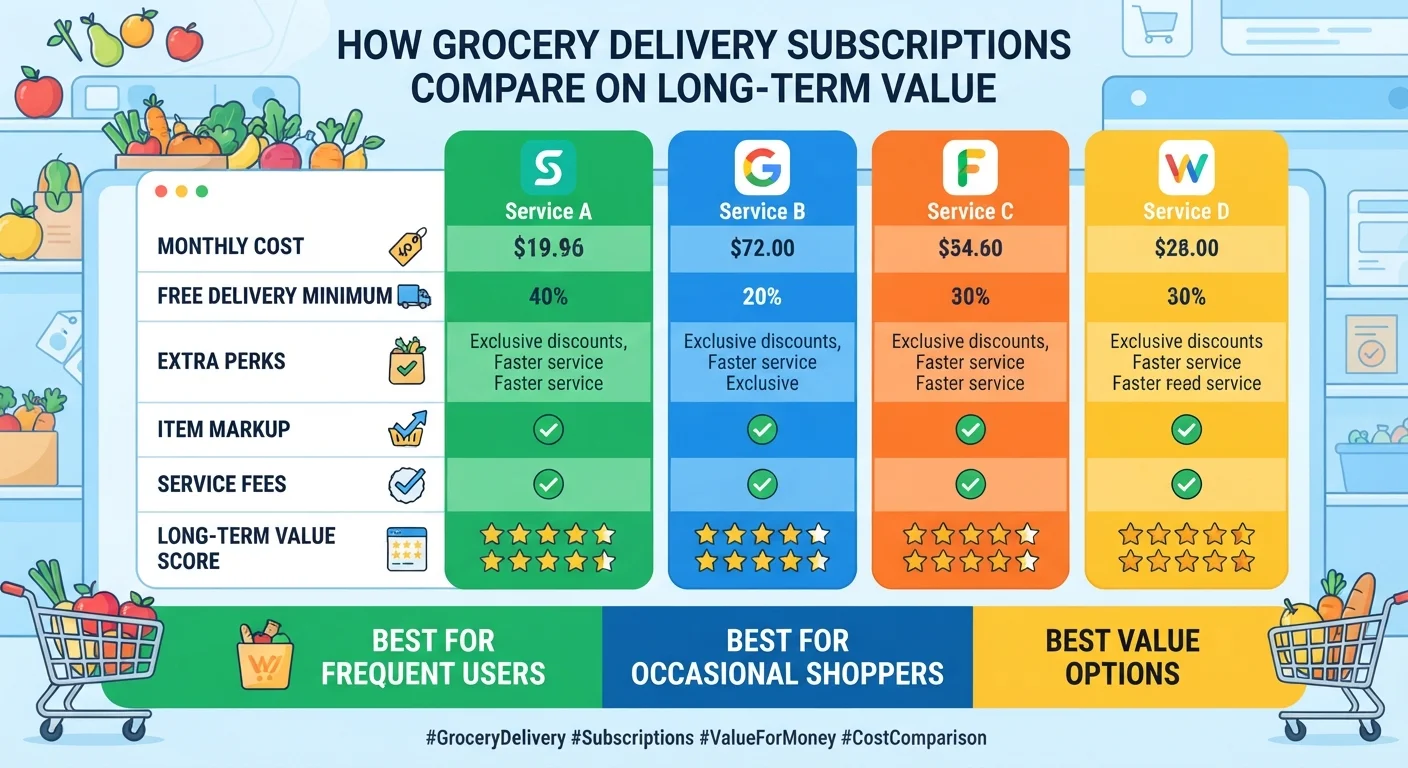
Annual grocery delivery memberships from major services generally cluster in the $98 to $139 range, Walmart+ at $98 a year, Instacart+ at $99 a year, and Amazon Fresh included with a $139 Amazon Prime membership, but the real value of any of these depends heavily on how often a household actually orders and, critically, whether the platform applies item-price markup that can quietly cancel out a waived delivery fee's savings.
This guide is independently written and is not affiliated with USDA, OPM, or the official federal Feds Feed Families campaign. It is not sponsored by any grocery delivery service mentioned.
The Membership Math, Broken Down
Dividing an annual membership fee across a weekly order works out to roughly $1.90 per order for most major services, a genuinely small figure once amortized across regular use, but this math only pays off for a household that actually places orders that frequently. A household ordering only occasionally is likely better served paying a per-order delivery fee rather than committing to an annual membership that may not get used enough to justify its cost.
Why the Cheapest-Looking Fee Isn't Always the Cheapest Total
- The Membership Math, Broken Down
- Why the Cheapest-Looking Fee Isn't Always the Cheapest Total
- Instacart's Real Advantage Is Selection, Not Necessarily Price
- Amazon Fresh Only Makes Sense With an Existing Prime Membership
- No-Membership Options Exist for Occasional Orders
- What Doesn't Change Regardless of Membership
- Checking SNAP EBT Compatibility Before Choosing a Service
- FAQ
- Which grocery delivery membership offers the best overall value?
- Does a waived delivery fee always mean real savings?
- Is Amazon Fresh a good option without an existing Prime membership?
- Does Instacart accept SNAP EBT at every store?
It's genuinely important to understand that Walmart+ is frequently identified as offering the lowest total cost specifically because Walmart charges the same prices online as in-store, with no shelf-price markup layered on top of the membership. Instacart and Amazon Fresh, by contrast, often apply a price markup of roughly 5 to 15 percent at many partner stores, meaning a waived delivery fee from either service can be partially or fully offset by paying more per item than the same product would cost walking into the physical store.
Instacart's Real Advantage Is Selection, Not Necessarily Price
Instacart's genuine strength is breadth, access to thousands of retail partners including Costco, Kroger, and various regional and specialty grocers through a single app, which matters most for a household that regularly needs items from more than one specific store. For a household loyal to a single retailer, a store-specific membership like Walmart+ or Kroger Boost is generally the more cost-effective choice.
Amazon Fresh Only Makes Sense With an Existing Prime Membership
Because Amazon Fresh delivery requires an active Amazon Prime membership with no standalone, cheaper option, its real cost for someone without Prime already is effectively the full $139 annual Prime fee, not a separate, smaller grocery-specific charge. For an existing Prime subscriber who already pays for the broader membership regardless, Amazon Fresh functions as a genuinely low-additional-cost option; for someone without Prime, it's one of the more expensive paths into grocery delivery.
Recommended Articles
 BUDGETING MEAL PLANNING
 BUDGETING MEAL PLANNING
 BUDGETING MEAL PLANNING
 BUDGETING MEAL PLANNING
No-Membership Options Exist for Occasional Orders
For a household that orders too infrequently to justify any annual membership, paying a per-order delivery fee, generally $4 to $10 depending on the platform and order size, remains a genuinely reasonable path, and several services, including Instacart without its optional Instacart+ upgrade, support this pay-as-you-go model without requiring any ongoing commitment.
What Doesn't Change Regardless of Membership
It's worth remembering that a membership waives the delivery fee specifically, not service fees, tips, or item markup where it applies, so a full accounting of a subscription's real value requires looking at the complete order total, not just the advertised "free delivery" headline.
Checking SNAP EBT Compatibility Before Choosing a Service
If a household relies on SNAP for groceries, it's worth confirming which specific delivery service and retailer combination accepts EBT in advance, since Instacart itself doesn't universally process SNAP across every partner store, participation is retailer-specific, while Walmart, Amazon, and several other major retailers accept SNAP EBT more broadly for online orders, subject to zip code availability.
Read More Articals
FAQ
Which grocery delivery membership offers the best overall value?
It depends on shopping habits: Walmart+ is frequently identified as the lowest total cost for a household loyal to one store, since Walmart applies no online price markup, while Instacart's value lies in its broader store selection rather than necessarily the lowest price.
Does a waived delivery fee always mean real savings?
Not always. Some platforms apply item-price markup of roughly 5 to 15 percent at partner stores, which can offset or fully cancel out the savings from a waived delivery fee.
Is Amazon Fresh a good option without an existing Prime membership?
Generally not the most cost-effective choice, since Amazon Fresh delivery requires an active Prime membership, making its effective cost the full annual Prime fee for someone who doesn't already subscribe.
Does Instacart accept SNAP EBT at every store?
No. Instacart itself doesn't universally process SNAP, participation depends on the individual retail partner, so confirming EBT acceptance for a specific store on the platform before ordering is worthwhile.
Sources: iTechGuides grocery delivery service comparison, MoneyWise Tips grocery delivery cost analysis, USDA SNAP Online Purchasing Program guidance referenced in earlier related coverage.