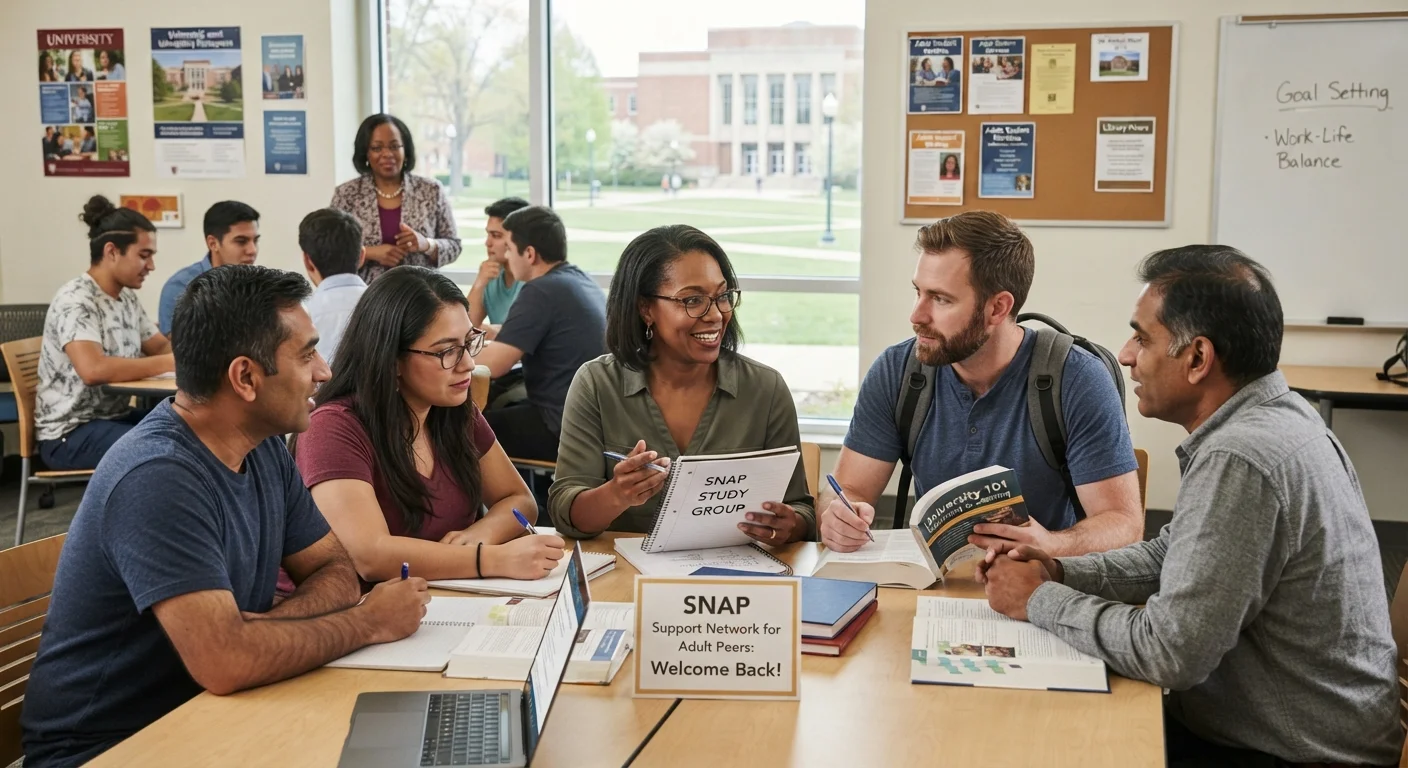
Adults enrolled at least half-time in college are generally subject to the same federal student restriction as any other college student, but several of the specific exemptions that lift this restriction are genuinely more common among non-traditional students than among typical 18-to-22-year-olds, including being age 50 or older, caring for a young dependent while attending school, and working while pursuing a degree.
This guide is independently written and is not affiliated with USDA, OPM, or the official federal Feds Feed Families campaign.
The Age 50 Exemption
Federal SNAP rules exempt students who are age 50 or older from the general student restriction entirely, meaning an adult returning to school later in life at 50 or beyond is evaluated under standard SNAP household rules, the same way any other adult applicant would be, without needing to prove a separate qualifying exemption. This is one of the more straightforward and commonly overlooked exemptions for adults returning to education mid-career or in retirement.
Caring for a Dependent Child
- The Age 50 Exemption
- Caring for a Dependent Child
- Working 20 or More Hours a Week
- Work-Study and Financial Aid Considerations
- Disability-Related Exemption
- Vocational Rehabilitation Programs
- Career and Technical Education Programs
- Enrolling Less Than Half-Time
- Documentation Matters
- FAQ
- Are adults over 50 exempt from SNAP's student restriction?
- Can a parent going back to school qualify for SNAP more easily?
- Does working part-time while in school help meet a SNAP exemption?
- Do all colleges define half-time enrollment the same way?
Many non-traditional students are also parents, and SNAP recognizes this directly: parents caring for and living with a child under 6 are generally exempt from the student restriction, and a single parent caring for a child under 12, where adequate child care isn't available to attend school and work simultaneously, may also qualify. If you're an adult student balancing coursework with raising a young child, this exemption is worth discussing specifically with your caseworker.
Working 20 or More Hours a Week
If you're working at least 20 hours a week while attending school, whether full-time work fit around a class schedule or a part-time job, you meet one of the standard student exemptions regardless of your age. Many adult students returning to school specifically to change careers or add credentials while continuing to work fall into exactly this category.
-
Food Assistance for Small Business Owners Facing a Slow Season
Work-Study and Financial Aid Considerations
Participation in a federal or state work-study program is a recognized exemption, even if you haven't yet been formally placed in a work-study position, as long as you've been approved for the program in your financial aid package. Checking with your school's financial aid office to confirm your specific work-study status and requesting documentation is worth doing if you believe this applies to your situation.
Disability-Related Exemption
Students unable to work, or with a reduced capacity to work, due to a documented disability or temporary illness are exempt from the student restriction, and this doesn't necessarily require the same level of formal disability determination used for SNAP's other disability-related rules, since state-level guidance can vary on what documentation is accepted, often including a medical provider's note.
Recommended Articles
 LIFE SITUATIONS & SPECIAL CIRCUMSTANCES
 LIFE SITUATIONS & SPECIAL CIRCUMSTANCES
 LIFE SITUATIONS & SPECIAL CIRCUMSTANCES
 LIFE SITUATIONS & SPECIAL CIRCUMSTANCES
Vocational Rehabilitation Programs
Adults placed in college through a state Vocational Rehabilitation Act program are frequently recognized as meeting a student exemption, since the underlying logic is that these students have a documented incapacity but are working toward employability through the specific training or education program they're enrolled in.
Career and Technical Education Programs
A meaningful number of states have designated specific community college certificate or career-focused degree programs as automatically satisfying a student exemption, recognizing that these programs are specifically structured to increase employability. Checking with your community college's financial aid or registrar's office about whether your specific program qualifies under this kind of state-approved designation is worth doing, since it can provide a more direct path than proving hours worked or another exemption.
Enrolling Less Than Half-Time
If you're taking a lighter course load, whether by choice or necessity while balancing work and family responsibilities, remember that the entire student restriction applies only to those enrolled at least half-time, a threshold each individual school defines. If you're enrolled less than half-time, you're evaluated under standard SNAP rules with no student-specific barrier at all.
Documentation Matters
Whichever exemption applies to your situation, SNAP offices generally require you to provide proof, such as an enrollment verification letter, a class schedule, a work-study award letter, a pay stub showing your hours, or documentation of a dependent's care needs. Gathering this documentation before your application or interview helps avoid a delay or an initial denial that could otherwise be resolved with the right paperwork.
Read More Articals
FAQ
Are adults over 50 exempt from SNAP's student restriction?
Yes. Students age 50 or older are entirely exempt from the general student restriction and are evaluated under standard SNAP rules like any other adult.
Can a parent going back to school qualify for SNAP more easily?
Often yes, through exemptions for parents caring for and living with a young child, particularly one under 6, or a single parent caring for a child under 12 without adequate available child care.
Does working part-time while in school help meet a SNAP exemption?
Yes, working at least 20 hours a week is a recognized student exemption, regardless of the student's age.
Do all colleges define half-time enrollment the same way?
No. Each individual institution of higher education determines what counts as half-time enrollment, and the student restriction only applies to those enrolled at or above that specific threshold.
Sources: USDA Food and Nutrition Administration Students page, Hunger Solutions New York SNAP Eligibility for Students, CLASP Frequently Asked Questions About SNAP and Students.