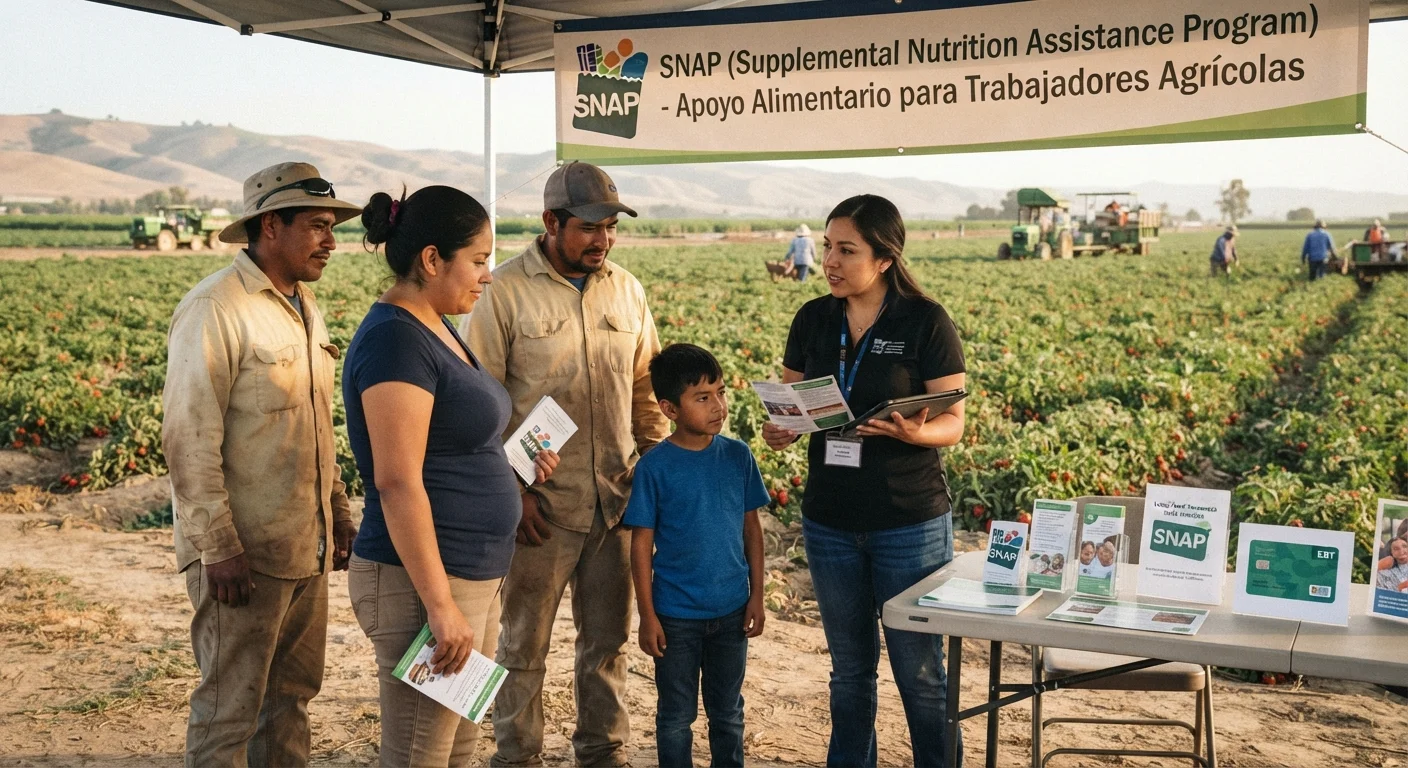
Migrant and seasonal farm workers have every standard SNAP right that any other applicant has, plus several specific protections built into federal regulation, including the ability to apply without a fixed address, an exemption from SNAP's usual monthly reporting requirement, and a "destitute household" provision that can qualify a worker for benefits within just 5 calendar days when their income has come from a source that has ended.
This guide is independently written and is not affiliated with USDA, OPM, or the official federal Feds Feed Families campaign.
Who Qualifies as a Migrant or Seasonal Farm Worker
A migrant farm worker is generally defined as someone who moves from area to area seeking or performing seasonal farm work or other seasonal crop-related activities, often temporarily leaving a principal residence in another state to accept this kind of work. A seasonal farm worker, by contrast, generally accepts seasonal agricultural or fishing employment without necessarily traveling as extensively. Both categories receive the same set of specific SNAP protections.
No Residency Requirement to Apply
- Who Qualifies as a Migrant or Seasonal Farm Worker
- No Residency Requirement to Apply
- The Destitute Household Provision
- How Income From Farm Work Is Calculated
- No Regular Reporting Requirement
- Applying Without Help From an Employer
- What Doesn't Count as Income
- Homelessness Protections That May Also Apply
- Language Access
- FAQ
- Do migrant farm workers need to be a resident of the state where they're working to get SNAP?
- What is the destitute household provision for farm workers?
- Do migrant farm workers have to submit regular reports like other SNAP households?
- Can a farm worker's employer apply for SNAP on their behalf?
SNAP policy does not require a migrant farm worker to be a resident of the state where they're currently working in order to apply for and receive benefits, and households don't need a fixed address, only needing to be physically present in the area at the time they apply. This recognizes the practical reality that farm work often involves frequent, planned relocation that wouldn't fit standard residency assumptions.
The Destitute Household Provision
A migrant or seasonal farm worker household can be considered "destitute" and entitled to expedited service if their income for the month of application came entirely from a source that has already terminated, and they have $100 or less in liquid resources. When this applies, the local office must issue the household's first SNAP benefit within 5 calendar days of the application, even faster than the standard 7-day expedited timeline used for other households.
How Income From Farm Work Is Calculated
For destitute determination purposes, only income actually received between the first of the month and the date of application is counted, and any income anticipated from a new source after the application date is disregarded for that specific calculation. The individual grower a worker is currently employed by, not a crew leader or labor contractor, is generally considered the source of income, and a worker who moves with the same crew leader from one grower to the next is treated as having moved from one terminated income source to another.
Recommended Articles
 LIFE SITUATIONS & SPECIAL CIRCUMSTANCES
 LIFE SITUATIONS & SPECIAL CIRCUMSTANCES
 LIFE SITUATIONS & SPECIAL CIRCUMSTANCES
 LIFE SITUATIONS & SPECIAL CIRCUMSTANCES
No Regular Reporting Requirement
Unlike most SNAP households, migrant and seasonal farm workers are not required to submit the periodic reports that other households must file during their certification period, a specific accommodation recognizing how impractical routine paperwork can be for a household that may be relocating frequently for work.
Applying Without Help From an Employer
Farm workers can apply for SNAP without assistance from their crew leader or labor contractor, and if an employer does act as an authorized representative on a worker's behalf, the agency is required to confirm this was freely requested by the worker, that the employer is accurately representing the worker's actual circumstances, and that any benefits are genuinely used for the worker's own household.
What Doesn't Count as Income
Certain employer-provided support doesn't count as income for a farm worker's SNAP case, including a hotel room paid for by a welfare office while a worker waits for crops to be ready, or gas, oil, or car repair costs covered while the worker is actively in the job stream. Most loans, including travel advances to reach a new work location, are similarly excluded from being counted as income.
Homelessness Protections That May Also Apply
Migrant or seasonal farm workers living in temporary housing, such as employer-provided housing during a harvest season, may separately qualify under SNAP's rules for people experiencing homelessness, which can provide additional protections and, in some states, a specific homeless shelter deduction, layered on top of the migrant-specific rules already described.
Language Access
Migrant farm workers are not required to bring their own interpreter to a SNAP appointment, and agencies are generally required to provide interpreter services when needed, recognizing the significant number of migrant farm worker households where Spanish or another language is the primary or only language spoken.
Read More Articals
FAQ
Do migrant farm workers need to be a resident of the state where they're working to get SNAP?
No. SNAP policy does not require state residency for migrant farm workers to apply, and a fixed address isn't required either, only physical presence in the area at the time of application.
What is the destitute household provision for farm workers?
A rule allowing a migrant or seasonal farm worker household with $100 or less in liquid resources and income from a terminated source to receive benefits within 5 calendar days, faster than the standard 7-day expedited timeline.
Do migrant farm workers have to submit regular reports like other SNAP households?
No. This population is specifically exempt from SNAP's usual periodic reporting requirement during their certification period.
Can a farm worker's employer apply for SNAP on their behalf?
Yes, if the worker freely requests this, but the agency must confirm the employer is accurately representing the worker's circumstances and that benefits are genuinely used for the worker's household.
Sources: Illinois Department of Human Services Migrant Farmworkers policy, Pennsylvania Department of Human Services SNAP Handbook, Connecticut Department of Social Services, Legal Services of Northern California CalFresh Guide.