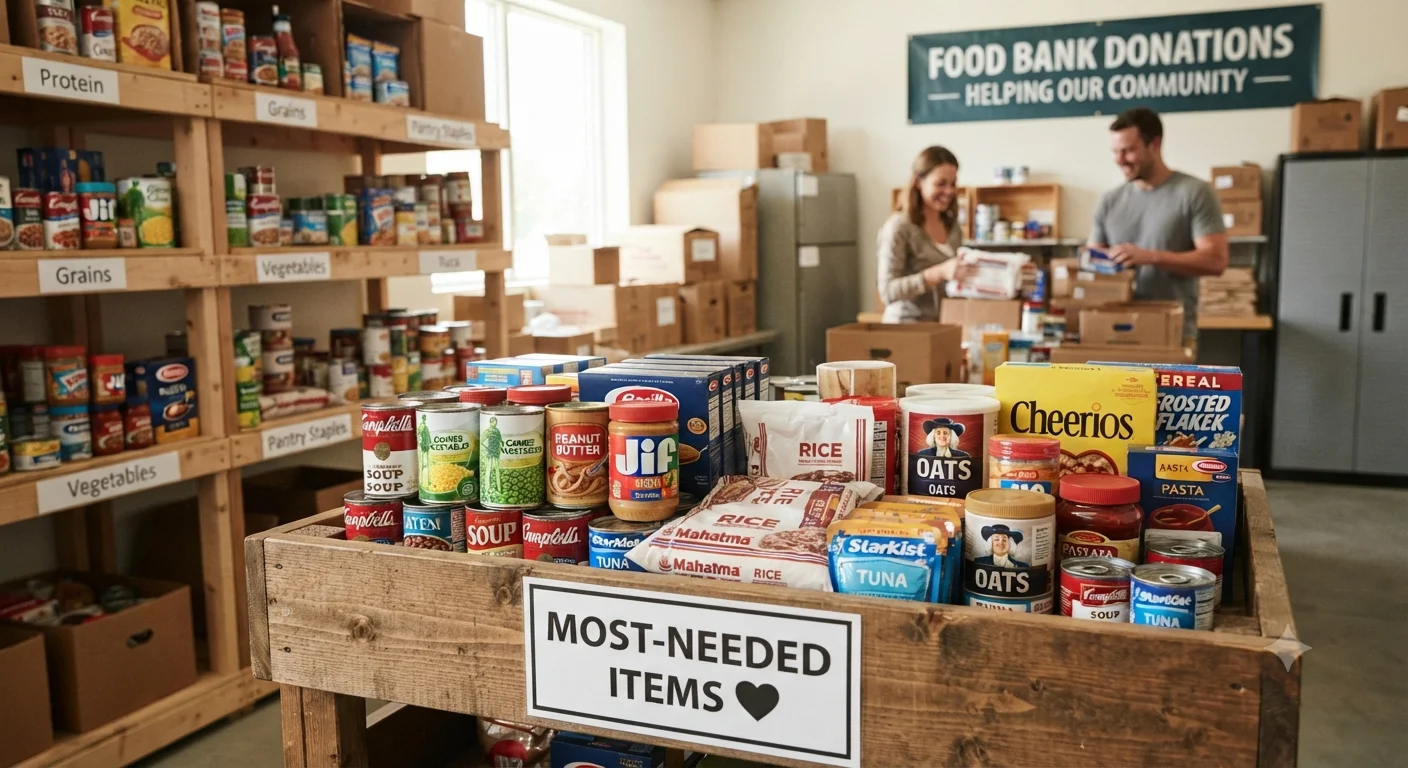
Registered dietitians working with food banks consistently point to the same core categories as most needed: shelf-stable proteins like canned chicken, tuna, and beans, nutritious whole grains like rice, oats, and pasta, and cooking essentials like oil and basic spices, since these items are both expensive for food-insecure families to buy regularly and versatile enough to form the base of many different meals.
This guide is independently written and is not affiliated with USDA, OPM, or the official federal Feds Feed Families campaign.
Shelf-Stable Proteins
Protein is consistently named by food bank dietitians as one of the most needed and hardest-to-afford categories, since protein-rich foods tend to be among the more expensive items at the grocery store. Strong options include:
- Canned chicken, tuna, and salmon, ideally low-sodium and packed in water
- Canned beans, including black beans, pinto beans, and chickpeas
- Peanut butter, consistently named as one of the single most requested items at food banks nationwide
- Lentils and dried beans
- Shelf-stable canned meats like chicken and canned ham
Nutritious Grains
- Shelf-Stable Proteins
- Nutritious Grains
- Canned Fruits and Vegetables
- Cooking Essentials
- Special Consideration: Pull-Tab Cans
- Items for Children and Infants
- What Not to Donate
- Non-Food Items Some Food Banks Also Accept
- Cash Donations Still Go Further
- FAQ
- What are the most needed items at food banks?
- What items should I never donate to a food bank?
- Should I donate cans with pull tabs instead of regular cans?
- Is it better to donate food or cash to a food bank?
Grains provide filling calories and pair naturally with the proteins above to form complete meals. Rice, particularly brown rice, whole-grain pasta, oats, and whole-grain cereal are consistently listed among top-needed items, since they store well, cost relatively little per serving, and can be prepared in dozens of different ways.
Canned Fruits and Vegetables
Nutrient-dense and long-lasting, canned vegetables and fruits round out a balanced donation. Look specifically for low-sodium vegetable options and fruit packed in water or 100 percent juice rather than heavy syrup, since these choices better support a genuinely healthy diet for the families receiving them.
Cooking Essentials
Basic cooking staples are frequently overlooked by donors but heavily relied upon by food banks, including cooking oils like canola or olive oil, and basic spices such as garlic powder, onion powder, oregano, salt, and pepper. Without these staples, even a well-stocked donation of proteins and grains is harder for a family to turn into an actual flavorful meal.
Special Consideration: Pull-Tab Cans
When choosing between two similar canned items, food equity advocates specifically recommend choosing pull-tab lids over cans that require a separate can opener, since not everyone receiving a donation has reliable access to one. Including a can opener as part of a donation is also a small but genuinely helpful gesture.
Items for Children and Infants
Since nearly a third of food bank clients are children, items sized and formulated for younger kids are consistently valuable, including shelf-stable milk or fortified non-dairy alternatives, whole-grain crackers and granola bars, and infant formula, though it's worth checking with your specific food bank first, since some have specific requirements or restrictions around formula donations due to safety and recall tracking concerns.
Recommended Articles
 CHARITABLE GIVING VOLUNTEERING
 CHARITABLE GIVING VOLUNTEERING
 CHARITABLE GIVING VOLUNTEERING
 CHARITABLE GIVING VOLUNTEERING
What Not to Donate
- Anything requiring refrigeration: fresh produce, dairy, and meat spoil easily and most food banks lack the cold storage capacity to accept individual perishable donations, though many do work directly with retailers and farms for large-scale perishable donations through separate channels
- Expired or near-expiration food: always check the best-by date before donating
- Homemade or home-canned goods: food banks generally cannot verify the ingredients or safety of home-prepared food and cannot accept it for liability reasons
- Oversized commercial cans: very large bulk cans, sometimes called number 10 cans, are often too large for an individual family to use and can be difficult for a pantry to redistribute in smaller portions
- Opened or damaged packaging: any item with a broken seal, dented can with a compromised seam, or torn packaging should be left out of a donation
Non-Food Items Some Food Banks Also Accept
Because SNAP benefits cannot cover household or personal care items, many food banks also accept and distribute toiletries and household basics, including toilet paper, soap, toothpaste, feminine hygiene products, and diapers, both for infants and adults. It's worth confirming directly with your specific food bank whether they accept these non-food items before including them in a donation, since not every location has the space or system to distribute them.
Cash Donations Still Go Further
Despite how satisfying it feels to physically hand over a box of food, most food banks and dietitians consistently point to cash as the single most effective donation, since bulk purchasing power lets a food bank turn a dollar into significantly more food value than an individual buying the same items at retail price, while also letting the food bank fill specific gaps, including fresh produce, more precisely than a general donation can.
Read More Articals
FAQ
What are the most needed items at food banks?
Shelf-stable proteins like canned chicken, tuna, and peanut butter, nutritious grains like rice and whole-grain pasta, low-sodium canned vegetables, and basic cooking essentials like oil and spices are consistently named as most needed.
What items should I never donate to a food bank?
Anything requiring refrigeration, expired food, homemade or home-canned goods, oversized commercial cans, and any item with damaged or opened packaging.
Should I donate cans with pull tabs instead of regular cans?
When possible, yes. Pull-tab cans are easier to open for people who may not have reliable access to a can opener.
Is it better to donate food or cash to a food bank?
Cash donations are generally more effective, since food banks can purchase food in bulk at wholesale prices, stretching each dollar further than an individual buying the same items at retail price.
Sources: EatingWell registered dietitian interviews, Feeding America donation guidance, Move For Hunger top donation items list.