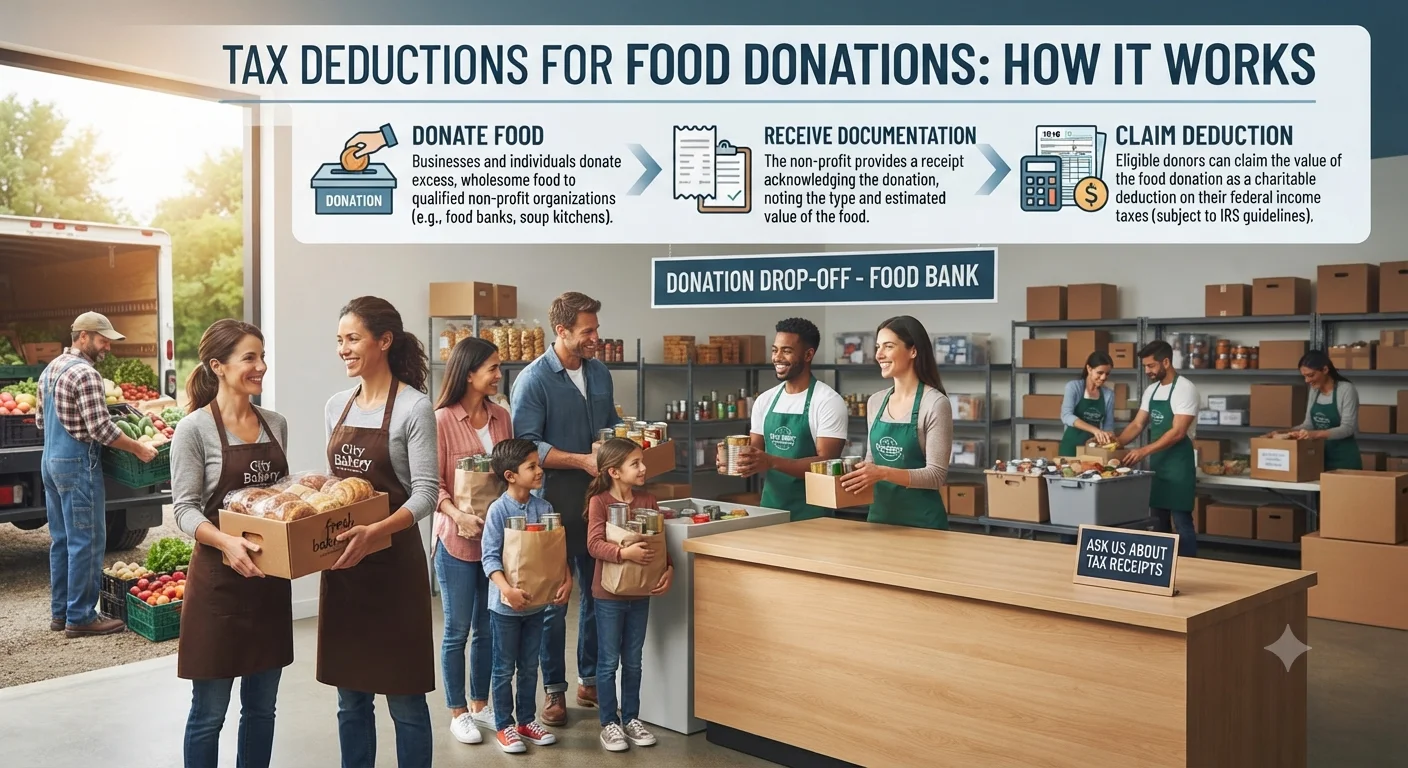
Food donations to a qualifying charitable organization, such as a registered 501(c)(3) food bank or pantry, can potentially be claimed as a tax deduction, but the specific rules and available benefit differ meaningfully between an individual donor itemizing personal deductions and a business donating inventory, so understanding which category applies to you is the first step before assuming a specific tax benefit.
This guide is independently written and is not affiliated with USDA, OPM, or the official federal Feds Feed Families campaign. It is not tax advice, and a licensed tax professional should be consulted for guidance specific to your situation.
The Basic Requirement: A Qualifying Organization
To claim any charitable deduction for a food donation, the recipient organization generally needs to be a qualifying 501(c)(3) nonprofit recognized by the IRS, which the large majority of established food banks and food pantries are. Donating food directly to an individual, rather than through a qualifying organization, generally does not create a deductible charitable contribution under federal tax rules.
For Individual Donors
- The Basic Requirement: A Qualifying Organization
- For Individual Donors
- Keeping Records for Individual Donations
- For Businesses Donating Inventory
- Why This Provision Exists
- Cash Donations vs. Food Donations
- When to Consult a Tax Professional
- FAQ
- Can I deduct food I donate to a food bank on my taxes?
- Do businesses get a bigger tax benefit for donating food than individuals?
- What documentation do I need to claim a food donation deduction?
- Is it simpler to deduct a cash donation than a food donation?
Individuals can potentially deduct the fair market value of donated food items, but only if they itemize deductions on their tax return rather than taking the standard deduction, which the majority of individual taxpayers now use following changes to federal tax law in recent years. This means for many individual donors, particularly those with relatively modest and infrequent food donations, a food drive contribution may not translate into an actual itemized tax benefit, even though the donation itself is still valuable to the recipient organization.
Keeping Records for Individual Donations
If you do itemize and plan to claim a deduction, keeping a receipt or written acknowledgment from the receiving organization, along with your own reasonable estimate of the donated items' fair market value, generally used goods valued at what they'd reasonably sell for, not their original purchase price, is important documentation to retain in case of a tax filing question.
For Businesses Donating Inventory
Businesses that donate food inventory, such as a restaurant, grocery store, or food manufacturer, may be eligible for an enhanced deduction under federal tax law specifically designed to encourage food donation rather than disposal. This enhanced deduction can, under certain circumstances, allow a business to deduct more than the food's basic cost, though the specific calculation involves the item's fair market value, cost basis, and expected selling price, making it considerably more complex than an individual's deduction and generally warranting guidance from a tax professional familiar with the specific rules.
Recommended Articles
 CHARITABLE GIVING VOLUNTEERING
 CHARITABLE GIVING VOLUNTEERING
 CHARITABLE GIVING VOLUNTEERING
 CHARITABLE GIVING VOLUNTEERING
Why This Provision Exists
The enhanced business deduction for food donation reflects a broader federal policy goal of reducing food waste by making it more financially attractive for a business to donate surplus, near-expiration, or imperfect food to a food bank rather than discarding it, aligning a business's tax incentive with the food bank system's ongoing need for a reliable donated food supply.
Cash Donations vs. Food Donations
It's worth noting that a cash donation to a qualifying food bank generally follows more straightforward charitable deduction rules than an in-kind food donation, since there's no need to estimate fair market value the way there is with donated goods. This is one of several reasons a cash donation, in addition to often being more efficient for the food bank's own purchasing power, can also be simpler to document accurately for tax purposes.
When to Consult a Tax Professional
Because charitable deduction rules, especially the enhanced business deduction for food inventory, involve specific calculations and eligibility requirements that can change with tax law updates, consulting a licensed tax professional before claiming a significant food donation deduction, particularly for a business, is strongly advisable rather than relying on general guidance alone.
Read More Articals
FAQ
Can I deduct food I donate to a food bank on my taxes?
Potentially, but only if you itemize deductions rather than taking the standard deduction, and only if the donation goes to a qualifying 501(c)(3) organization, which most established food banks and pantries are.
Do businesses get a bigger tax benefit for donating food than individuals?
Businesses donating food inventory may be eligible for an enhanced deduction under federal tax law, which can, under certain conditions, exceed a standard deduction, though the calculation is more complex and generally warrants professional tax guidance.
What documentation do I need to claim a food donation deduction?
A receipt or written acknowledgment from the receiving organization, along with a reasonable estimate of the donated items' fair market value, is important to retain in case of a tax filing question.
Is it simpler to deduct a cash donation than a food donation?
Generally yes, since cash donations don't require estimating a fair market value the way in-kind food donations do, making documentation more straightforward.
Sources: Internal Revenue Service charitable contribution guidance. This article is for general informational purposes only and does not constitute tax advice.