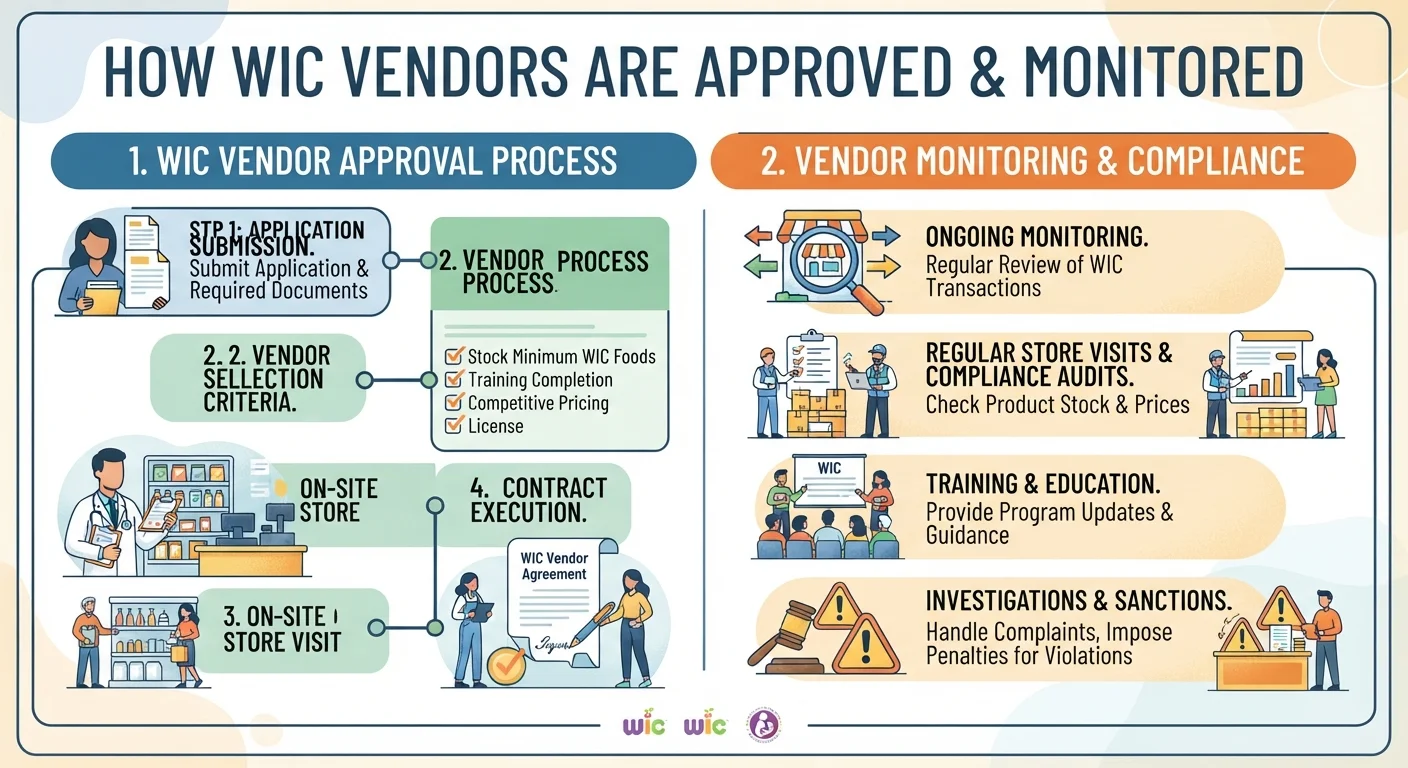
Nearly 46,000 grocery stores, pharmacies, farm stands, and commissaries are currently authorized nationwide to accept WIC benefits, and each state independently decides which specific stores get that authorization, evaluating food prices, the business integrity of the store's owner, and whether the store carries enough variety and quantity of WIC-approved foods before signing off.
This guide is independently written and is not affiliated with USDA, OPM, or the official federal Feds Feed Families campaign.
Who Decides Which Stores Get Authorized
Each state's WIC agency is responsible for authorizing its own vendors, meaning the specific process, timing, and criteria genuinely vary by state, though every state considers the same three broad factors required at minimum: the store's prices for WIC foods, whether the owner has a history that includes disqualification from SNAP, and the store's actual inventory of WIC-approved items.
Meeting Basic Business Requirements First
- Who Decides Which Stores Get Authorized
- Meeting Basic Business Requirements First
- Competitive Pricing Requirements
- The Application and Authorization Process
- Ongoing Requirements After Authorization
- How Vendors Are Monitored for Compliance
- Cost Containment and Reimbursement Reporting
- Why Approved Food Lists Sometimes Change
- Why This System Matters for WIC Families
- FAQ
- How many stores accept WIC nationwide?
- What does a store need to become a WIC vendor?
- Are WIC vendors monitored after they're approved?
- Why did South Carolina limit WIC milk purchases to store brand?
Before a store can even apply, it generally needs to already be authorized to accept SNAP benefits and qualify as a full-service grocery store under that state's specific definition. Some states also cap how much of a store's total food sales can come from WIC transactions, commonly no more than 50 percent, to ensure the vendor pool includes genuine full-service grocery stores rather than stores that exist primarily to process WIC transactions.
Competitive Pricing Requirements
New applicant vendors are typically required to submit their prices for WIC products as part of the application, and states evaluate these prices against other similar stores in the same competitive peer group, only accepting applicants whose prices are genuinely competitive within that comparison group, a system designed to help WIC stretch its funding across the greatest possible number of eligible families.
The Application and Authorization Process
Once a store submits an application, the state WIC agency reviews it for completeness, accuracy, and compliance with the state's specific selection criteria. If the applicant meets these standards, an on-site visit, formal certification, and new vendor training are scheduled before final authorization, at which point the store receives a vendor identification number along with official WIC signage and shelf tags to display.
Ongoing Requirements After Authorization
Authorization isn't permanent or unconditional. Vendors must maintain minimum stock requirements for WIC-approved foods, complete required annual and pre-authorization training, and notify the state WIC agency, often 15 days in advance, of any plans to change the store's name, ownership, location, or to cease operating entirely.
Recommended Articles
 WIC FAMILY NUTRITION
 WIC FAMILY NUTRITION
 WIC FAMILY NUTRITION
 WIC FAMILY NUTRITION
How Vendors Are Monitored for Compliance
Authorized vendors are routinely monitored after approval and subject to undercover compliance investigations designed to verify they're actually following program rules, protecting against fraudulent transactions or improper handling of WIC benefits that would otherwise be invisible to a routine paperwork review.
Cost Containment and Reimbursement Reporting
Some states provide vendors with a detailed monthly disclosure report breaking down exactly which items were redeemed through WIC EBT and at what reimbursement amount, including whether specific items were adjusted for cost containment purposes, giving vendors transparency into how the state's pricing controls are actually being applied to their own transactions.
Why Approved Food Lists Sometimes Change
States periodically update their specific list of WIC-approved products, sometimes for cost containment reasons. South Carolina, for example, began requiring WIC to pay only for store-brand or the lowest-cost milk starting December 2025, explicitly framing this change as a way to stretch WIC funding to serve more families, since store-brand milk carries the same nutrition and quality as name brands at a lower price.
Why This System Matters for WIC Families
The vendor authorization and monitoring system exists specifically to ensure WIC participants have reliable access to safe, nutritious food at fair prices wherever they choose to shop, and the competitive pricing requirement in particular is a big part of why WIC's overall funding can stretch to serve as many eligible families as it currently does.
Read More Articals
FAQ
How many stores accept WIC nationwide?
Nearly 46,000 stores are currently authorized to accept WIC benefits across the country, according to USDA.
What does a store need to become a WIC vendor?
Generally, existing SNAP authorization, qualification as a full-service grocery store, competitive pricing compared to similar stores, and sufficient stock of WIC-approved foods, evaluated through a state-specific application and authorization process.
Are WIC vendors monitored after they're approved?
Yes. Authorized vendors are routinely monitored and subject to undercover compliance investigations to verify they're following program rules.
Why did South Carolina limit WIC milk purchases to store brand?
Starting December 2025, South Carolina began covering only store-brand or the lowest-cost milk, since it offers the same nutrition as name brands at a lower price, allowing WIC funding to stretch further across eligible families.
Sources: USDA Food and Nutrition Administration WIC and Retail Grocery Stores, Arkansas Department of Health, South Carolina Department of Public Health, Texas Health and Human Services.