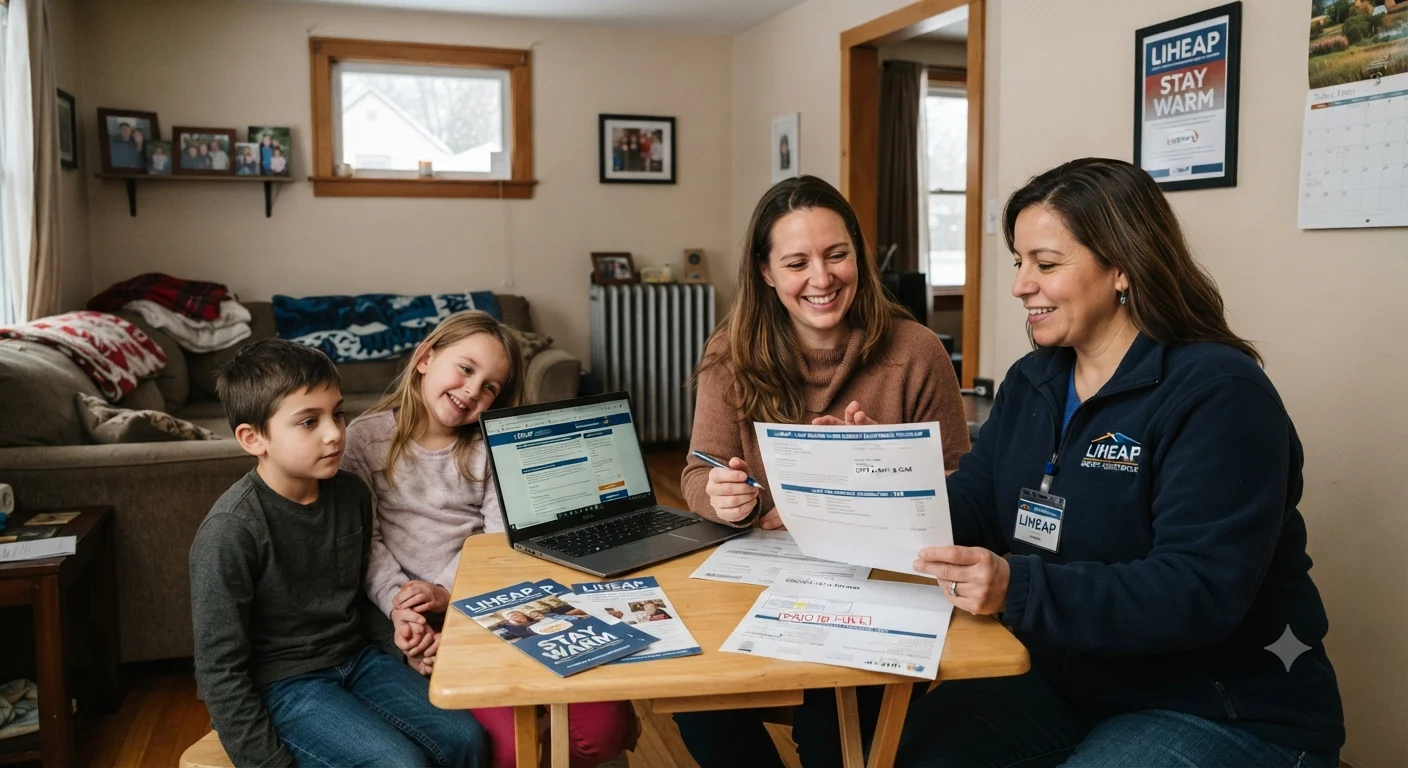
The Low Income Home Energy Assistance Program, known as LIHEAP, helps low income households pay heating and cooling bills through a one time annual grant, typically ranging from $200 to $1,000 depending on household size, income, and fuel type. While LIHEAP does not provide food directly, covering a utility bill that would otherwise compete with the grocery budget is one of the most practical ways a family can stretch its money further each month.
This guide is independently written and is not affiliated with USDA, OPM, or the official federal Feds Feed Families campaign.
What LIHEAP Covers
LIHEAP can include up to four components, though not every state offers all of them, since availability depends on each state's program design and funding:
- Help paying regular winter heating bills, covering fuels such as natural gas, electricity, oil, propane, and wood
- Help paying summer cooling bills in states that offer this component
- Crisis assistance for situations like a broken furnace, a shutoff notice, or a dangerously low fuel supply
- Weatherization support, such as insulation and furnace repair, sometimes coordinated through a related federal program
The benefit itself is a grant, not a loan, and it is almost always paid directly to the utility company or fuel provider as a credit on the household's account rather than issued as cash to the applicant.
Income Limits for 2026
- What LIHEAP Covers
- Income Limits for 2026
- Automatic Eligibility Through Other Programs
- Renters and Subsidized Housing
- How to Apply
- How LIHEAP Connects to Your Food Budget
- FAQ
- What is the income limit for LIHEAP in 2026?
- Does receiving SNAP make me automatically eligible for LIHEAP?
- Can renters apply for LIHEAP?
- How long does it take to get a LIHEAP benefit?
The federal maximum income limit is 150 percent of the federal poverty level, or 60 percent of the state median income, whichever is higher. At 150 percent of the federal poverty level, that works out to approximately $23,940 per year for a one person household and roughly $49,500 per year for a family of four, though individual states are allowed to set their own limit anywhere between about 110 and 150 percent of the poverty level. Because the exact figure varies so much by state, it is worth checking your own state's published income table rather than relying on the federal benchmark alone.
Automatic Eligibility Through Other Programs
In most states, if you or someone in your household already receives SNAP, SSI, TANF, or Veterans Pension benefits, you are considered categorically eligible for LIHEAP and can skip the separate income verification step entirely. Bringing your most recent benefits award letter to your appointment and telling the caseworker which programs you already participate in typically cuts the application process roughly in half.
Renters and Subsidized Housing
LIHEAP is open to both homeowners and renters. If you rent and pay your energy bills directly, you can apply the same way a homeowner would. If your heat is included in your rent, you may still qualify in many states, though your eligibility can depend on your specific housing situation and how your energy costs are structured. In a small number of states, households in public or subsidized housing where utilities are included in rent are not eligible for the standard heating benefit unless they pay their heating costs directly to a fuel supplier themselves, so it is worth confirming this detail with your local agency.
Recommended Articles
 GOVERNMENT ASSISTANCE GUIDES
 GOVERNMENT ASSISTANCE GUIDES
 GOVERNMENT ASSISTANCE GUIDES
 GOVERNMENT ASSISTANCE GUIDES
How to Apply
LIHEAP is federally funded but state administered, and each state sets its own application window, which typically opens in October or November and can close early once funding runs out. To apply:
- Call the National Energy Assistance Referral hotline at 1 800 342 3009, or search "your state LIHEAP application" to find your local Community Action Agency
- Gather documents: photo ID, Social Security numbers for household members, proof of income for the past 30 days, a recent utility bill, and proof of address
- Submit your application online, by phone, by mail, or in person, depending on what your state offers
- Wait for a determination, which typically takes two to four weeks during normal periods and longer during peak heating season from November through February
Crisis applications, for situations like an active shutoff or a broken furnace in freezing weather, are generally processed much faster, often within 18 to 48 hours under federal rule, so it is worth telling your caseworker explicitly if your situation is urgent.
How LIHEAP Connects to Your Food Budget
LIHEAP and SNAP are separate programs, and receiving one does not affect your eligibility for the other. In fact, many states use SNAP enrollment as one of the ways to automatically qualify a household for LIHEAP. For a family choosing between paying a heating bill and buying groceries during a cold month, a LIHEAP grant applied directly to the utility account can meaningfully free up cash that would otherwise have been diverted from food spending.
FAQ
What is the income limit for LIHEAP in 2026?
The federal maximum is 150 percent of the federal poverty level or 60 percent of the state median income, whichever is higher. This is roughly $23,940 per year for one person and $49,500 for a family of four, though individual states may set a lower limit.
Does receiving SNAP make me automatically eligible for LIHEAP?
In most states, yes. Households already receiving SNAP, SSI, TANF, or Veterans Pension are typically considered categorically eligible for LIHEAP and can skip the standard income verification step.
Can renters apply for LIHEAP?
Yes. Renters can apply whether they pay their energy bills directly or through their rent, though eligibility for renters whose heat is included in rent can depend on state specific rules.
How long does it take to get a LIHEAP benefit?
Standard applications typically take two to four weeks, longer during peak winter demand. Crisis applications for situations like a shutoff or broken furnace are usually processed within 18 to 48 hours.
Sources: U.S. Department of Health and Human Services Administration for Children and Families, National Council on Aging, Pennsylvania Department of Human Services, New Jersey Department of Community Affairs, Washington State Department of Commerce.