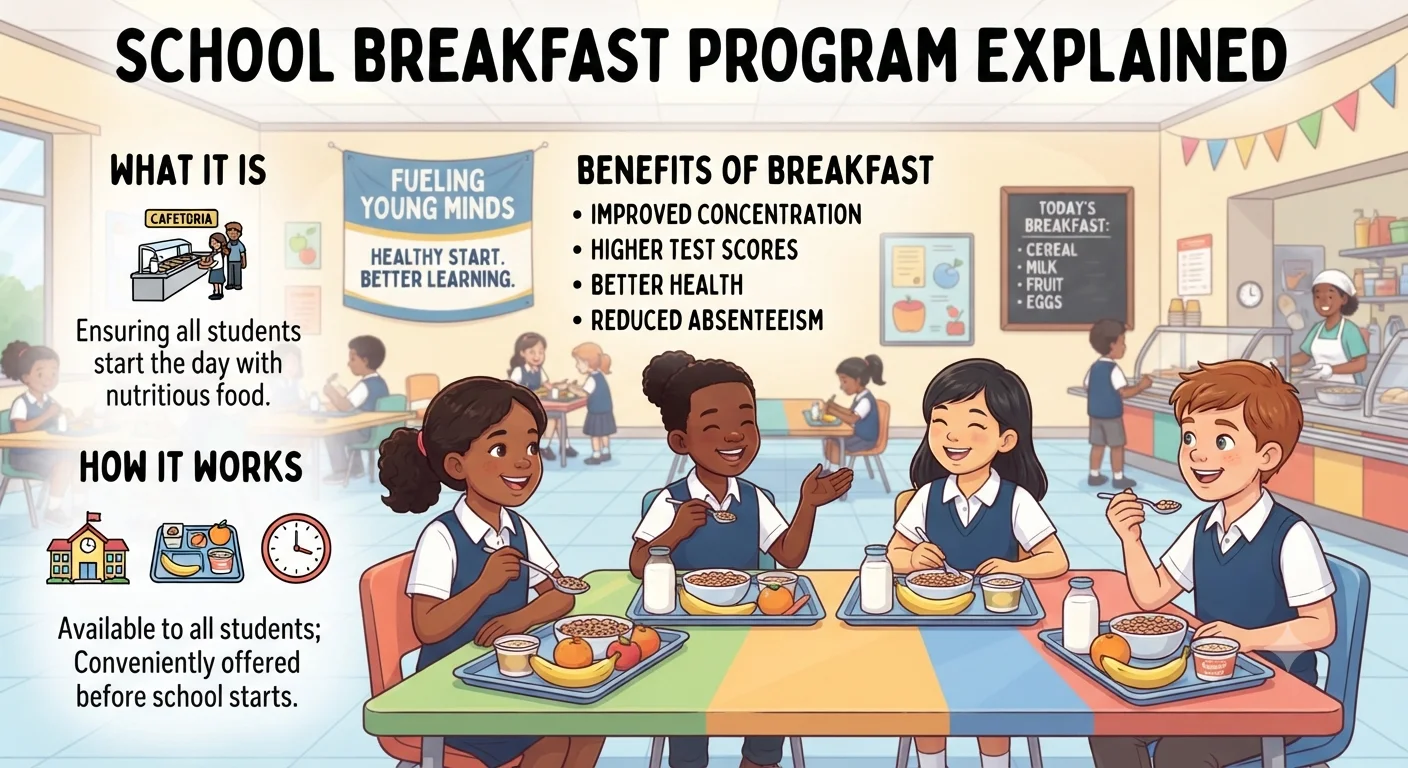
The School Breakfast Program uses the same federal income guidelines as free and reduced-price lunch, meaning any child certified for free or reduced-price lunch automatically qualifies for the same tier of breakfast pricing at no separate application required. Despite this, research consistently shows that only about half of students who eat school lunch also eat school breakfast on an average day, leaving a meaningful participation gap even where eligibility is essentially guaranteed.
This guide is independently written and is not affiliated with USDA, OPM, or the official federal Feds Feed Families campaign.
What the School Breakfast Program Is
The School Breakfast Program is a federally assisted meal program operating in public and nonprofit private schools and residential child care institutions, administered at the federal level by USDA's Food and Nutrition Administration, renamed from the Food and Nutrition Service as of June 1, 2026. It began as a pilot project in 1966 and was made a permanent program in 1975, making it one of the longer-running federal child nutrition programs still in operation.
Income Eligibility
- What the School Breakfast Program Is
- Income Eligibility
- What Students Pay
- Why Breakfast Participation Lags Behind Lunch
- Why School Breakfast Matters
- Rural and Low-Income Communities Face Extra Barriers
- How to Apply
- FAQ
- Do I need a separate application for school breakfast if my child already gets free lunch?
- How much does reduced-price breakfast cost?
- Why do fewer students eat school breakfast than school lunch?
- Does eating school breakfast actually affect academic performance?
Eligibility mirrors the National School Lunch Program exactly: children from households with income at or below 130 percent of the federal poverty level qualify for free breakfast, while those between 130 and 185 percent qualify for reduced-price breakfast. For the 2026-2027 school year, this works out to roughly the same household income thresholds used for free and reduced-price lunch, approximately $42,900 per year for free meals and $61,050 for reduced-price meals for a family of four. Households above 185 percent of the poverty level pay full price, though that price is still typically subsidized below the actual cost of preparing the meal.
What Students Pay
Students who qualify for reduced-price meals pay no more than 40 cents for breakfast under federal rules, a cap that has remained a nominal, symbolic amount for years specifically to keep the reduced-price tier genuinely accessible. Many states have gone further and eliminated the reduced-price copay altogether at the state level, or adopted universal free meals statewide, meaning the practical out-of-pocket cost for many families is lower than the federal minimum suggests.
Why Breakfast Participation Lags Behind Lunch
Even in schools where free breakfast is fully available, participation is consistently lower than lunch participation, often attributed to logistical barriers like early arrival times, bus schedules that don't allow time to eat before class, and in some cases a lingering stigma around visibly eating a "free" meal in a common cafeteria space before the school day officially begins. Many schools have addressed this specifically by moving breakfast into the classroom or offering a grab-and-go breakfast students can eat after the first bell, which research has shown meaningfully increases participation compared to a traditional pre-bell cafeteria model.
Recommended Articles
 SCHOOL CHILD NUTRITION PROGRAMS
 SCHOOL CHILD NUTRITION PROGRAMS
 SCHOOL CHILD NUTRITION PROGRAMS
 SCHOOL CHILD NUTRITION PROGRAMS
Why School Breakfast Matters
A substantial body of research supports the connection between eating school breakfast and improved attendance, punctuality, classroom behavior, and academic performance, since a hungry student arriving to class is measurably less prepared to focus and learn than one who has eaten. This research base is a large part of why school breakfast is treated as a core education support tool rather than simply a food assistance program on its own.
Rural and Low-Income Communities Face Extra Barriers
Research has specifically highlighted that students in rural, low-income households are more likely than their metropolitan peers to live in food-insecure households, while also facing additional logistical barriers to accessing school breakfast, such as longer bus rides that cut into the time available to eat before class starts. This combination makes targeted breakfast access strategies, like classroom breakfast or grab-and-go options, particularly important in rural school districts.
How to Apply
In most cases, there's no separate breakfast application required beyond the standard free and reduced-price meal application submitted through your child's school, since approval for one program automatically applies to the other. If your household already receives SNAP or TANF, your child is typically automatically certified for both breakfast and lunch through direct certification, with no separate paperwork needed.
Read More Articals
FAQ
Do I need a separate application for school breakfast if my child already gets free lunch?
No. The School Breakfast Program uses the same income eligibility guidelines and the same application as free and reduced-price lunch, so approval for one automatically applies to the other.
How much does reduced-price breakfast cost?
Federal rules cap reduced-price breakfast at no more than 40 cents, though many states have eliminated this copay entirely or adopted universal free meals statewide.
Why do fewer students eat school breakfast than school lunch?
Common barriers include early arrival times, bus schedules that limit time to eat before class, and stigma around eating in a cafeteria before the school day starts, which many schools address by offering classroom breakfast or grab-and-go options.
Does eating school breakfast actually affect academic performance?
Research consistently links school breakfast participation to improved attendance, punctuality, classroom behavior, and academic performance.
Sources: USDA Food and Nutrition Administration School Breakfast Program FAQs, Food Research and Action Center, Hunger Solutions New York.