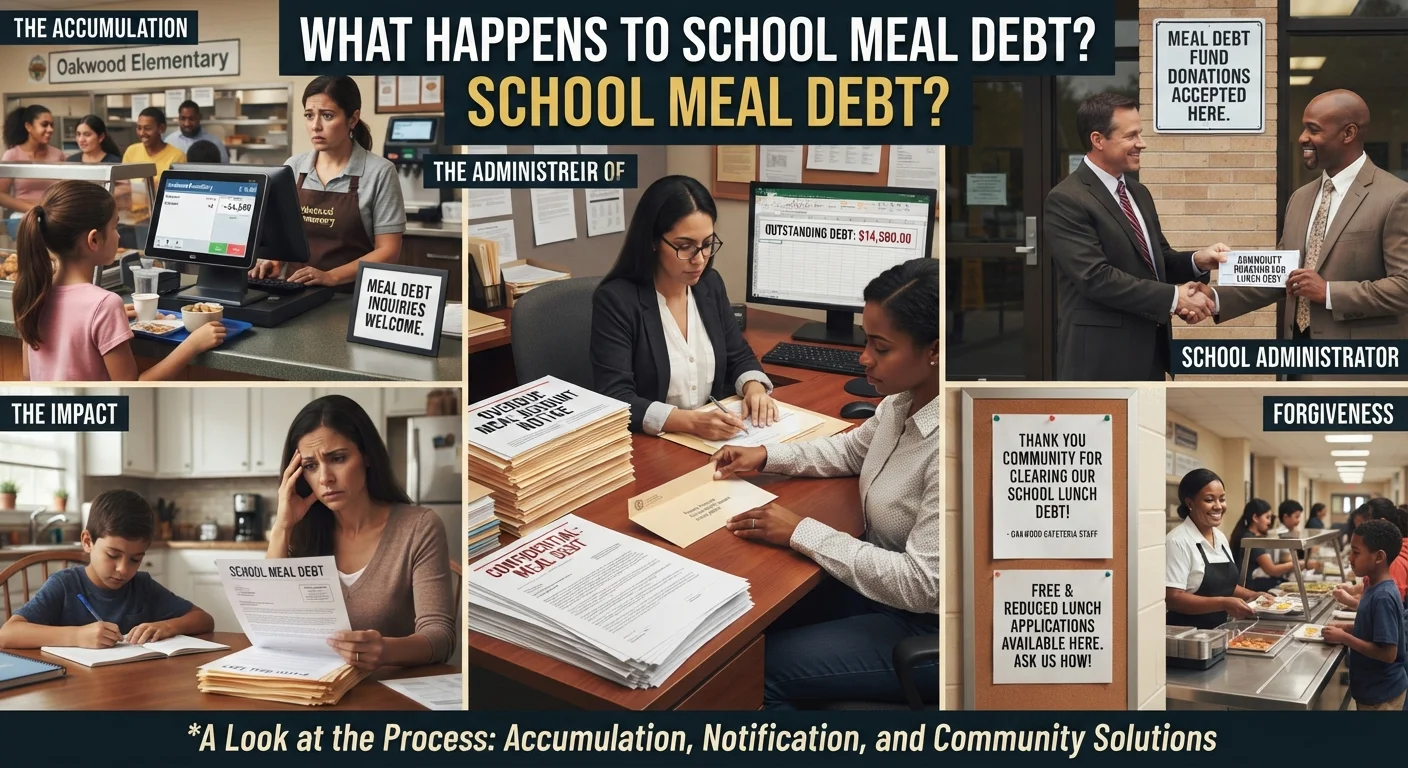
School meal debt accumulates when a student who doesn't qualify for free meals, or whose reduced-price copay isn't paid, continues eating school meals without a sufficient account balance, and it remains a significant issue nationally even as more schools adopt free-meal policies through the Community Eligibility Provision or state-level universal meal laws.
This guide is independently written and is not affiliated with USDA, OPM, or the official federal Feds Feed Families campaign.
How School Meal Debt Happens
Meal debt typically builds up gradually rather than all at once, often because a family's meal account balance runs low and isn't replenished, because a reduced-price eligible family doesn't realize a small daily copay is still due, or because a family who would qualify for free meals hasn't yet submitted or completed the required application. In many cases, a school will continue serving a student a meal even with an insufficient balance, which is how debt accumulates over the course of a semester or school year.
Federal Rules on Meal Charging
- How School Meal Debt Happens
- Federal Rules on Meal Charging
- What Schools Can and Cannot Do
- Check Whether Your Child Actually Qualifies for Free Meals
- Check If Your School Uses CEP
- How Meal Debt Gets Resolved
- What Parents Can Do Proactively
- FAQ
- How does school meal debt build up?
- Can a school deny a student a meal over unpaid debt?
- Should I check if my child qualifies for free meals if we already have debt?
- What should I do if my child's school already sent unpaid meal debt to collections?
USDA requires school districts to have a written meal charge policy, though the specific details of that policy, including exactly how much debt a student can accrue before service is affected, are set locally by each district rather than dictated uniformly at the federal level. Federal guidance strongly discourages practices that single out or stigmatize a student with unpaid meal debt in front of classmates, such as publicly announcing a debt or providing a visibly different, lesser meal than other students receive.
What Schools Can and Cannot Do
While specific practices vary by district, most school meal charge policies avoid denying a student a meal outright, since federal guidance and many state laws prioritize ensuring children are fed regardless of account balance. Districts typically instead send notices home to parents, offer payment plans, or proactively help families complete a free or reduced-price meal application if their income suggests they might qualify. A number of states have passed their own laws specifically prohibiting "lunch shaming" practices, going beyond the baseline federal guidance.
Check Whether Your Child Actually Qualifies for Free Meals
A meaningful share of school meal debt involves families who would actually qualify for free or reduced-price meals but haven't completed the application, sometimes due to language barriers, unfamiliarity with the process, or simply not realizing their income falls under the threshold. Submitting or updating a meal application, which can typically be done at any point during the school year, not just at its start, is often the most direct way to prevent debt from accumulating further.
Recommended Articles
 SCHOOL CHILD NUTRITION PROGRAMS
 SCHOOL CHILD NUTRITION PROGRAMS
 SCHOOL CHILD NUTRITION PROGRAMS
 SCHOOL CHILD NUTRITION PROGRAMS
Check If Your School Uses CEP
If your child's school participates in the Community Eligibility Provision, every enrolled student eats free regardless of individual family income, and meal debt for regular breakfast and lunch shouldn't be possible under that model. It's worth confirming your school's CEP status directly, since a family might assume they need to pay when in fact their specific school already provides meals free to everyone.
How Meal Debt Gets Resolved
Districts handle unpaid meal debt in different ways, including working directly with families on a payment plan, applying philanthropic or district funds to forgive outstanding balances, particularly for lower-income families, or in some cases sending debt to collections as a last resort, though many districts and states have moved away from this more aggressive approach in recent years given the negative attention it's drawn.
What Parents Can Do Proactively
- Submit or update a free and reduced-price meal application as soon as a household's income changes, rather than waiting for a new school year
- Set up low-balance alerts through the school's online payment system if one is available, to catch a shrinking balance before it becomes debt
- Contact the school's front office directly if a balance has already become a debt, since many districts are willing to work out a payment plan rather than pursue more aggressive collection
- Ask specifically whether the district or a local nonprofit has a meal debt forgiveness fund, since these exist in a number of communities but aren't always widely advertised
Read More Articals
FAQ
How does school meal debt build up?
It typically accumulates gradually when a student's meal account balance runs low or a reduced-price copay goes unpaid, often because a family hasn't realized the balance is dropping or hasn't completed a free meal application they might actually qualify for.
Can a school deny a student a meal over unpaid debt?
Most district policies avoid outright denial, since federal guidance and many state laws prioritize ensuring children are fed, though specific practices vary by district's local meal charge policy.
Should I check if my child qualifies for free meals if we already have debt?
Yes. A significant share of school meal debt involves families who would actually qualify for free or reduced-price meals but haven't completed the application, and submitting one can be done at any point in the school year.
What should I do if my child's school already sent unpaid meal debt to collections?
Contact the school district directly to ask about payment plans or a meal debt forgiveness fund, since many districts and states have moved away from aggressive collection practices and may have alternative resolution options available.
Sources: USDA Food and Nutrition Administration meal charge policy guidance, Food Research and Action Center school meal debt research.