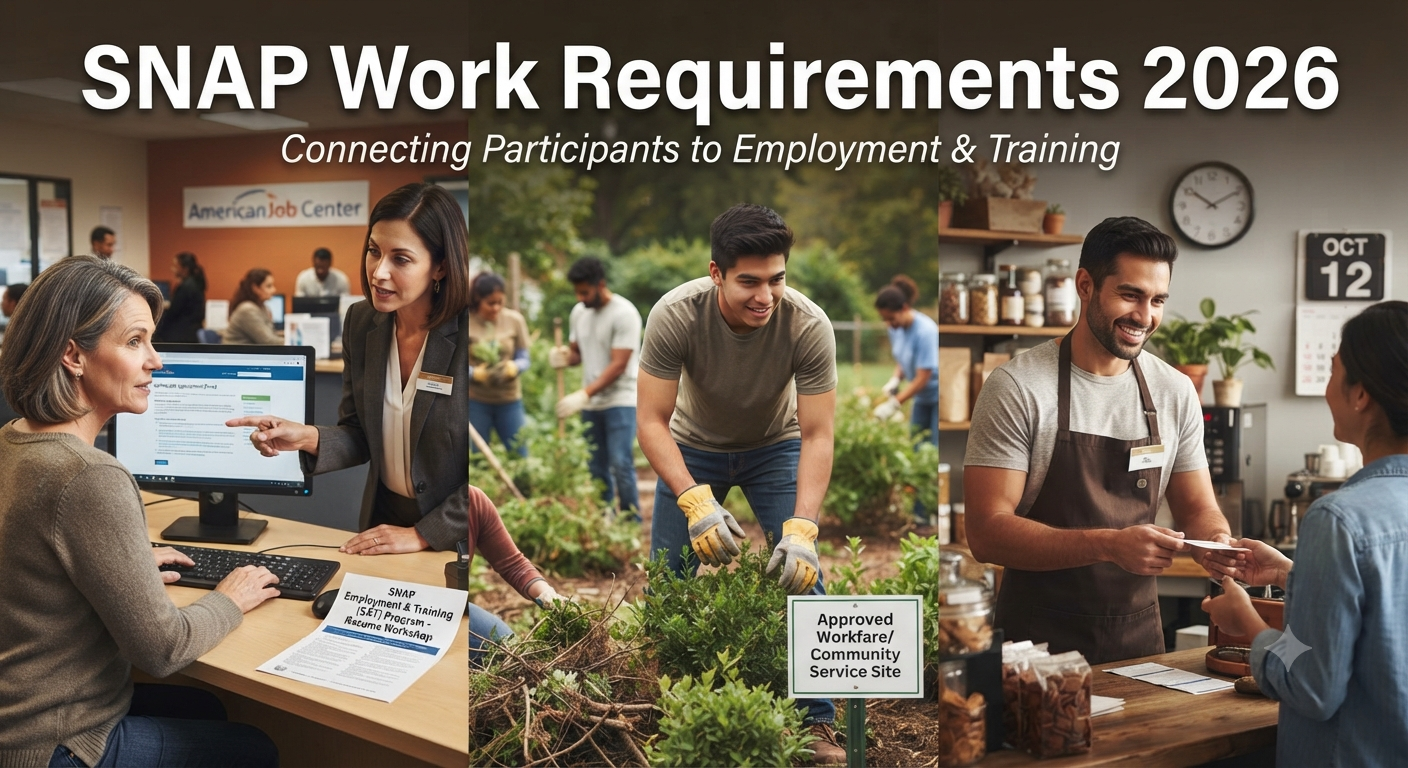
Under the One Big Beautiful Bill Act (OBBBA), signed into law in July 2025, SNAP's stricter work requirement known as the ABAWD rule now applies to able-bodied adults ages 18 through 64, up from the previous cutoff of 54. Affected adults must work, train, or volunteer at least 80 hours per month to keep receiving SNAP beyond a 3-month limit within any 36-month period; most states began enforcing the expanded rules starting December 1, 2025, with many applying them at each household's next recertification.
This guide is independently written and is not affiliated with USDA, OPM, or the official federal "Feds Feed Families" campaign.
Who the Rules Apply To
SNAP has two separate sets of work rules:
- General work requirements apply to most able-bodied adults ages 16–59. These require registering for work, accepting suitable job offers, and not voluntarily quitting or reducing hours below 30/week without good cause.
- ABAWD (Able-Bodied Adults Without Dependents) requirements are stricter and now apply to adults ages 18–64 who don't have dependents and aren't otherwise exempt. This is the age range that expanded under the 2025 law adults 55 to 64 who were previously exempt are now included.
Hours Required Per Month
- Who the Rules Apply To
- Hours Required Per Month
- Exemptions (Disability, Caregiving, Age)
- Adults Ages 60–64: A Special Case
- What Happens If You Don't Comply
- How to Report Work Hours
- FAQ
- What are the SNAP work requirements in 2026?
- Who is exempt from the new SNAP work requirements?
- Did the age limit for SNAP work requirements really change?
- What if I lose SNAP for not meeting the work requirement?
To meet the ABAWD requirement, you need at least 80 hours per month (roughly 20 hours/week) through any combination of:
- Paid employment, including part-time, gig, or self-employment work
- An approved SNAP Employment and Training (E&T) program
- Unpaid work or volunteering
- Workfare (work performed in exchange for benefits)
Job searching alone, without enrollment in an approved training or work program, does not satisfy the requirement.
Exemptions (Disability, Caregiving, Age)
You're exempt from the ABAWD work requirement if you are:
- Age 65 or older (fully exempt from all SNAP work requirements)
- Unable to work due to a documented physical or mental limitation
- Pregnant
- Caring for a dependent child under age 14 in your household this exemption narrowed under the 2025 law; it previously covered any child under 18
- Enrolled at least half-time in school or an approved vocational training program
- Participating in a substance abuse treatment program
- Age 24 or younger and were in foster care on your 18th birthday
Notably, the new law also removed automatic exemptions that previously covered veterans, people experiencing homelessness, and former foster youth these groups must now meet the work requirement unless they qualify under a different exemption, such as disability.
Recommended Articles
 SNAP EBT
 SNAP EBT
 SNAP EBT
 SNAP EBT
Adults Ages 60–64: A Special Case
Adults 60 to 64 are exempt from the general work requirements but are still subject to the ABAWD time limit unless they qualify for another exemption an important distinction, since it means this age group needs to actively confirm their exemption status rather than assume they're automatically covered.
What Happens If You Don't Comply
If you're subject to the ABAWD rule and don't meet the 80-hour requirement, you can receive SNAP for only 3 months within any 36-month period. After that, benefits stop until you either complete 80 hours of qualifying activity in a 30-day period or qualify for an exemption. This isn't necessarily permanent benefits can be regained once the requirement is met again.
How to Report Work Hours
Most states notify affected households by mail (often called a "Work Activity Letter") and through their online benefits portal before the requirement takes effect. If you receive this notice:
- Contact your local SNAP office promptly, especially if you believe you qualify for an exemption
- Ask about enrolling in your state's SNAP Employment & Training program if you need help meeting the hours
- Report your qualifying hours through your state's online portal, by phone, or at your recertification appointment
- Request a fair hearing if you disagree with a work-requirement decision this is a right under federal law
States can also apply for ABAWD waivers in areas with high unemployment, though the threshold for these waivers rose from roughly 6–7% to 10% unemployment under the 2025 law, meaning fewer areas now qualify for a waiver than in previous years.
Read More Articals
FAQ
What are the SNAP work requirements in 2026?
Able bodied adults ages 18–64 without dependents (or without a child under 14 in the household) generally must work, train, or volunteer at least 80 hours per month to receive SNAP beyond a 3-month limit in any 36-month period.
Who is exempt from the new SNAP work requirements?
Adults 65+, people with a documented disability, pregnant individuals, caregivers of a child under 14, students enrolled at least half-time, and people in substance abuse treatment programs are generally exempt.
Did the age limit for SNAP work requirements really change?
Yes. The 2025 One Big Beautiful Bill Act raised the ABAWD age ceiling from 54 to 64, meaning adults 55–64 who were previously exempt are now subject to the work requirement unless they qualify for another exemption.
What if I lose SNAP for not meeting the work requirement?
You can regain eligibility by completing 80 hours of qualifying work, training, or volunteering within a 30-day period, or by qualifying for an exemption.
Sources: USDA Food and Nutrition Administration (fna.usda.gov), One Big Beautiful Bill Act (2025), NY State OTDA, ACCESS NYC, Center on Budget and Policy Priorities.