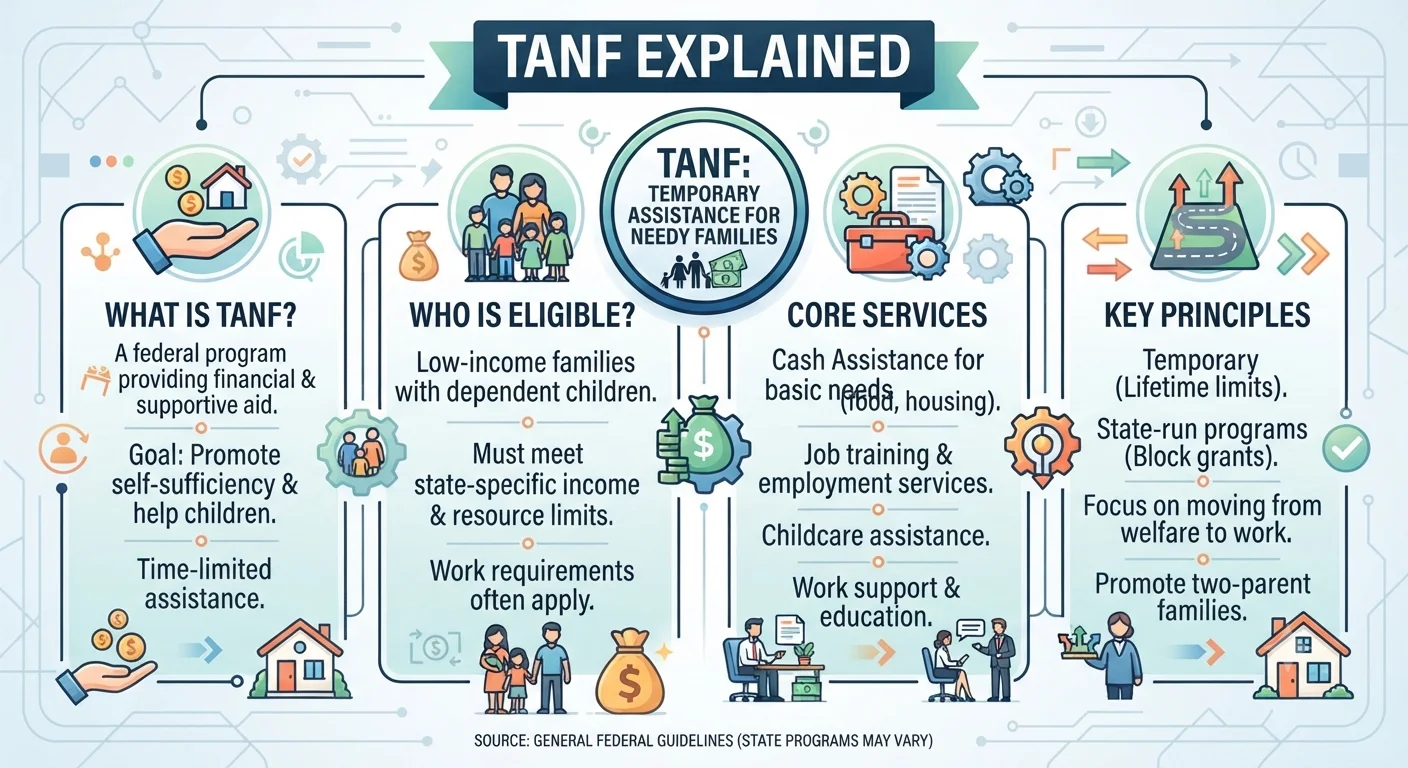
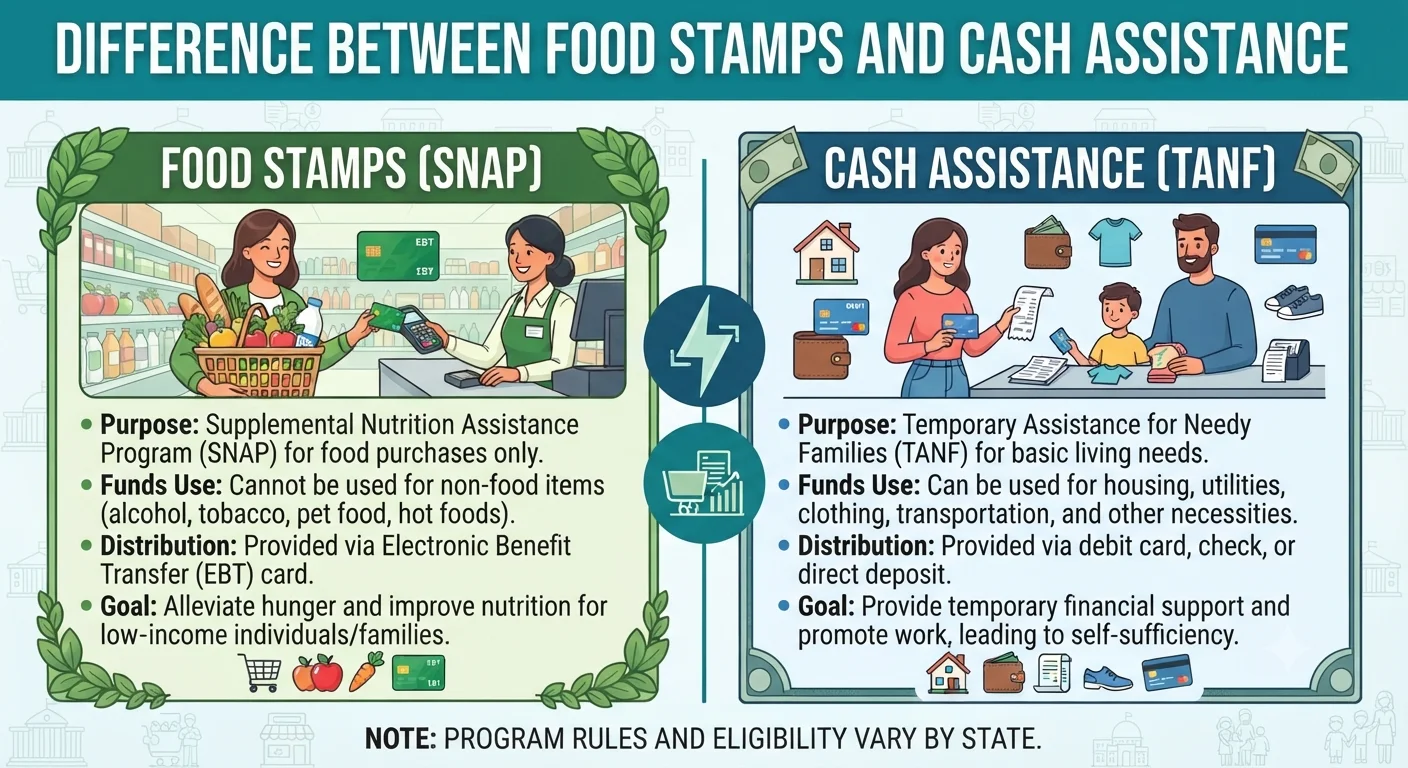
TANF is a federally funded, state-run cash assistance program for low-income families with a child under 18 (or a pregnant household member) living at home. Unlike SNAP, TANF cash can be used for nearly any household need rent, utilities, transportation, clothing, or childcare not just food, and payment amounts, income limits, and rules vary significantly by state.
This guide is independently written and is not affiliated with USDA, OPM, or the official federal "Feds Feed Families" campaign.
What TANF Provides
TANF was created in 1996 to replace the older Aid to Families with Dependent Children program, and it's deliberately designed as short-term help rather than open-ended support. Beyond monthly cash payments, most states also offer:
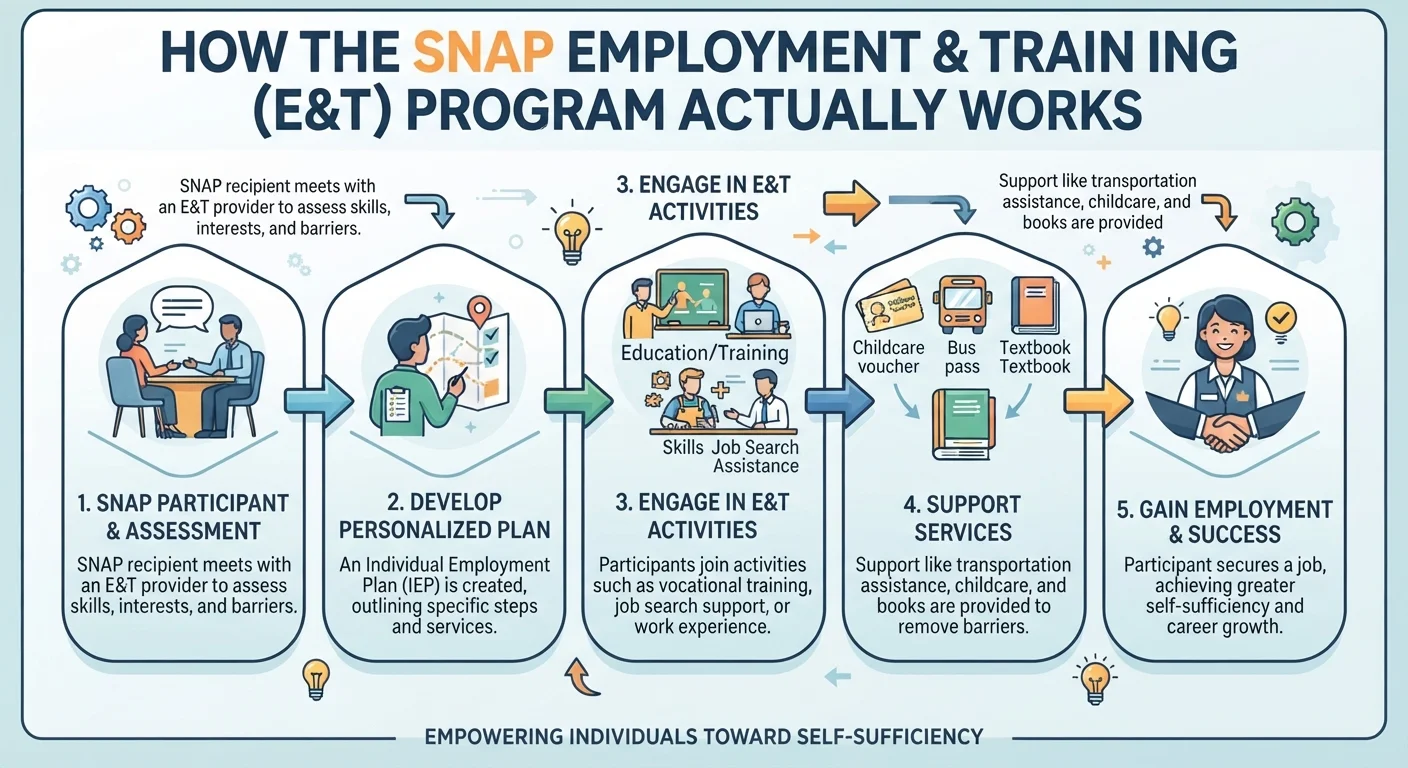
- Job training and employment services
- Childcare subsidies to help recipients meet work requirements
- Transportation assistance
- Emergency one-time payments for crises like job loss or eviction
- In some states, tuition assistance for job-related education
Eligibility Requirements
To qualify for TANF, a household generally must:
- Include a child under 18 living at home, or a pregnant household member
- Be a resident of the state where applying
- Meet the state's income limit, which is typically well below the federal poverty line in some states as low as 35% of the poverty guideline
- Meet an asset/resource limit, commonly between $1,000 and $2,000, though a growing number of states have eliminated this test or set it higher (Washington D.C., for example, uses $3,000, or $4,500 for households with a member 60 or older)
Citizenship rules apply as well: U.S. citizens who meet the financial tests qualify, while lawful permanent residents who entered the country on or after August 22, 1996 generally face a five-year waiting period before receiving federally funded TANF.
Benefit Amounts Vary Widely by State
Because TANF is a block grant, each state sets its own payment levels, and the differences are large. States like New Hampshire, California, and Alaska offer some of the highest payments often $900 to $1,200 per month for a family of three while states like Arkansas, Georgia, and Oklahoma offer considerably less, sometimes around $300 per month for a comparable family size.
Work Requirements
Adults receiving TANF who are not exempt must generally participate in work-related activities job search, job training, or actual employment for a set number of hours per week. A common structure is 30 hours per week for most adults, dropping to 20 hours per week for a single parent with a child under 6. Exemptions typically apply for people who are pregnant, caring for a very young child, dealing with a documented disability, or facing another state-recognized hardship.
Recommended Articles
 GOVERNMENT ASSISTANCE GUIDES
 GOVERNMENT ASSISTANCE GUIDES
 GOVERNMENT ASSISTANCE GUIDES
 GOVERNMENT ASSISTANCE GUIDES
TANF also carries a federal lifetime limit of 60 months (5 years) of assistance for adults, though states can extend this in cases of documented hardship, disability, or high state unemployment.
How TANF Affects SNAP Eligibility
Receiving TANF cash counts as unearned income when SNAP calculates your household's benefit, so it can somewhat reduce your monthly SNAP amount. However, households receiving TANF are also automatically categorically eligible for SNAP, which means they skip SNAP's separate income and asset tests entirely. In practice, this makes it easier not harder for TANF recipients to also receive SNAP, even though the cash itself factors into the calculation.
How to Apply by State
TANF is administered entirely at the state level, often under a different name CalWORKs in California, for example. To apply:
- Search "[your state] TANF" or "[your state] cash assistance" to find your state's official portal
- Submit an application online, by mail, or in person at a local county human services office
- Gather documentation: Social Security numbers for household members, proof of income, birth certificates for children, proof of residency, and immunization records where required
- Complete an interview with a caseworker, who will also help build your "Individual Responsibility Plan" your roadmap toward work or training
Most applications are decided within 30 to 45 days, though many states offer emergency cash assistance within 1 to 7 days for households facing eviction or an immediate crisis.
Read More Articals
FAQ
What is TANF and who qualifies?
TANF is a state-run cash assistance program for low-income families with a child under 18 or a pregnant member. Eligibility depends on state-specific income and asset limits, which vary considerably.
Is TANF the same as food stamps?
No. TANF is cash assistance that can be used for almost any household expense; SNAP (food stamps) is restricted to food purchases only.
Does TANF reduce my SNAP benefits?
It can slightly, since TANF cash counts as income in the SNAP calculation but TANF recipients are also automatically eligible for SNAP, skipping the standard income and asset tests.
How long can someone receive TANF?
Federal law caps TANF at 60 months (5 years) over a lifetime for most adult recipients, though states may allow extensions for documented hardship.
Sources: U.S. Department of Health and Human Services Office of Family Assistance, USAGov, state TANF agency pages (Texas HHS, Mississippi DHS, Washington DSHS, D.C. DHS).