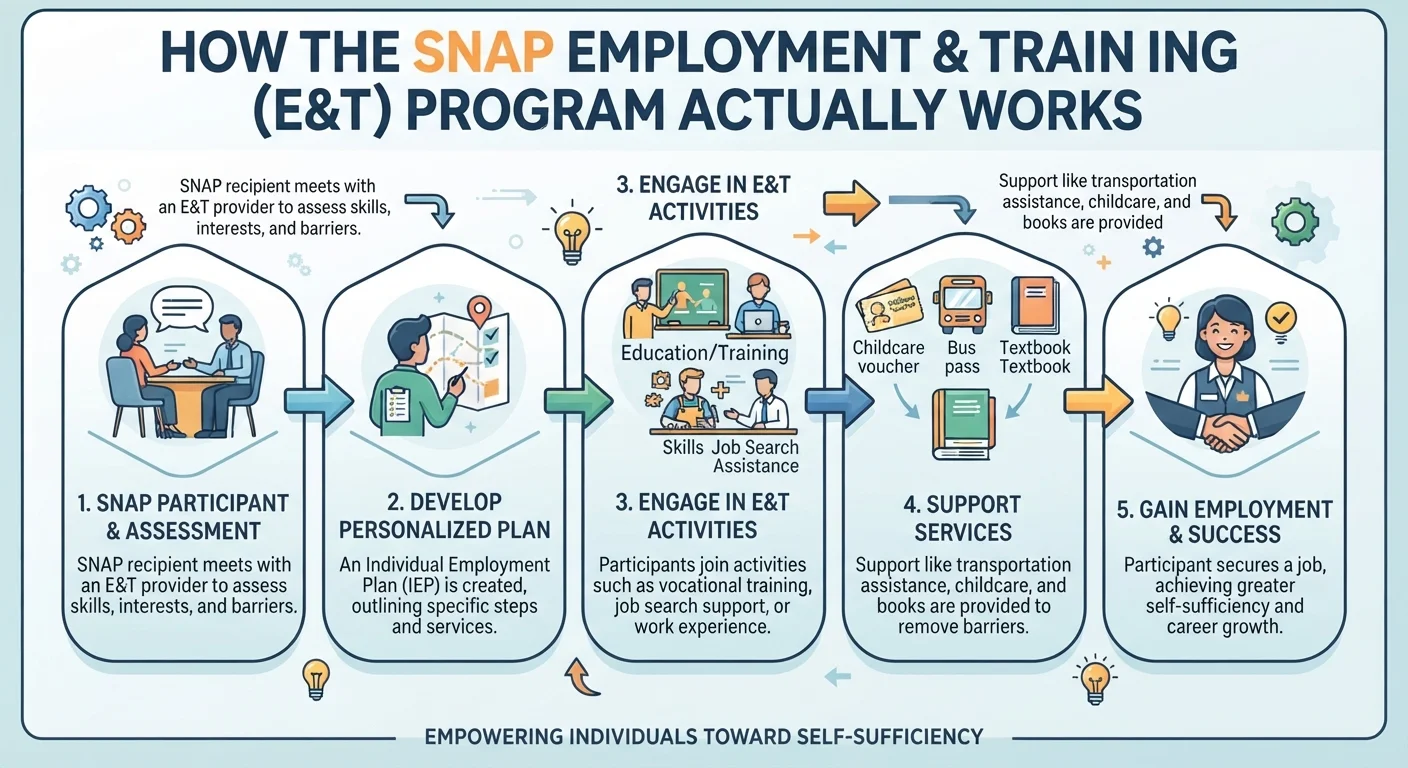
SNAP Employment and Training, commonly called SNAP E&T, is a federally required program in every state, offering SNAP recipients free case management, job training, education, and work-readiness support, along with financial help covering costs like transportation, work clothing, and tools needed to actually participate. For most SNAP recipients, participation is voluntary, but for those specifically subject to SNAP's stricter work requirement, enrolling in an approved E&T activity can be one way to satisfy that requirement.
This guide is independently written and is not affiliated with USDA, OPM, or the official federal Feds Feed Families campaign.
Why Every State Has an E&T Program
Section 6(d) of the Food and Nutrition Act of 2008 requires every state to operate a SNAP E&T program, defined as case management combined with one or more program components like job search assistance, education, or vocational training, though states have considerable flexibility in how they design and deliver these services locally.
What a Personal Case Manager Actually Does
- Why Every State Has an E&T Program
- What a Personal Case Manager Actually Does
- Real Training, Not Just a Job Search Requirement
- Financial Support Beyond the Training Itself
- Addressing Barriers to Employment Directly
- Voluntary vs. Required Participation
- Support After Finding a Job
- How to Get Started
- FAQ
- Is SNAP Employment and Training mandatory?
- Does SNAP E&T cover costs like transportation and work clothing?
- What kind of training does SNAP E&T actually offer?
- Does support end once someone finds a job through SNAP E&T?
Enrolling in SNAP E&T typically means being paired with a dedicated case manager who reviews your education, work history, skills, and any personal challenges together with you to build an individualized plan matched to your specific goals, then checks in regularly to track progress, offer coaching, and connect you to additional resources as your situation evolves.
Real Training, Not Just a Job Search Requirement
SNAP E&T is genuinely flexible, whether the goal is going back to school or learning skills for an in-demand trade. Maryland's program, as one concrete example, offers free training averaging 12 to 16 weeks in fields including welding, construction, machine operation, manufacturing, healthcare, hospitality, and computer technology, with all training programs free of cost to SNAP recipients.
Financial Support Beyond the Training Itself
Recognizing that practical barriers, not just a lack of skills, often stand between someone and steady employment, SNAP E&T programs typically cover costs like clothing, uniforms, tools, and materials necessary for training or a new job, transportation to and from training or interviews, and in Pennsylvania's program specifically, special allowances called SPALs that provide targeted, needs-based grants for exactly these kinds of participation costs.
Recommended Articles
 GOVERNMENT ASSISTANCE GUIDES
 GOVERNMENT ASSISTANCE GUIDES
 GOVERNMENT ASSISTANCE GUIDES
 GOVERNMENT ASSISTANCE GUIDES
Addressing Barriers to Employment Directly
SNAP E&T programs are experienced in helping participants overcome specific barriers to employment, including a criminal background, limited prior work experience, or limited transportation, and can connect participants with legal services for issues like resolving a suspended driver's license that's preventing them from getting to a job.
Voluntary vs. Required Participation
Most SNAP recipients who want to participate in E&T can do so voluntarily, subject to funding availability in their state. Adults specifically subject to the stricter Able-Bodied Adult Without Dependents work requirement, generally ages 18 to 64 without dependents and not otherwise exempt, may be required to participate in E&T or another qualifying work activity to continue receiving benefits beyond the standard three-month limit.
Support After Finding a Job
SNAP E&T doesn't necessarily end the moment someone finds employment. Texas's program, for example, offers job retention and support services for up to 90 days after a participant finds work, recognizing that keeping a new job, not just landing one, is often where additional support matters most.
How to Get Started
Contacting your SNAP caseworker or local SNAP office directly is the most reliable way to ask about Employment and Training options available in your state, since providers and specific services vary significantly by state and even by county, and USDA maintains a state-by-state directory connecting participants to their local service providers.
Read More Articals
FAQ
Is SNAP Employment and Training mandatory?
For most SNAP recipients, no, participation is voluntary. For adults specifically subject to the stricter ABAWD work requirement, enrolling in an approved E&T activity can be required to continue receiving benefits beyond the standard three-month limit.
Does SNAP E&T cover costs like transportation and work clothing?
Yes, in most states. Programs typically cover costs necessary for participation, including transportation, uniforms, tools, and materials needed for training or a new job.
What kind of training does SNAP E&T actually offer?
This varies by state, but programs commonly include vocational training in fields like healthcare, construction, welding, and computer technology, alongside education, job search assistance, and work-readiness support.
Does support end once someone finds a job through SNAP E&T?
Not always. Some state programs, including Texas, offer job retention and support services for up to 90 days after a participant becomes employed.
Sources: USDA Food and Nutrition Administration SNAP E&T, Iowa Health and Human Services, Texas Workforce Commission, Maryland Department of Human Services, Pennsylvania Department of Human Services.