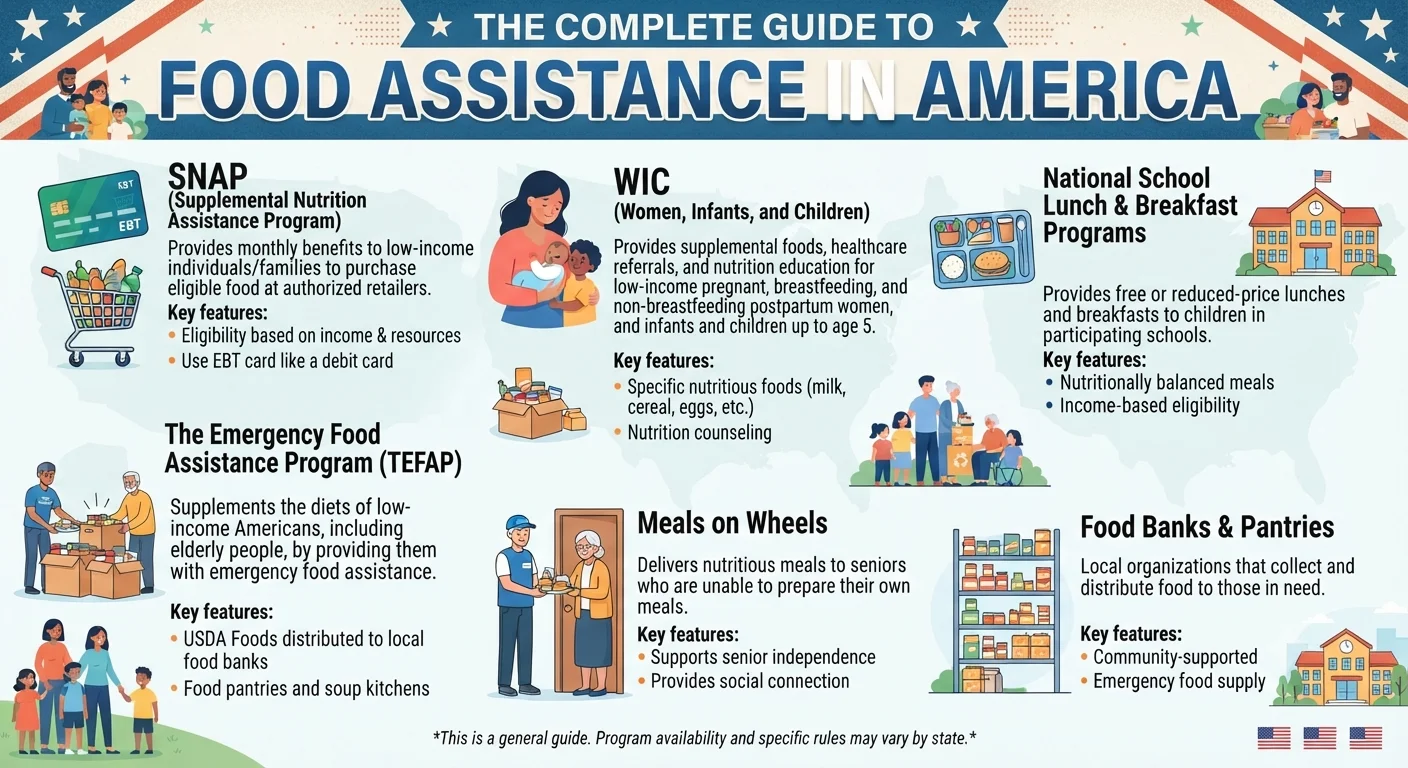
The United States runs more than a dozen major federal food assistance programs, each targeting a specific population or life stage, from SNAP's broad grocery support for any qualifying household, to WIC's targeted nutrition for pregnant women and young children, to school-based meal programs, senior-specific food boxes, and disaster relief. Understanding how these programs relate to each other, rather than treating each as an isolated option, often reveals that a household qualifies for more support than a single program alone would suggest.
This guide is independently written and is not affiliated with USDA, OPM, or the official federal Feds Feed Families campaign.
SNAP: The Foundation Program
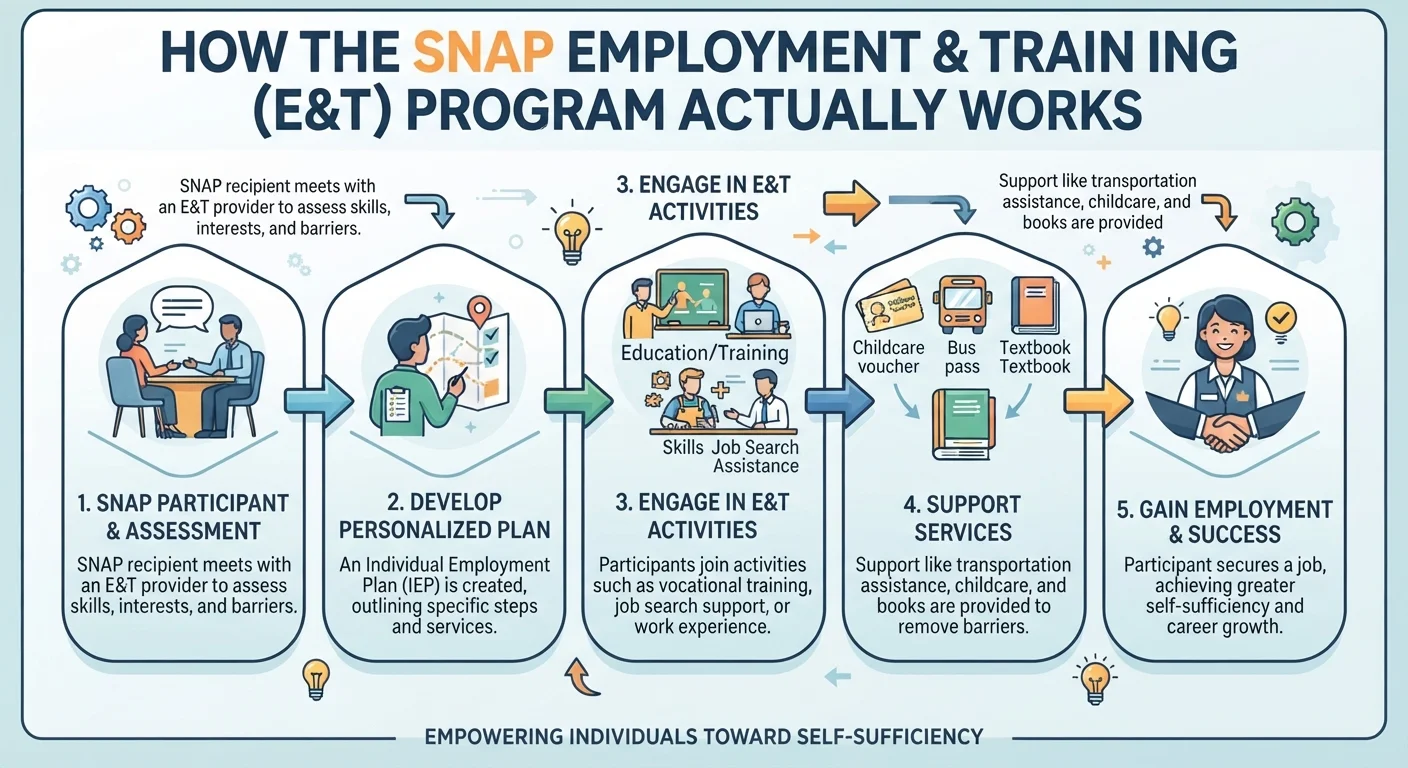
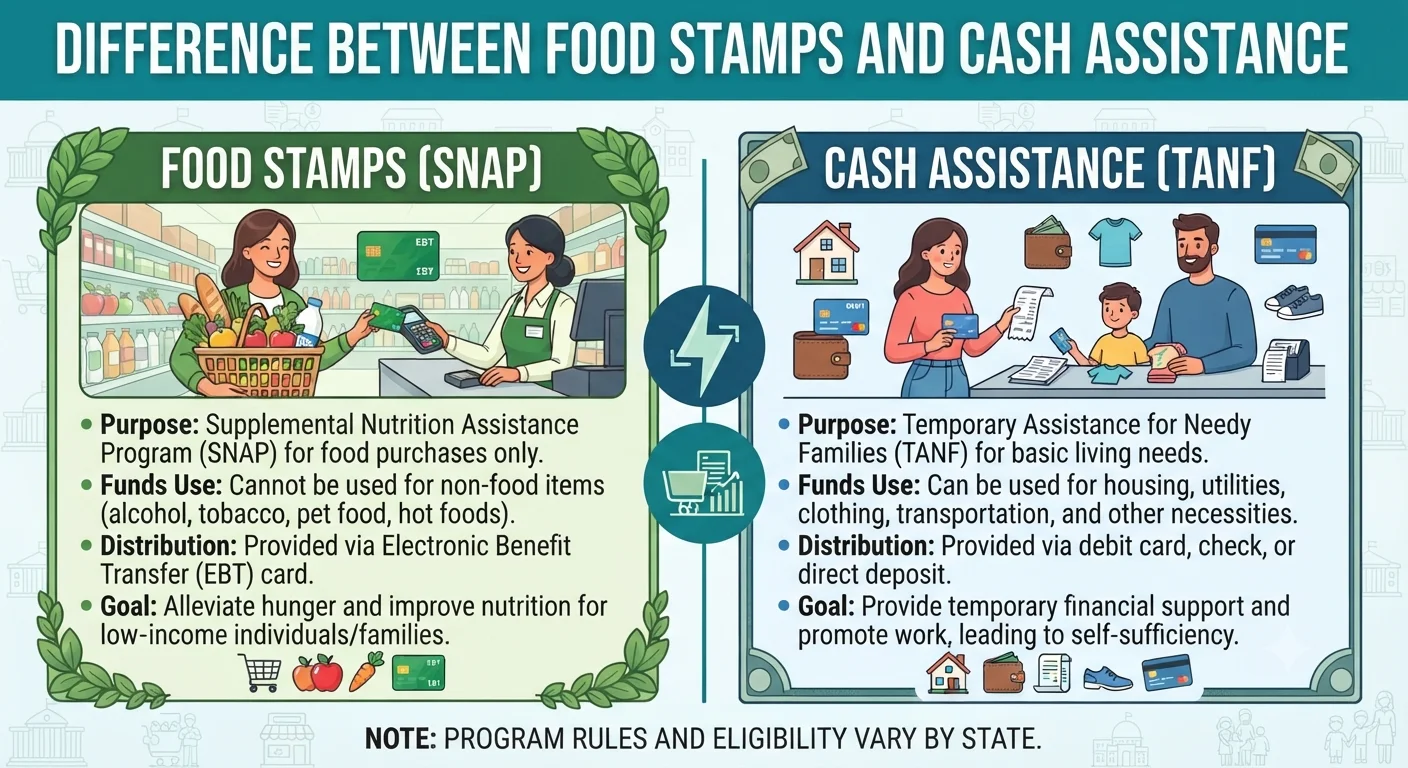
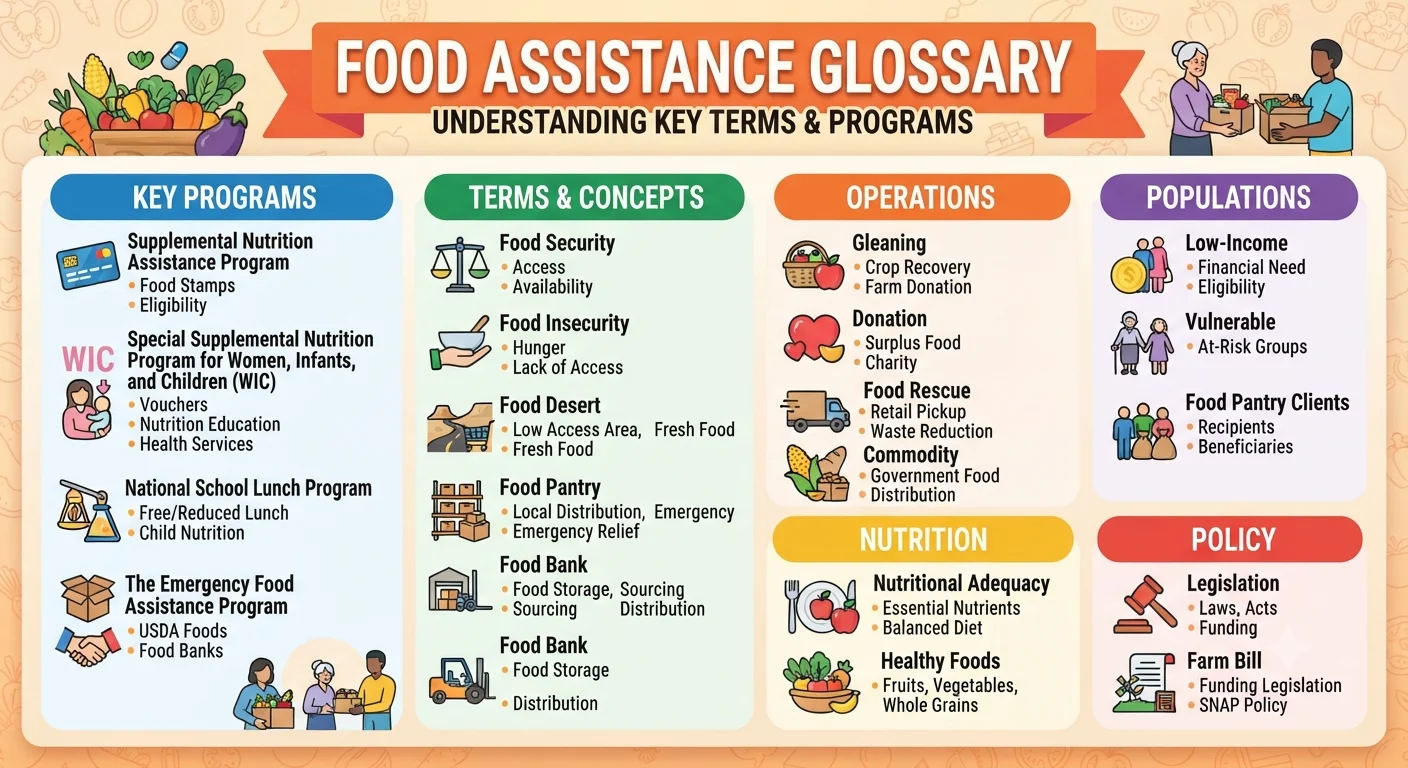
The Supplemental Nutrition Assistance Program is the largest and broadest federal food assistance program, providing monthly grocery benefits on an EBT card to income-eligible households of any size or composition. For FY2026, maximum monthly benefits range from $298 for a one-person household to $994 for a family of four in the 48 contiguous states, with eligibility generally based on gross income at or below 130 percent of the federal poverty level, though many states raise this limit through Broad-Based Categorical Eligibility.
WIC: Targeted Support for Early Life
- SNAP: The Foundation Program
- WIC: Targeted Support for Early Life
- School and Child Nutrition Programs
- Programs for Seniors
- Federal Food Distribution Programs
- Cash Assistance That Supports Food Security Indirectly
- Emergency and Disaster Programs
- Community-Based Support
- How These Programs Work Together
- FAQ
- What is the difference between SNAP and WIC?
- Can a household qualify for multiple food assistance programs at once?
- What food assistance is available for seniors specifically?
- Where should someone start if they're not sure which programs they qualify for?
The Special Supplemental Nutrition Program for Women, Infants, and Children serves pregnant, postpartum, and breastfeeding women, infants, and children up to age 5, using a higher income threshold of 185 percent of the federal poverty level. Rather than a flexible dollar benefit, WIC provides a defined package of nutrition-focused foods, plus nutrition education, breastfeeding support, and health screenings. Households already receiving SNAP, Medicaid, or TANF automatically meet WIC's income requirement.
School and Child Nutrition Programs
Several programs specifically support children during the school year and summer break:
- National School Lunch Program and School Breakfast Program use the same income guidelines, generally free at 130 percent of the federal poverty level and reduced-price at 185 percent
- Community Eligibility Provision lets qualifying high-poverty schools serve free meals to every student with no individual application
- Fresh Fruit and Vegetable Program provides free produce snacks at qualifying elementary schools, separate from regular meals
- Summer EBT (SUN Bucks) provides a grocery benefit, generally $120 per eligible child in 2026, to replace school meals during summer break
- Summer Food Service Program serves free meals at community sites in qualifying areas during the summer
- Afterschool Meal Program extends free meals to structured afterschool programs in qualifying areas
- Child and Adult Care Food Program (CACFP) reimburses licensed child care providers and adult day care facilities for serving nutritious meals
Programs for Seniors
Beyond SNAP's favorable rules for elderly households, including a higher asset limit and exemption from the gross income test, specific senior-focused programs include the Commodity Supplemental Food Program, which provides a free monthly food box to adults 60 and older, and the Senior Farmers Market Nutrition Program, offering seasonal produce vouchers to low-income seniors.
Recommended Articles
 GOVERNMENT ASSISTANCE GUIDES
 GOVERNMENT ASSISTANCE GUIDES
 GOVERNMENT ASSISTANCE GUIDES
 GOVERNMENT ASSISTANCE GUIDES
Federal Food Distribution Programs
TEFAP (The Emergency Food Assistance Program) supplies USDA-purchased commodities to food banks and pantries nationwide at no cost to recipients. FDPIR (Food Distribution Program on Indian Reservations) provides a similar USDA commodity package as an alternative to SNAP for eligible households on or near reservations.
Cash Assistance That Supports Food Security Indirectly
TANF (Temporary Assistance for Needy Families) provides flexible cash assistance for households with children, which can be used for any household need, including food, and TANF recipients are automatically categorically eligible for SNAP. LIHEAP, while an energy assistance program rather than a food program, indirectly protects a household's food budget by covering heating and cooling costs that would otherwise compete with grocery spending.
Emergency and Disaster Programs
D-SNAP (Disaster Supplemental Nutrition Assistance Program) activates after a federally declared disaster, providing one month of maximum SNAP benefits to affected households, including many who don't normally qualify for regular SNAP.
Community-Based Support
Beyond federal programs, local food banks, pantries, soup kitchens, and faith-based organizations form an extensive community-level safety net, generally requiring minimal or no formal eligibility documentation, and often serving as a connection point to federal program enrollment for households not yet accessing available benefits.
How These Programs Work Together
A single household can often qualify for and use several of these programs simultaneously, since eligibility for one frequently doesn't reduce or disqualify eligibility for another, and in many cases, participation in one program, particularly SNAP, TANF, or Medicaid, automatically satisfies the income requirement for another, such as WIC or LIHEAP. Rather than researching and applying for programs in isolation, understanding this interconnected system helps a household identify the full range of support it may be entitled to.
Read More Articals
FAQ
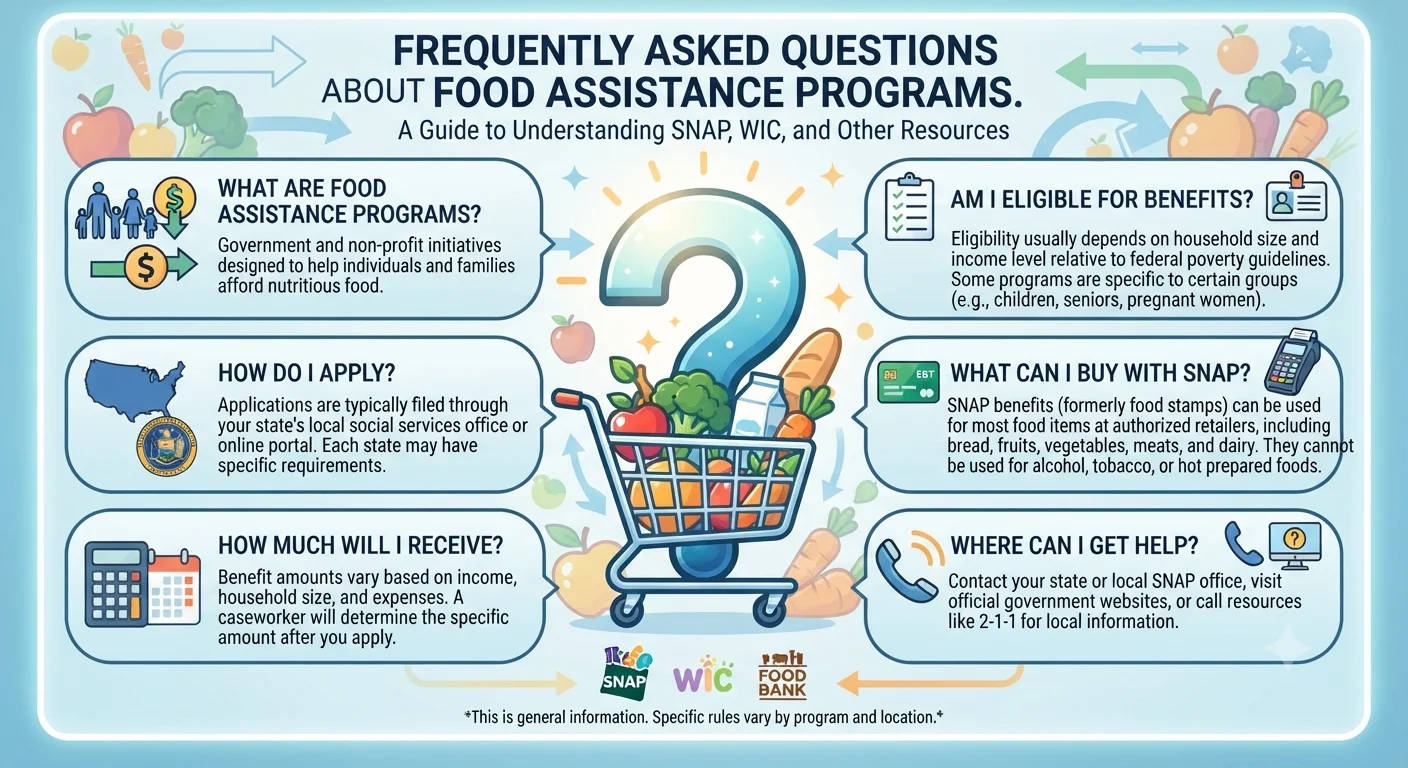
What is the difference between SNAP and WIC?
SNAP provides flexible monthly grocery benefits to any qualifying household, while WIC provides a defined package of nutrition-specific foods and services specifically for pregnant women, new mothers, infants, and children under 5.
Can a household qualify for multiple food assistance programs at once?
Yes. Many programs are designed to work together, and participation in one, particularly SNAP or TANF, often automatically satisfies the eligibility requirement for another, like WIC or LIHEAP.
What food assistance is available for seniors specifically?
The Commodity Supplemental Food Program provides a free monthly food box for adults 60 and older, and the Senior Farmers Market Nutrition Program offers seasonal produce vouchers, in addition to SNAP's favorable rules for elderly households.
Where should someone start if they're not sure which programs they qualify for?
The official Benefits.gov screening tool, calling 211, or contacting a local food bank are all effective starting points for identifying the full range of programs a household may be eligible for.
Sources: USDA Food and Nutrition Administration, Feeding America, U.S. Department of Health and Human Services.