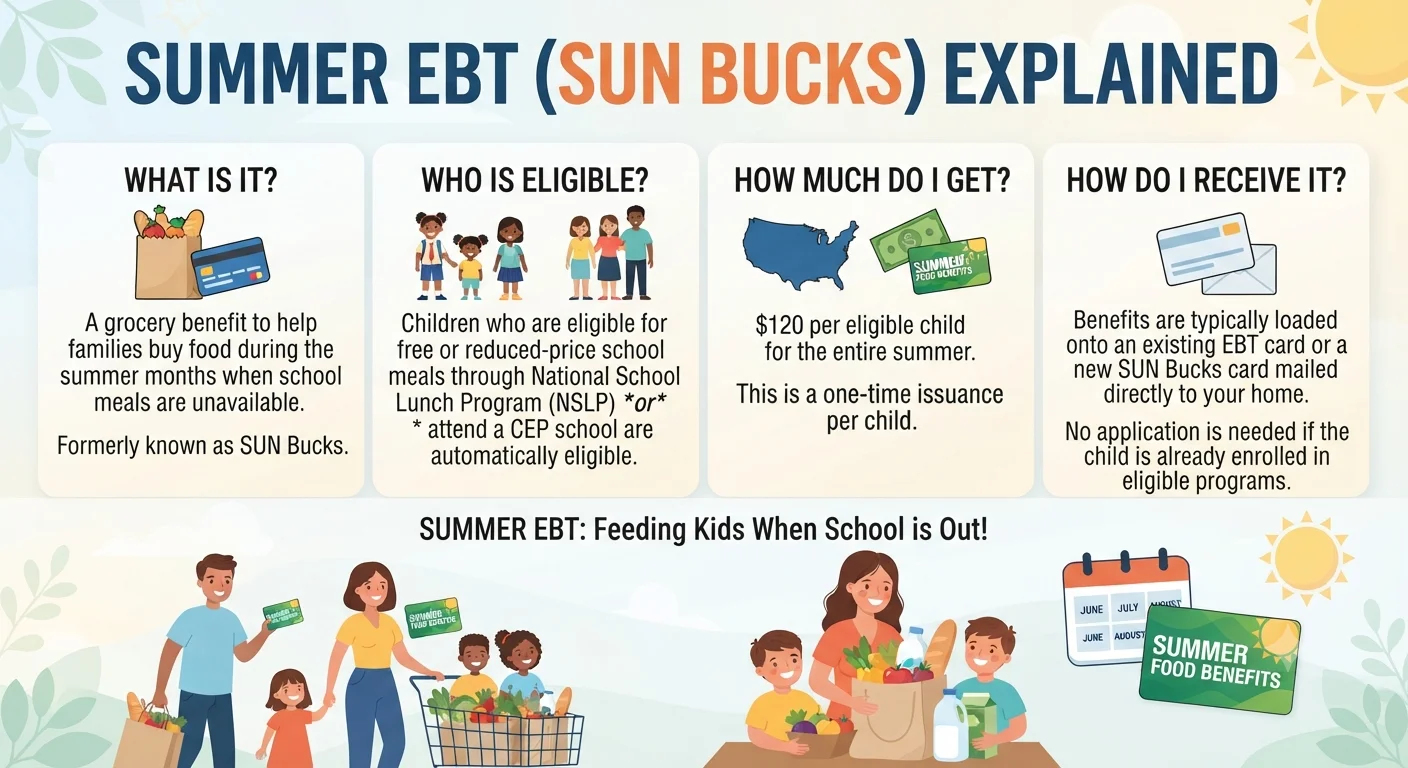
Summer EBT, also called SUN Bucks, provides $120 in grocery benefits per eligible school-age child for summer 2026 issued as a lump sum or in $40 monthly installments to help replace the school meals children lose access to during summer break. Most eligible families are enrolled automatically; more than 37 states, Washington D.C., all five U.S. territories, and several tribal nations are participating in 2026.
This guide is independently written and is not affiliated with USDA, OPM, or the official federal "Feds Feed Families" campaign.
What Is Summer EBT?
Summer EBT was made a permanent federal program under the Consolidated Appropriations Act of 2023 and now returns every summer, administered by the USDA's Food and Nutrition Administration. It's designed specifically to fill the gap left when school breakfast and lunch programs pause for summer break, giving families grocery money to use in place of those meals.
Which States Participate
- What Is Summer EBT?
- Which States Participate
- Benefit Amount Per Child
- Free Reduced School Lunch Program : Eligibility and How to Apply
- Automatic vs. Manual Enrollment
- How It Differs From Regular SNAP
- FAQ
- What is Summer EBT and how do I get it?
- Does Summer EBT affect my regular SNAP benefits?
- Which states are not participating in Summer EBT in 2026?
- How long do I have to use Summer EBT benefits?
As of summer 2026, more than 37 states, Washington D.C., and all five U.S. territories are participating, with Iowa joining for the first time this year. States that have opted out for 2026 include Alaska, Florida, Georgia, Idaho, Indiana, Mississippi, Oklahoma (as a state though several tribal nations within Oklahoma are participating independently), South Carolina, South Dakota, Tennessee, Texas, Utah, and Wyoming. If you live in a non-participating state, your child will not receive Summer EBT this year, though some tribal nations run independent programs even where the state has opted out check whether you live on or attend school within a participating tribal service area.
Benefit Amount Per Child
The standard 2026 benefit is $120 per eligible child for the summer, typically issued as $40 monthly deposits for June, July, and August, or as a single lump sum depending on the state. Hawaii issues a higher amount, $189 per child, and most U.S. territories issue $180 per child, reflecting regional cost-of-living adjustments. Benefits generally expire 122 days after they're loaded onto the card, so they need to be used before that window closes.
Automatic vs. Manual Enrollment
Most children are enrolled automatically and don't require a separate application. Your child is likely automatically eligible if:
Recommended Articles
 SCHOOL CHILD NUTRITION PROGRAMS
 SCHOOL CHILD NUTRITION PROGRAMS
 SCHOOL CHILD NUTRITION PROGRAMS
 SCHOOL CHILD NUTRITION PROGRAMS
- Your household currently receives SNAP, TANF, or FDPIR benefits, or
- Your child is approved for free or reduced-price school meals, or
- Your child receives Medicaid and your household income meets the qualifying threshold in a state that uses Medicaid for eligibility
If your child isn't automatically enrolled but your household income is at or below 185% of the federal poverty level (about $61,050/year for a family of four), you can still apply directly through your state's SUN Bucks portal search "[your state] SUN Bucks application" or check with your child's school district. Keeping your address current with both your SNAP/Medicaid caseworker and your child's school is important, since benefit notifications and cards are mailed to the address on file.
How It Differs From Regular SNAP
Summer EBT is a separate, one-time seasonal benefit it does not reduce or replace your household's regular monthly SNAP allotment, and receiving one has no effect on your eligibility for the other. Summer EBT generally follows the same purchase rules as SNAP (eligible groceries, not hot food, alcohol, or non-food items), and in the roughly 22 states that have added restrictions on candy or sugary drinks to their SNAP program, those same restrictions typically apply to Summer EBT as well. Families can also use Summer EBT alongside the separate Summer Food Service Program, which provides free hot meals at community sites the two programs are designed to stack, not substitute for each other.
Read More Articals
FAQ
What is Summer EBT and how do I get it?
Summer EBT (SUN Bucks) provides $120 in grocery benefits per eligible school-age child during summer break. Most eligible families are enrolled automatically if they already receive SNAP, TANF, or free/reduced school meals; families that aren't automatically enrolled can apply through their state's SUN Bucks portal.
Does Summer EBT affect my regular SNAP benefits?
No. Summer EBT is a separate, one-time seasonal benefit and does not reduce your household's regular monthly SNAP allotment.
Which states are not participating in Summer EBT in 2026?
As of 2026, Alaska, Florida, Georgia, Idaho, Indiana, Mississippi, Oklahoma (as a state), South Carolina, South Dakota, Tennessee, Texas, Utah, and Wyoming have opted out, though some tribal nations in these states run independent programs.
How long do I have to use Summer EBT benefits?
Sources: USDA Food and Nutrition AdministratioBenefits generally expire 122 days after they're loaded onto your card, so they should be used well before summer ends.n Summer EBT program page, state SUN Bucks agency pages (Pennsylvania, Massachusetts, California).