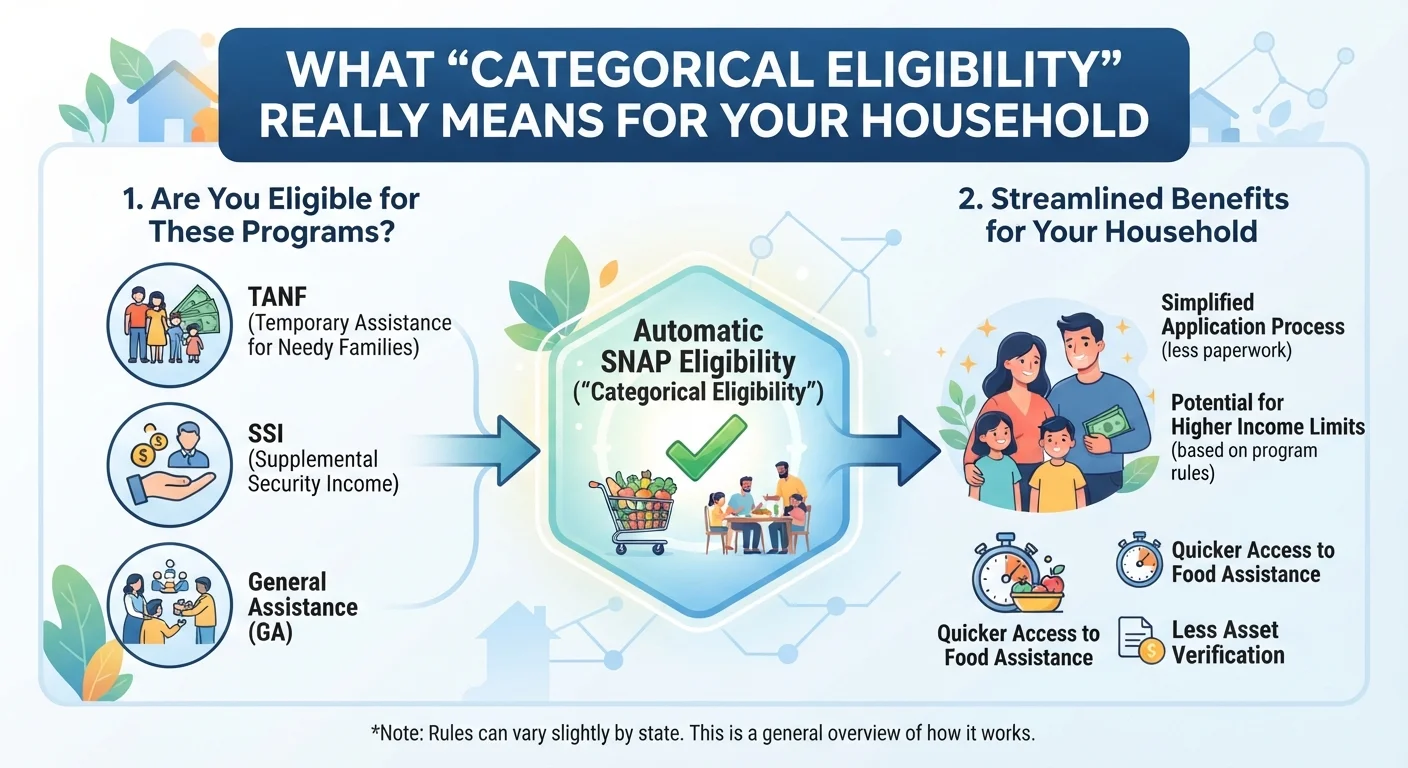
Categorical eligibility is the federal rule that automatically qualifies a household for SNAP, bypassing the standard gross income, net income, and asset tests, if every member of the household already receives Supplemental Security Income, Temporary Assistance for Needy Families cash assistance, or a qualifying state General Assistance benefit. The word "categorically" simply means the household is placed into a category of people already presumed to need food assistance based on that other program's own eligibility determination.
This guide is independently written and is not affiliated with USDA, OPM, or the official federal Feds Feed Families campaign.
How the Standard Eligibility Path Compares
Under the traditional eligibility path, a household must pass a gross income test, at or below 130 percent of the federal poverty level, a net income test, at or below 100 percent of the poverty level after allowable deductions, and an asset test, $3,000 for most households, adjusted annually for inflation. Categorical eligibility replaces all three of these tests with a single question: does every household member already receive a qualifying benefit from another means-tested program?
Actual Enrollment, Not Just Meeting the Criteria
- How the Standard Eligibility Path Compares
- Actual Enrollment, Not Just Meeting the Criteria
- Where This Rule Came From
- What Categorical Eligibility Actually Waives
- Broad-Based Categorical Eligibility: A Genuinely Debated Expansion
- Both Sides of the Policy Debate
- What Disqualifies a Household Even With Categorical Eligibility
- How to Know If This Applies to Your Household
- FAQ
- What is SNAP categorical eligibility?
- Do you need to already be receiving TANF or SSI, or just eligible for it?
- What is Broad-Based Categorical Eligibility?
- Is Broad-Based Categorical Eligibility controversial?
A key, sometimes misunderstood requirement is that categorical eligibility requires actually receiving benefits from TANF, SSI, or a qualifying program, not simply meeting the general criteria that would make someone eligible to apply for one of those programs. A household where every member is actively enrolled and receiving payments qualifies; a household that would technically meet SSI's requirements but hasn't yet applied does not.
Where This Rule Came From
Categorical eligibility's roots trace back to the early 1970s, when the first evidence of conferring SNAP eligibility based on participation in another public assistance program emerged, and the rule was further shaped by the Personal Responsibility and Work Opportunity Reconciliation Act of 1996, which replaced the older AFDC cash assistance program with the TANF block grant and updated the underlying eligibility language to reflect that change.
-
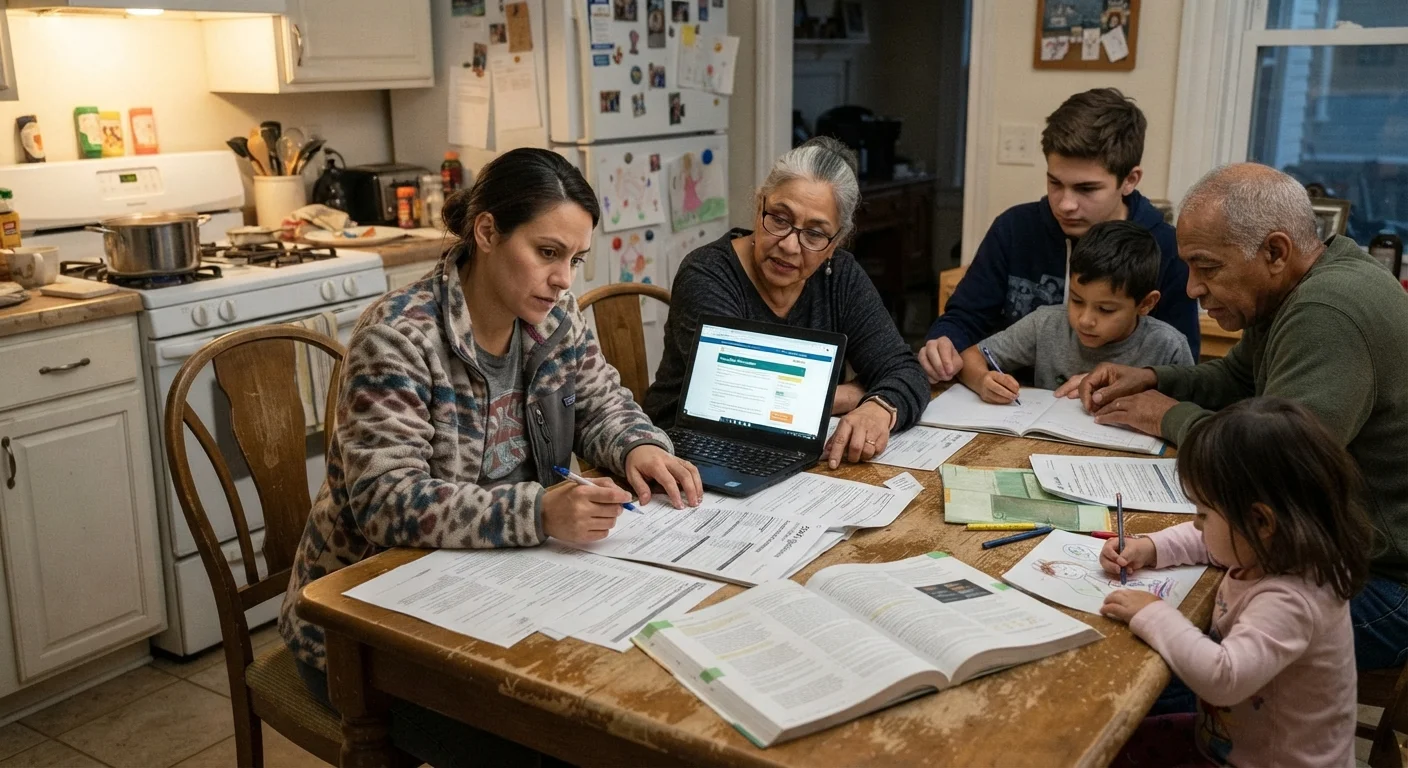
How to Read Your SNAP Notice of Eligibility Letter
What Categorical Eligibility Actually Waives
For a household that qualifies this way, the assets of household members receiving TANF, SSI, or General Assistance are disregarded entirely from the household's total resources when determining eligibility, and in most states, categorically eligible households don't need to provide separate verification of several standard application details that other households must document.
Broad-Based Categorical Eligibility: A Genuinely Debated Expansion
Since the 1996 welfare reform law, states have gained the flexibility to expand categorical eligibility beyond its traditional scope, most commonly through a policy called Broad-Based Categorical Eligibility, which more than 40 states have adopted, using it to raise SNAP's gross income limit, sometimes to 200 percent of the federal poverty level, and typically waive the asset test entirely, by connecting eligibility to a low-cost or informational TANF-funded service rather than actual cash assistance.
Recommended Articles
 SNAP EBT
 SNAP EBT
 SNAP EBT
 SNAP EBT
Both Sides of the Policy Debate
This expansion is genuinely contested in current policy discussion. Supporters argue Broad-Based Categorical Eligibility reduces administrative burden, smooths what would otherwise be an abrupt "benefit cliff" where a small raise causes someone to lose SNAP entirely, and reflects that many working households with modest income still face genuine food insecurity. Critics, including analysis from the American Enterprise Institute, have argued the policy stretches the concept of "receiving a TANF benefit" to cover services, like a brochure or referral, that bear little resemblance to actual cash assistance, and that this loose connection undermines the original, more targeted purpose of categorical eligibility.
What Disqualifies a Household Even With Categorical Eligibility
Categorical eligibility isn't an unconditional pass. A household is still disqualified if any member has been found to have committed an intentional program violation, carrying penalties of 12 months for a first offense, 24 months for a second, and permanent disqualification for a third, or if a household member is currently on strike, regardless of whether the household otherwise qualifies categorically.
How to Know If This Applies to Your Household
If every member of your household currently receives TANF or SSI, mentioning this explicitly when you apply, and providing your award letter or case number for that program, is the most direct way to have your application evaluated under the categorical eligibility path rather than the standard income and asset tests.
Read More Articals
FAQ
What is SNAP categorical eligibility?
A rule that automatically qualifies a household for SNAP, skipping the standard income and asset tests, if every household member already receives TANF, SSI, or a qualifying General Assistance benefit.
Do you need to already be receiving TANF or SSI, or just eligible for it?
You must actually be enrolled and receiving benefits, not simply meet the general criteria that would make you eligible to apply.
What is Broad-Based Categorical Eligibility?
A state option, adopted by more than 40 states, that expands categorical eligibility by connecting it to a low-cost TANF-funded service rather than actual cash assistance, used to raise SNAP's income limit and waive the asset test.
Is Broad-Based Categorical Eligibility controversial?
Yes, genuinely. Supporters argue it reduces red tape and smooths benefit cliffs for working households, while critics argue it stretches the concept of "receiving a TANF benefit" beyond its original intent.
Sources: Congressional Research Service via Congress.gov, Georgia Department of Human Services PAMMS, American Enterprise Institute.