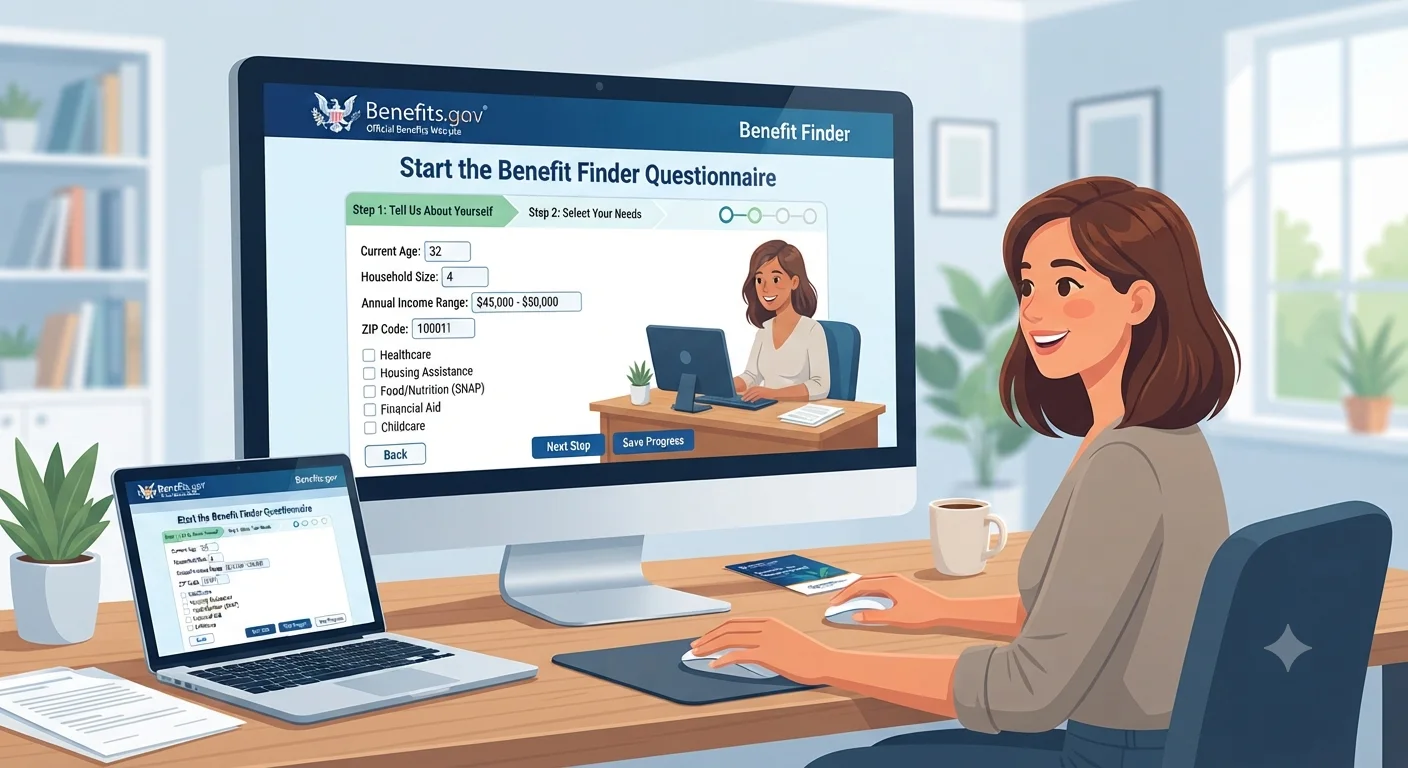
Benefits.gov is the official federal government screening tool, hosted through USA.gov, that lets you anonymously check potential eligibility across more than 1,000 benefit programs administered by 16 different federal agencies, without submitting a formal application or providing identifying personal information beyond basic household and income details.
This guide is independently written and is not affiliated with USDA, OPM, or the official federal Feds Feed Families campaign. It is not affiliated with any private or third-party benefits screening website.
What Benefits.gov Actually Does
Benefits.gov functions as a pre-screening questionnaire rather than an actual application, matching your answers against the eligibility criteria for a wide range of federal and state programs and showing you which ones you may qualify for, along with direct links to the actual application for each program. It does not send your information to the IRS, Social Security Administration, or any state agency, meaning completing the questionnaire alone does not put you on record as having applied for anything.
How the Screening Process Works
- What Benefits.gov Actually Does
- How the Screening Process Works
- Why Accuracy Matters
- Screening Is Not the Same as Applying
- Related Federal Screening Tools
- Rerunning the Screener After Life Changes
- Being Cautious of Third-Party Screening Sites
- FAQ
- What is Benefits.gov?
- Does completing a benefits screener count as applying?
- Should I use my gross or net income when using a benefits screener?
- How often should I recheck my eligibility using a screening tool?
The tool asks a series of questions about your household size, income, state of residence, age, and other relevant factors, then generates a personalized list of programs you may be eligible for based on your specific answers. This can include everything from SNAP and Medicaid to more specialized programs like veterans benefits, housing assistance, or education grants, depending on your specific circumstances.
Why Accuracy Matters
Because the screening results depend entirely on the information you provide, answering questions honestly and completely is essential to getting an accurate picture of what you may qualify for. A common mistake is entering net take-home pay instead of gross income, since most public assistance programs calculate eligibility based on gross monthly income before taxes and other deductions, and using the wrong figure can produce a misleading result.
Screening Is Not the Same as Applying
It's worth being clear that completing a benefits screener, whether the official Benefits.gov tool or a similar state-run version, is never the same as actually applying for a program. Every program identified through the screening process still requires its own separate, formal application submitted directly to the administering agency, and only that formal application results in an actual eligibility determination and benefit issuance.
Recommended Articles
 GOVERNMENT ASSISTANCE GUIDES
 GOVERNMENT ASSISTANCE GUIDES
 GOVERNMENT ASSISTANCE GUIDES
 GOVERNMENT ASSISTANCE GUIDES
Related Federal Screening Tools
Beyond the general Benefits.gov tool, the Social Security Administration maintains its own more specialized Benefit Eligibility Screening Tool, commonly called BEST, specifically for Social Security Disability, Medicare, SSI, and related programs, accessible directly through the SSA's website. Like the broader Benefits.gov tool, BEST is anonymous and does not create a formal application on its own.
Rerunning the Screener After Life Changes
Because eligibility thresholds and program fit can shift significantly after a major household change, such as a marriage, the birth of a child, a job loss, or a change in income, it's worth rerunning a screening tool after any such life event rather than assuming your previous results still apply. A household that didn't qualify for a specific program a year ago may well qualify now, and vice versa.
Being Cautious of Third-Party Screening Sites
A number of private websites offer their own benefits screening tools, some of which are genuinely useful, but it's worth confirming you understand whether you're using the official government tool at Benefits.gov or a private, third-party version, since accuracy, data handling practices, and the specific programs covered can vary considerably between the official tool and unaffiliated private alternatives.
Read More Articals
FAQ
What is Benefits.gov?
The official federal government benefits screening tool, hosted through USA.gov, that lets you anonymously check potential eligibility across more than 1,000 programs from 16 federal agencies based on your household information.
Does completing a benefits screener count as applying?
No. Screening tools are pre-screening questionnaires only. You still need to submit a separate, formal application directly to each program's administering agency to actually apply and receive a benefit determination.
Should I use my gross or net income when using a benefits screener?
Most public assistance programs, and most screening tools, use gross monthly income before taxes and deductions, so entering net take-home pay can produce an inaccurate result.
How often should I recheck my eligibility using a screening tool?
It's worth rerunning a screener after any significant household change, such as a marriage, new child, job loss, or income change, since eligibility for various programs can shift meaningfully after these events.
Sources: Benefits.gov, U.S. Social Security Administration Benefit Eligibility Screening Tool, U.S. Department of Labor.