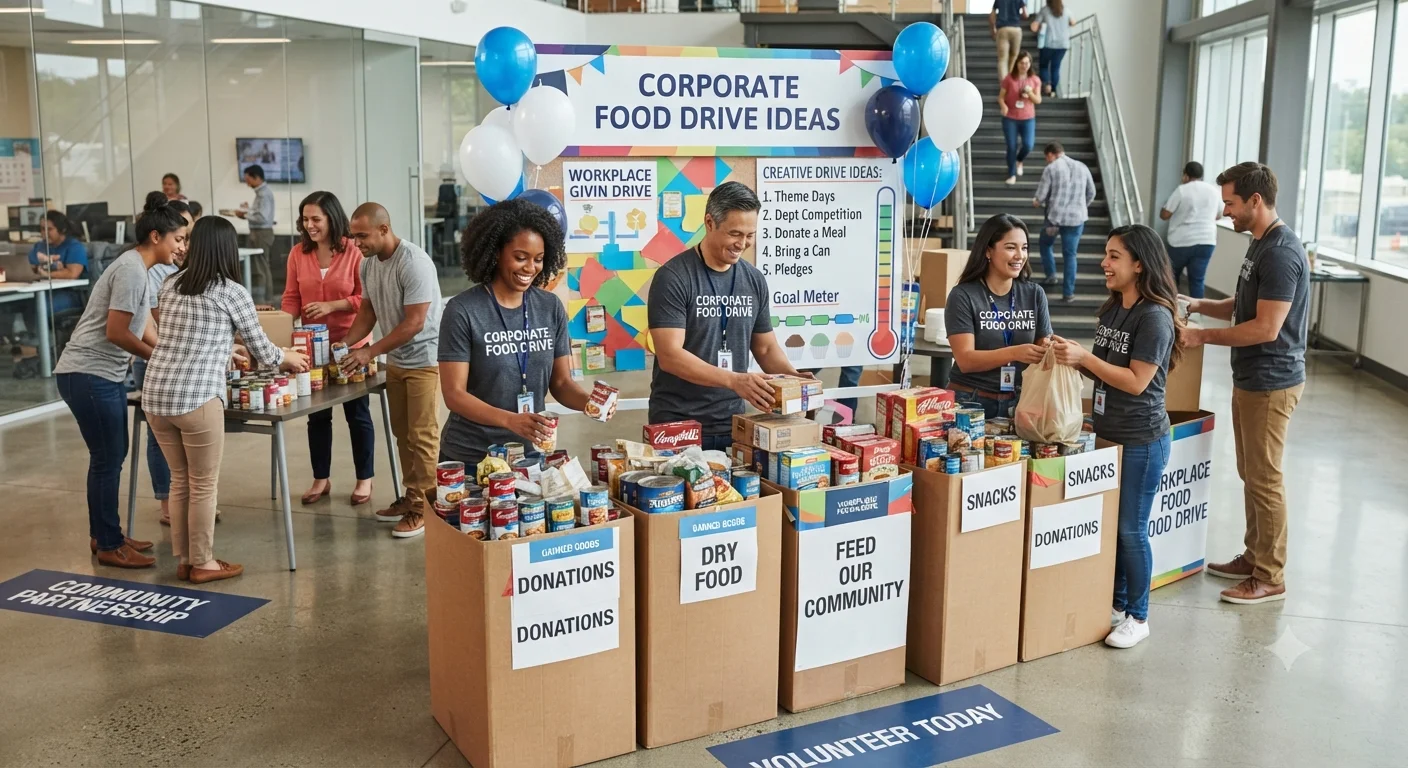
Workplace food drives tend to succeed when they combine a clear, achievable goal with an element of friendly competition or employer matching, since both approaches consistently drive higher participation than a simple donation bin placed quietly in a break room.
This guide is independently written and is not affiliated with USDA, OPM, or the official federal Feds Feed Families campaign.
Start With a Food Bank Partnership
Before launching internally, contact a local food bank or pantry to register your drive and understand their current specific needs, since many organizations provide free collection bins, promotional graphics, and a point of contact who can help guide your internal campaign. Registering formally also gives your effort a clear, credible destination to promote to employees, rather than an informal box with no defined endpoint.
Department vs. Department Competitions
- Start With a Food Bank Partnership
- Department vs. Department Competitions
- Employer Matching Programs
- Volunteer Time Off for Hunger Relief
- Event-Based Giving
- Setting a Realistic, Motivating Goal
- Promoting Internally
- Delivering the Donation
- FAQ
- What makes a workplace food drive successful?
- Should a company match employee donations during a food drive?
- Can employees volunteer instead of donating food or money?
- How do we choose which food bank to partner with for a corporate drive?
Structuring a drive as a friendly competition between departments, floors, or office locations is one of the most reliably effective ways to boost participation. Track and publicly display progress, whether measured in pounds collected, items donated, or dollars raised, and consider a small, low-cost prize for the winning team, such as a catered lunch or an extra time-off perk, to add motivation beyond goodwill alone.
Employer Matching Programs
Many companies offer to match employee cash donations dollar for dollar, or even at a multiplied rate, which can significantly increase total impact without requiring additional individual giving. If your company doesn't already have a formal matching program, proposing one specifically tied to a food drive can be an easier internal ask than requesting a permanent, ongoing matching policy.
Volunteer Time Off for Hunger Relief
Beyond collecting food or cash, some companies allow employees to use paid volunteer time specifically for hunger relief activities, such as sorting donations at a local food bank warehouse or helping staff a mobile pantry distribution. Pairing a collection drive with an organized volunteer shift gives employees more than one way to contribute, which can broaden participation among people who may not have extra food or cash to give but do have time.
Event-Based Giving
Tying a food donation requirement or suggestion to an existing company event, such as a holiday party, team outing, or all-hands meeting, can generate a concentrated burst of donations without requiring a separate standalone campaign. A simple ask, such as requesting a canned good donation for entry to a holiday potluck, tends to feel low-pressure while still meaningfully contributing to the overall total.
Recommended Articles
 CHARITABLE GIVING VOLUNTEERING
 CHARITABLE GIVING VOLUNTEERING
 CHARITABLE GIVING VOLUNTEERING
 CHARITABLE GIVING VOLUNTEERING
Setting a Realistic, Motivating Goal
A specific, achievable target, such as a set number of pounds per employee or a total dollar figure tied to company size, gives the campaign a concrete finish line and makes the eventual results easier to communicate. Overly ambitious goals can actually discourage participation if the target feels unreachable partway through the drive, so calibrating the goal to your specific company size and past giving history tends to work better than an arbitrary round number.
Promoting Internally
- Send regular email updates through internal communication channels highlighting progress toward the stated goal
- Use physical signage near collection bins in high-traffic areas like break rooms and building entrances
- Feature the drive in any internal newsletter or all-hands meeting to keep visibility high throughout the campaign
- Share the final results and a thank-you message once the drive concludes, ideally with a specific outcome, such as meals provided, translated from the total collected
Delivering the Donation
Coordinate a scheduled drop-off or pickup with your partner food bank once the drive concludes, since a large volume of donated food or a sizable check typically requires advance coordination for the receiving organization to properly log and store it. Many food banks are also happy to send a representative to help close out a workplace drive with a short thank-you visit or a group photo, which can help build enthusiasm for a future drive.
Read More Articals
FAQ
What makes a workplace food drive successful?
A clear, achievable goal combined with either friendly competition between departments or employer matching for cash donations consistently drives higher participation than a passive collection bin alone.
Should a company match employee donations during a food drive?
It can meaningfully increase total impact. Even a temporary match tied specifically to the food drive, rather than a permanent policy, can be an easier internal proposal while still boosting overall giving.
Can employees volunteer instead of donating food or money?
Yes, many companies offer paid volunteer time for hunger relief activities like sorting donations at a food bank, which broadens participation among employees who may have more time than spare food or cash to give.
How do we choose which food bank to partner with for a corporate drive?
Search for food banks in your company's local area, or ask employees if they have existing relationships with a specific organization, then contact that food bank directly to register your drive and understand their current needs.
Sources: Rotary International food drive guidance, Move For Hunger corporate giving resources.