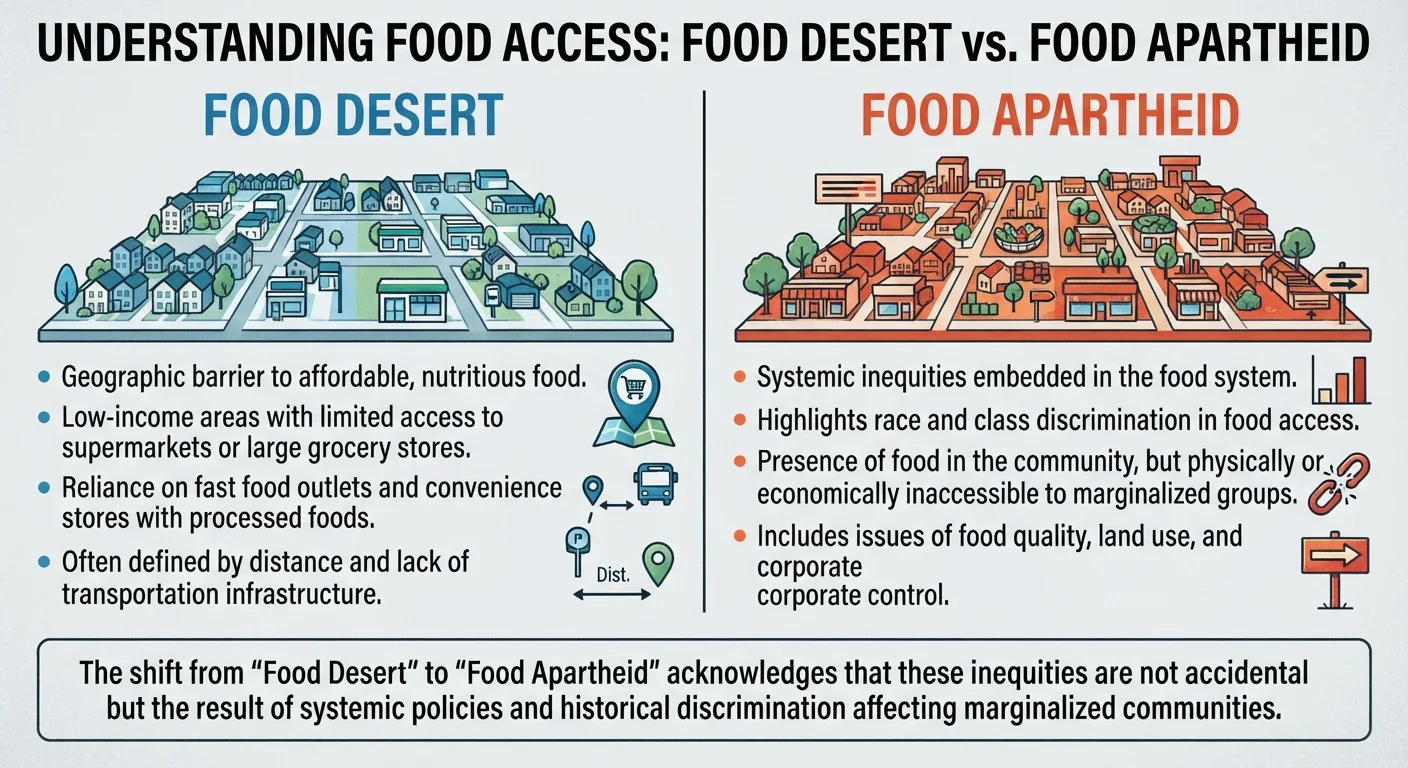
Food justice advocate Karen Washington coined the term "food apartheid" specifically to challenge the framing behind "food desert," arguing that describing limited food access using a naturally occurring landscape metaphor obscures the deliberate, human-made policy decisions, including historical housing discrimination, zoning, and lending practices, that actually created these conditions in specific communities. This is a genuine, ongoing terminology debate within food justice advocacy and academia, and "food desert" remains the standard term used in federal policy and USDA's own research methodology.
This guide is independently written and is not affiliated with USDA, OPM, or the official federal Feds Feed Families campaign.
The Core Argument Behind "Food Apartheid"
Washington's central critique is that a desert is a naturally occurring ecosystem, arid and shaped by climate rather than human decision-making, while the communities described as "food deserts" arrived at their current state through specific, traceable policy choices. Advocates using the "food apartheid" framing argue this reframing forces a more direct confrontation with root causes, including racially discriminatory housing policy, food industry consolidation, and wage stagnation, rather than treating limited food access as an unfortunate but essentially accidental gap.
Where the Term "Apartheid" Comes From
- The Core Argument Behind "Food Apartheid"
- Where the Term "Apartheid" Comes From
- Why "Food Desert" Remains the Standard Policy Term
- The Research Supporting Racial Disparities in Food Access
- Understanding This as a Genuine, Ongoing Debate
- What This Debate Doesn't Change
- FAQ
- What is "food apartheid" and who coined the term?
- Is "food desert" still the official term used in federal policy?
- Do research studies support the idea that food access disparities have a racial dimension?
- Is there a single correct answer to which term should be used?
The word apartheid originates from Afrikaans, meaning "apartness," and refers specifically to the South African governmental system that legally enforced racial segregation from 1948 to 1994 through laws requiring physical separation between races and eliminating Black South Africans' right to own land, among other measures. Advocates who use "food apartheid" deliberately invoke this historical reference to argue that similarly systemic, structural forces, not random chance, produce unequal food access along racial and economic lines within the United States.
Why "Food Desert" Remains the Standard Policy Term
Despite this advocacy, "food desert" continues to be the term used in USDA's own Food Access Research Atlas methodology and in the Congressional Research Service's analysis of federal food access policy, largely because it functions as a measurable, geographically specific research classification, a census tract meeting both an income and a distance threshold, rather than a broader framework describing underlying causes. This means the two terms genuinely operate somewhat differently: one is a technical measurement tool, the other is an advocacy framework centered on root-cause analysis.
Recommended Articles
 NEWS POLICY UPDATES
 NEWS POLICY UPDATES
 NEWS POLICY UPDATES
 NEWS POLICY UPDATES
The Research Supporting Racial Disparities in Food Access
Independent of which term is used, research comparing communities with similar poverty rates has found that predominantly Black and Latino neighborhoods tend to have fewer supermarkets offering a variety of fresh produce and healthy food, and more small convenience or liquor stores with limited healthy options, compared to predominantly white neighborhoods with comparable income levels. This underlying pattern of racial disparity in food access is well documented in the research literature regardless of which specific terminology is applied to describe it.
Understanding This as a Genuine, Ongoing Debate
It's worth being clear that this isn't a settled question with one objectively correct answer, it's an active, ongoing debate within food justice scholarship and advocacy about which framing more effectively describes the problem and motivates the most appropriate policy response. Some researchers and advocates continue to use "food desert" for its established, measurable research value, while others have moved specifically toward "food apartheid" or related terms like "food sovereignty" to center structural causes and community-driven solutions more explicitly.
What This Debate Doesn't Change
Regardless of which term is used, the practical resources available to a household facing limited food access, SNAP, WIC, local food banks, and community programs like mobile pantries and community gardens, remain the same, and this guide's broader coverage of those resources applies equally whichever framing a reader finds most accurate for describing the underlying problem.
Read More Articals
FAQ
What is "food apartheid" and who coined the term?
"Food apartheid" was coined by food justice advocate Karen Washington to reframe limited food access as the result of deliberate, human-made policy decisions rather than a naturally occurring gap, invoking South Africa's historical system of legally enforced racial segregation.
Is "food desert" still the official term used in federal policy?
Yes. USDA's own Food Access Research Atlas methodology and Congressional Research Service analysis continue to use "food desert" or "low-access area" as the standard technical, measurable classification.
Do research studies support the idea that food access disparities have a racial dimension?
Yes, this pattern is well documented independent of terminology. Research comparing communities with similar poverty rates has consistently found fewer supermarkets and more limited healthy food options in predominantly Black and Latino neighborhoods compared to predominantly white neighborhoods with similar income levels.
Is there a single correct answer to which term should be used?
No. This remains a genuine, active debate within food justice scholarship and advocacy, and both terms continue to be used depending on whether the goal is technical measurement or root-cause policy framing.
Sources: NRDC, University of Michigan School for Environment and Sustainability, Stray Dog Institute, Congressional Research Service.