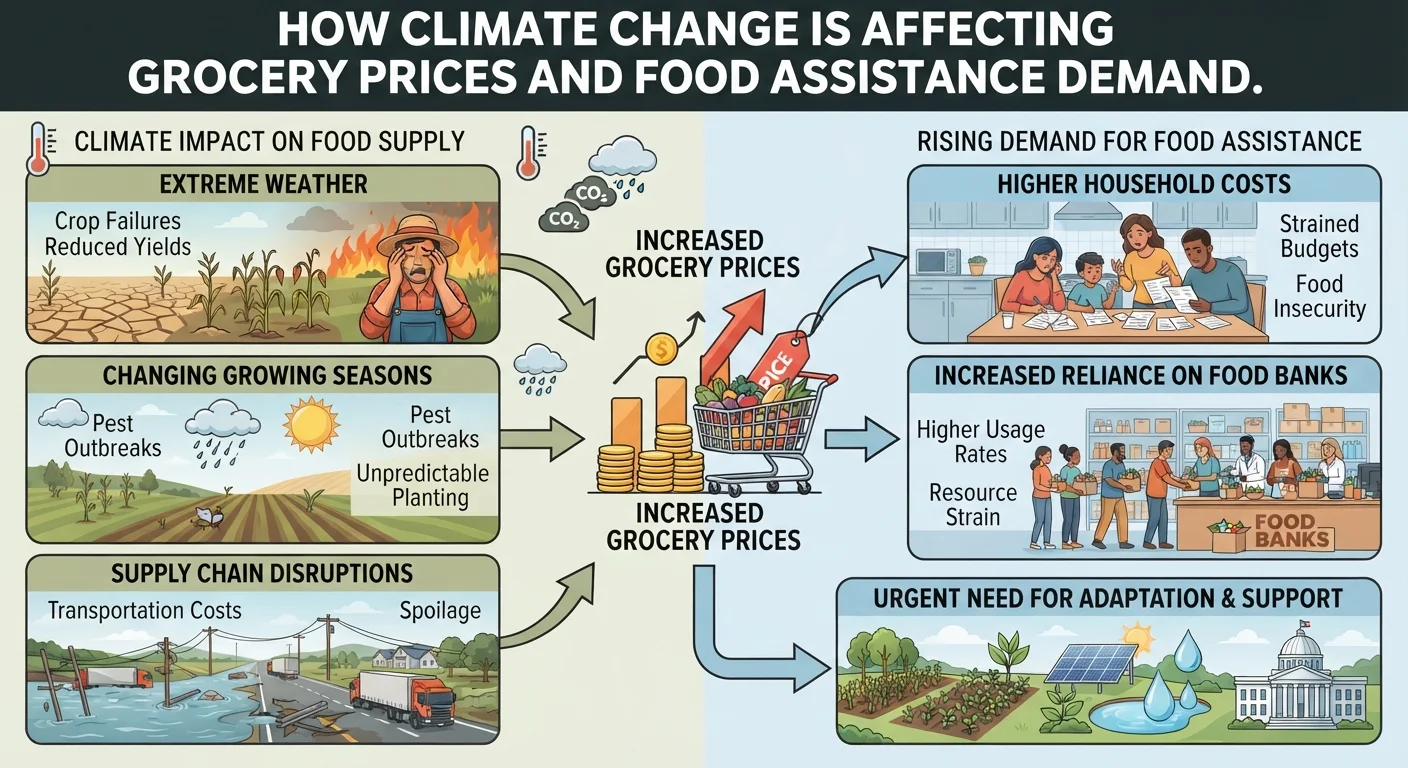
According to David Ortega, a food economist at Michigan State University, "climate change, and in particular drought, is one of multiple factors driving increases in food prices, and these pressures are compounding each other," a pattern reflected in real 2026 data showing grocery prices running 2.9 to 3.2 percent higher than a year earlier as of spring 2026, with beef, vegetables, and non-alcoholic beverages projected to rise significantly faster than the broader average.
This guide is independently written and is not affiliated with USDA, OPM, or the official federal Feds Feed Families campaign.
How Drought and Extreme Weather Actually Reach Your Grocery Bill
Drought and water scarcity affect agriculture in direct, measurable ways: they reduce crop yields, increase the cost of production, and physically limit how much a farmer can grow in a given season, and these supply constraints then push prices upward at every subsequent stage of the supply chain, from the farm gate to the store shelf.
A Documented, Peer-Reviewed Link, Not Just a General Correlation
- How Drought and Extreme Weather Actually Reach Your Grocery Bill
- A Documented, Peer-Reviewed Link, Not Just a General Correlation
- A Concrete, Repeatedly Cited Example
- Why Beef Prices Specifically Are Under Such Pressure
- Why Corn-Based Products Are Especially Exposed
- The Effect on Farming Communities Themselves
- Why This Disproportionately Affects Lower-Income Households
- What Households Can Do in Response
- FAQ
- Is there real scientific evidence linking climate change to grocery price increases?
- What's a concrete example of climate weather affecting grocery prices?
- Why are beef prices rising so significantly in 2026?
- Does climate-driven food inflation affect all households equally?
Research led by Maximilian Kotz at the Potsdam Institute for Climate Impact Research mapped 16 specific extreme weather events since 2022 directly to documented food price spikes across 18 countries, finding that global surveys consistently rank rising food prices as the second most commonly felt effect of climate change worldwide, trailing only extreme heat itself. Kotz specifically noted that "these effects are going to continue to become worse in the future" as climate patterns continue shifting.
A Concrete, Repeatedly Cited Example
Intense drought across California and Arizona in 2022 contributed to an 80 percent year-over-year increase in the U.S. producer price of vegetables by November of that year, a specific, well-documented example that continues to be cited across multiple independent analyses as illustrating how directly a single severe regional drought can move national grocery prices, particularly given how concentrated U.S. vegetable production is in a small number of growing regions.
Why Beef Prices Specifically Are Under Such Pressure
Beef prices are forecast to rise by roughly 12.1 percent in 2026, driven by a combination of a multi-year contraction in the national cattle herd tied to prolonged drought conditions that made ranchers hesitant to rebuild their herds, and separate biosecurity restrictions on cattle imports related to a resurgent agricultural pest. This illustrates how climate pressure and other supply chain factors can compound simultaneously within a single food category, rather than climate change acting as a single, isolated cause.
Recommended Articles
 NEWS POLICY UPDATES
 NEWS POLICY UPDATES
 NEWS POLICY UPDATES
 NEWS POLICY UPDATES
Why Corn-Based Products Are Especially Exposed
Because an estimated 4,000 items in a typical grocery store contain corn in some form, disruption to a major corn-producing region ripples across an unusually wide range of everyday products, and NASA has projected U.S. maize production could decline by as much as 24 percent by the end of the century under continued climate change, a long-term trend distinct from any single season's weather event.
The Effect on Farming Communities Themselves
Beyond consumer prices, an analysis of Kansas farms found that every additional 1 degree Celsius of warming over the past four decades decreased farmers' gross income by roughly 7 percent, illustrating that climate-driven price increases at the grocery store reflect genuine economic strain on the agricultural producers further up the supply chain, not simply retailer markup.
Why This Disproportionately Affects Lower-Income Households
Because lower-income households spend a larger share of their overall budget on food compared to higher-income households, the same percentage increase in grocery prices represents a meaningfully larger real-world burden for a family already managing a tight budget, which is part of why food banks and SNAP administrators track these climate-linked price trends closely as an early signal of potential rising demand.
What Households Can Do in Response
While climate-driven price volatility is largely outside any individual household's control, leaning more heavily on frozen and canned produce, which are less exposed to short-term fresh produce price spikes, and building meals around staples like rice, beans, and lentils, which have historically shown more price stability than fresh vegetables and beef, are practical ways to reduce a household's exposure to this specific kind of volatility.
Read More Articals
FAQ
Is there real scientific evidence linking climate change to grocery price increases?
Yes. Peer-reviewed research led by researchers at the Potsdam Institute for Climate Impact Research has directly mapped 16 specific extreme weather events since 2022 to documented food price spikes across 18 countries.
What's a concrete example of climate weather affecting grocery prices?
Intense drought in California and Arizona in 2022 contributed to an 80 percent year-over-year increase in the U.S. producer price of vegetables, an example repeatedly cited across independent analyses.
Why are beef prices rising so significantly in 2026?
A multi-year contraction in the national cattle herd, driven partly by prolonged drought discouraging herd rebuilding, combined with separate biosecurity import restrictions, is projected to push beef prices up roughly 12.1 percent.
Does climate-driven food inflation affect all households equally?
No. Because lower-income households spend a larger share of their budget on food, the same percentage price increase represents a proportionally larger real-world burden for those households.
Sources: Newsweek reporting with Michigan State University economist David Ortega, Center for American Progress, Climate Central, peer-reviewed research led by Maximilian Kotz via Yahoo News and Guardian reporting.