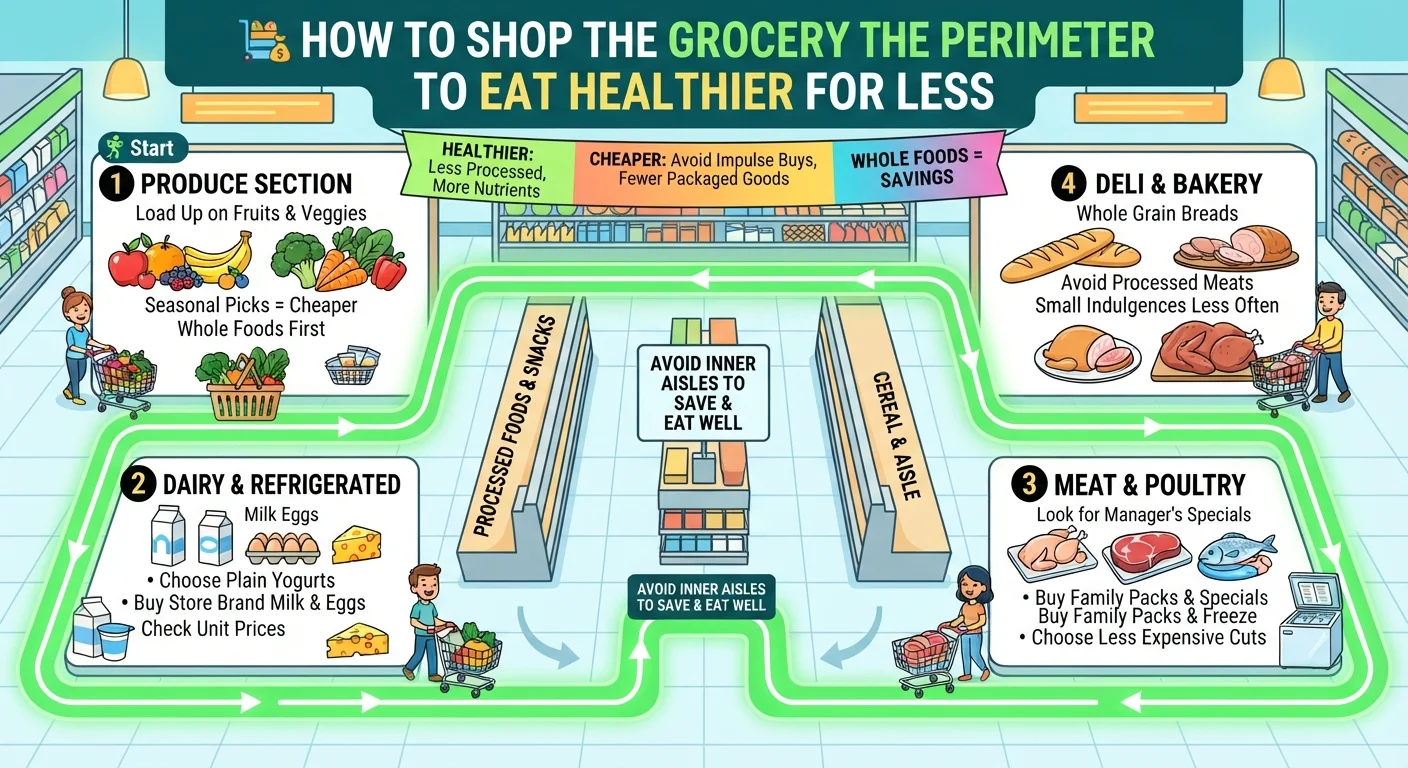
Most grocery stores place fresh produce, meat, seafood, dairy, and eggs along the outer walls, largely because these perishable categories require refrigeration or climate control that's more practically located along a building's exterior, while the center aisles house shelf-stable, often more heavily processed packaged goods. Dietitians frequently recommend shopping the perimeter first as a simple, low-effort strategy for anchoring a shopping trip around whole foods, though it works best as a starting heuristic rather than an absolute rule.
This guide is independently written and is not affiliated with USDA, OPM, or the official federal Feds Feed Families campaign.
Why the Perimeter Tends to Hold Healthier Options
Fresh produce, lean meats, seafood, eggs, and plain dairy are generally lower in sodium, added sugar, and preservatives than many packaged center-aisle products, according to registered dietitian guidance from Mayo Clinic Health System. Building a shopping trip around this outer ring first, before venturing into the center aisles, is a practical way to make sure whole foods form the foundation of what ends up in the cart, rather than an afterthought.
Why This Is a Heuristic, Not a Perfect Rule
- Why the Perimeter Tends to Hold Healthier Options
- Why This Is a Heuristic, Not a Perfect Rule
- The Perimeter Isn't Automatically Healthy Either
- Using the Perimeter Strategy on a Tight Budget
- Organizing a Shopping List Around the Store's Layout
- Shopping Hungry Undermines Any Strategy
- Combining This With a SNAP Budget
- FAQ
- Why is fresh food usually located around a grocery store's perimeter?
- Does shopping the perimeter mean I should skip the center aisles entirely?
- Is everything around the perimeter automatically a healthy choice?
- Is perimeter shopping budget-friendly?
It's genuinely important to understand that shopping the perimeter is not a complete or flawless strategy. Some of the most affordable, nutritious, and genuinely healthy staples for a tight budget, dried beans, lentils, canned tomatoes, whole grains like brown rice and oats, and canned fish, live in the center aisles, and skipping them entirely in favor of only perimeter shopping would actually work against both a healthy diet and a tight budget. Several dietitians who recommend this strategy are explicit that healthy staples in the center aisles absolutely belong in the cart too.
The Perimeter Isn't Automatically Healthy Either
Not everything along the outer walls is a genuinely healthy or cost-effective choice. Deli counters often carry high-sodium processed cold cuts, bakery displays can pack a significant amount of sugar and calories into a single item, and some yogurt and dairy products near the dairy case carry substantial added sugar. Treating the perimeter as a starting point rather than an automatic green light for every item found there is a more accurate way to use this strategy.
Recommended Articles
 BUDGETING MEAL PLANNING
 BUDGETING MEAL PLANNING
 BUDGETING MEAL PLANNING
 BUDGETING MEAL PLANNING
Using the Perimeter Strategy on a Tight Budget
Prioritizing the perimeter first doesn't mean spending more, since frozen and canned produce, both genuinely nutritious and typically cheaper than fresh, are worth incorporating alongside fresh perimeter items rather than treated as a lesser substitute. A practical approach for a tight budget combines perimeter shopping for fresh basics with intentional trips into the center aisles for specific, affordable staples like beans, rice, and canned goods.
Organizing a Shopping List Around the Store's Layout
Structuring a written grocery list to follow a store's actual layout, produce, then meat and seafood, then dairy, then the specific center-aisle staples needed, reduces backtracking through the store and cuts down on the chance of wandering into an unplanned section and picking up an impulse item.
Shopping Hungry Undermines Any Strategy
Regardless of which section of the store a shopper is navigating, arriving hungry consistently makes anyone more susceptible to impulse purchases, since a hungry brain responds more strongly to visually appealing food regardless of whether it's genuinely on the plan for that trip. Eating something before a shopping trip supports whichever strategy, perimeter-first or otherwise, a household is trying to follow.
Combining This With a SNAP Budget
For a household using SNAP, the perimeter-first approach works well as an organizing principle for fresh groceries, while the same benefit dollars still need to reach into the center aisles for cost-effective, shelf-stable staples that genuinely stretch a monthly budget further than fresh items alone typically can.
Read More Articals
FAQ
Why is fresh food usually located around a grocery store's perimeter?
Largely for practical infrastructure reasons, since perishable items requiring refrigeration or climate control are more efficiently placed along a store's exterior walls.
Does shopping the perimeter mean I should skip the center aisles entirely?
No. Genuinely healthy, budget-friendly staples like dried beans, lentils, canned tomatoes, and whole grains live in the center aisles and are worth including alongside perimeter shopping.
Is everything around the perimeter automatically a healthy choice?
No. Deli meats, bakery items, and some sweetened dairy products located on the perimeter can still be high in sodium, sugar, or calories, so this strategy works best as a starting point, not an automatic guarantee.
Is perimeter shopping budget-friendly?
It can be, especially when paired with frozen and canned produce, which are typically cheaper than fresh while remaining nutritionally comparable, alongside targeted trips into the center aisles for affordable staples.
Sources: Mayo Clinic Health System, Welia Health, general registered dietitian nutrition guidance.