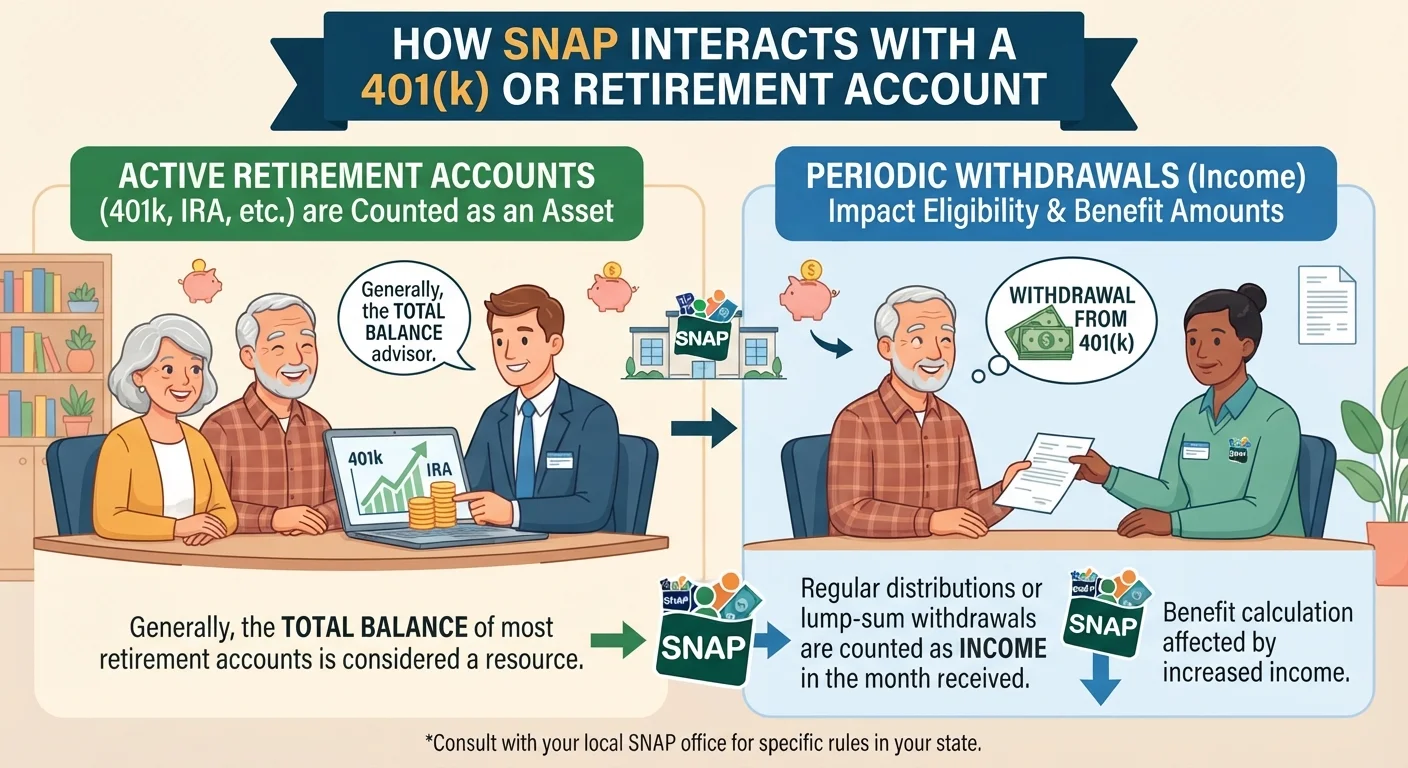
Federal SNAP policy specifically excludes most retirement accounts, including 401(k)s, traditional and Roth IRAs, Keogh plans, and pensions, from being counted as a resource, meaning the balance in your retirement savings does not count against you even in the smaller number of states that still enforce an asset test. This exclusion stems from updated USDA guidance issued to state agencies in 2017 and has remained in place since.
This guide is independently written and is not affiliated with USDA, OPM, or the official federal Feds Feed Families campaign.
Why the Exclusion Exists
The Food and Nutrition Act of 2008 limits how much in countable resources a household can have and still receive SNAP, but USDA has specifically directed states to exclude retirement accounts from this calculation, recognizing that penalizing households for saving responsibly toward retirement would work against the broader goal of long-term financial stability that SNAP is ultimately meant to support.
Which Accounts Are Covered
- Why the Exclusion Exists
- Which Accounts Are Covered
- Pensions and Annuities
- Joint Ownership Complications
- The Genuinely Important Distinction: Balance vs. Withdrawal
- What This Means for a Household With Modest Retirement Savings
- Reporting Retirement Income Correctly
- Checking Your Specific State's Treatment
- FAQ
- Does having a 401(k) or IRA affect SNAP eligibility?
- Does this exclusion apply in every state?
- Does withdrawing money from a retirement account affect SNAP?
- Should someone cash out retirement savings to meet a SNAP asset limit?
The exclusion generally covers 401(k) plans, traditional and Roth IRAs, MyRAs, and Keogh plans, a retirement plan structure specifically for self-employed individuals and their employees. If a household member's Keogh plan is countable under a specific state's more detailed rules, its value is counted less any early withdrawal penalty that would apply if the funds were accessed, similar to how some states also handle an IRA that doesn't fully meet their specific exclusion criteria.
Pensions and Annuities
Retirement accounts that aren't structured as an IRA or Keogh plan specifically, such as most pensions and annuities, are also generally excluded from resource calculations under the same broad principle, though the exact treatment can involve additional state-specific detail depending on how the specific account is structured.
Joint Ownership Complications
If a retirement account or other asset is owned jointly with someone outside your SNAP household, it's generally considered available in its entirety to your household unless you can demonstrate that you don't actually have access to the full amount, in which case only the portion you can genuinely access is counted.
The Genuinely Important Distinction: Balance vs. Withdrawal
This is the detail that trips up many applicants: while a retirement account's balance is excluded as a resource, any money you actually withdraw from that account is treated differently and generally counts as income for the specific month you receive it. A household drawing down a 401(k) for living expenses, for example, needs to report that withdrawal as income on their SNAP case, even though the remaining, unwithdrawn balance in the account continues to be excluded.
Recommended Articles
 SNAP EBT
 SNAP EBT
 SNAP EBT
 SNAP EBT
What This Means for a Household With Modest Retirement Savings
Because the exclusion applies regardless of state asset-testing policy, a household can generally hold a meaningful retirement balance and still qualify for SNAP based on their current income alone, without needing to consider cashing out savings simply to meet an asset limit, a step that would also typically trigger significant tax consequences and early withdrawal penalties that make it a poor financial decision in nearly every circumstance.
Reporting Retirement Income Correctly
If you're already receiving regular distributions from a retirement account, whether a pension payment or a required minimum distribution from an IRA, this counts as regular unearned income and should be reported the same way any other recurring income source would be, distinct from the underlying account balance itself, which remains excluded.
Checking Your Specific State's Treatment
While the federal exclusion is broadly consistent, a small number of states apply slightly more detailed rules to specific account types, particularly Keogh plans or an IRA that doesn't cleanly fit the standard federal category, so confirming your specific situation with your caseworker if you have an unusual retirement account structure is worth doing rather than assuming every account type is treated identically everywhere.
Read More Articals
FAQ
Does having a 401(k) or IRA affect SNAP eligibility?
No, generally. Federal policy excludes most retirement accounts, including 401(k)s, traditional and Roth IRAs, and Keogh plans, from being counted as a resource, even in states that still enforce an asset test.
Does this exclusion apply in every state?
Yes, since it stems from federal USDA guidance that applies regardless of which state you live in or whether that state enforces its own asset test.
Does withdrawing money from a retirement account affect SNAP?
Yes. While the account balance itself is excluded, any amount you actually withdraw generally counts as income for the month you receive it and must be reported.
Should someone cash out retirement savings to meet a SNAP asset limit?
Generally not necessary or advisable, since retirement accounts are already excluded from the asset test, and cashing one out would typically trigger significant tax consequences and early withdrawal penalties.
Sources: USDA Food and Nutrition Administration Excluded Retirement Accounts guidance, Montana Department of Public Health and Human Services SNAP Manual, Colorado Department of Human Services Countable and Exempt Resources training document.