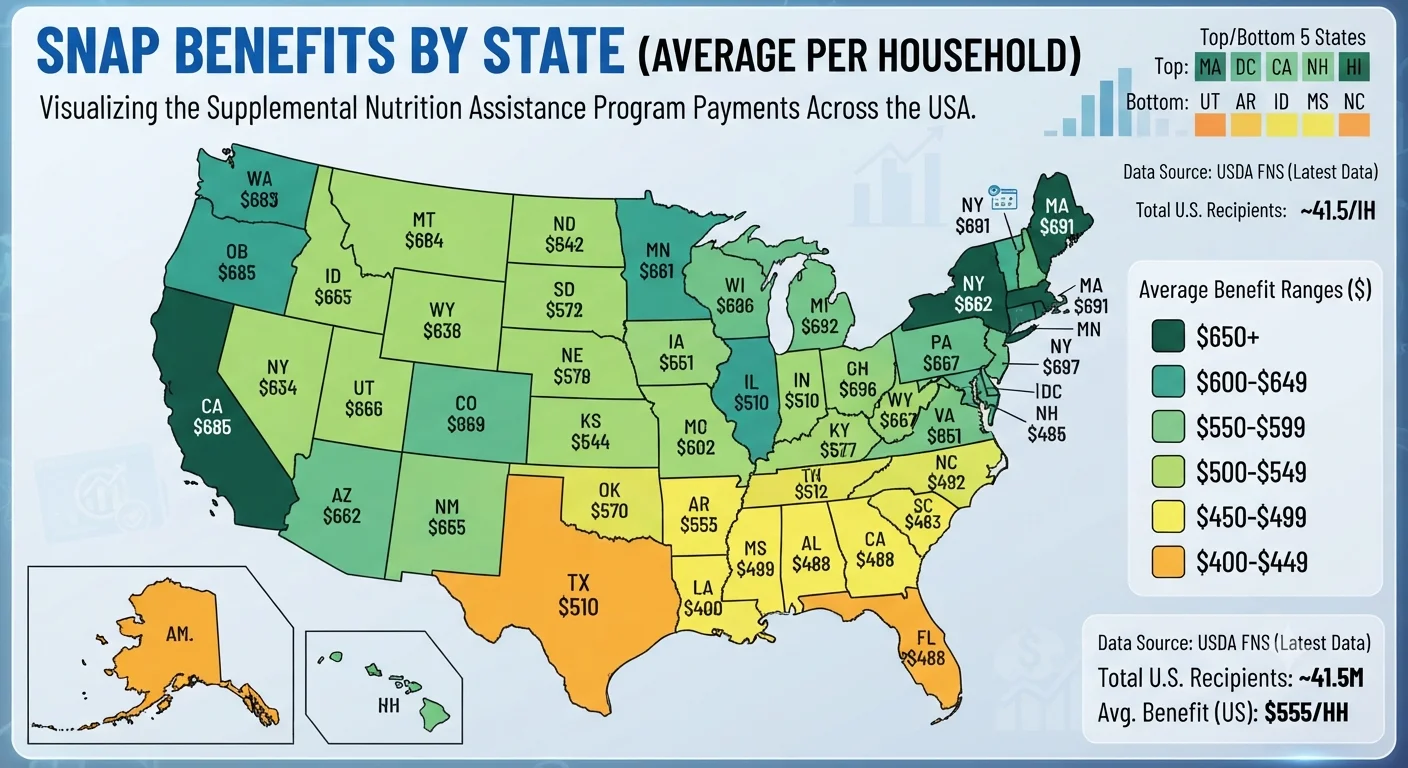
While SNAP is a federal program, each state administers its own application process, sets its own deposit schedule, and can adjust income limits and asset tests within federal guidelines. This means two households with identical income and family size can qualify differently, or receive their monthly deposit on completely different days, depending purely on which state they live in.
This guide is independently written and is not affiliated with USDA, OPM, or the official federal Feds Feed Families campaign.
Why SNAP Rules Vary by State
SNAP is federally funded and federally regulated in its broad strokes, but the Food and Nutrition Act gives states meaningful flexibility in a few key areas: whether to adopt Broad Based Categorical Eligibility, how to structure the standard utility allowance used in benefit calculations, and how to schedule monthly deposits across their caseload. States also use different names for their SNAP program and different online systems, which is often the most confusing part for applicants moving between states.
States With Broad Based Categorical Eligibility
- Why SNAP Rules Vary by State
- States With Broad Based Categorical Eligibility
- Deposit Date Patterns by State
- State SNAP Agency Directory
- How to Find Your State's Application
- FAQ
- Do SNAP benefits differ by state?
- Why do some states have higher SNAP income limits than others?
- Can I use my SNAP benefits if I move to a different state?
- How do I find my state's SNAP deposit date?
More than 40 states and Washington D.C. use Broad Based Categorical Eligibility, or BBCE, which raises the gross income limit, often to around 200 percent of the federal poverty level, and frequently removes the asset test entirely for most applicants. States without BBCE stick closer to the federal baseline of 130 percent of the poverty level for gross income and a $3,000 to $4,500 asset limit. Whether your state uses BBCE can be the single biggest factor in whether your household qualifies, so it is worth confirming directly with your state agency rather than assuming the federal baseline applies everywhere.
Deposit Date Patterns by State
Most states stagger SNAP deposits across the month rather than depositing everyone's benefit on the same day, typically based on the last digit of a case number, birth date, or Social Security number. Some states deposit on a fixed day each month, while others use a rolling schedule across the first 20 or so days of the month. Because this schedule is state specific and does not change month to month once assigned, checking your state agency's deposit calendar once is usually enough to know your pattern going forward.
Recommended Articles
 SNAP EBT
 SNAP EBT
 SNAP EBT
 SNAP EBT
State SNAP Agency Directory
Because SNAP portals and program names differ by state, the fastest way to find your state's official application is to search "your state name SNAP application" and confirm you have landed on an official state government website, typically ending in .gov. A few examples of how names differ:
- California calls its program CalFresh
- Texas administers SNAP through the Texas Health and Human Services Commission
- Washington State runs SNAP through the Department of Social and Health Services
- Many other states simply use the name SNAP or Food Assistance alongside their state human services department
How to Find Your State's Application
If a direct search does not turn up a clear result, benefits.gov maintains a national directory that links out to each state's official SNAP application portal. This is a reliable starting point if you are unsure which state department handles SNAP where you live, especially if you have recently moved and need to reapply under a new state's rules.
Read More Articals
FAQ
Do SNAP benefits differ by state?
Yes. While federal law sets the baseline rules, income limits, asset tests, and deposit schedules can all vary by state, particularly in states that use Broad Based Categorical Eligibility.
Why do some states have higher SNAP income limits than others?
States that adopt Broad Based Categorical Eligibility can raise their gross income limit well above the federal baseline of 130 percent of the poverty level, often to around 200 percent.
Can I use my SNAP benefits if I move to a different state?
Your EBT card generally works nationwide for purchases, but you must apply for and receive SNAP through the state where you currently live, not your previous state.
How do I find my state's SNAP deposit date?
Check your state's SNAP agency website or EBT customer service line, since deposit schedules are typically based on a case number or birth date pattern specific to that state.
Sources: USDA Food and Nutrition Administration, benefits.gov, state SNAP agency pages including California CDSS, Texas HHS, and Washington DSHS.