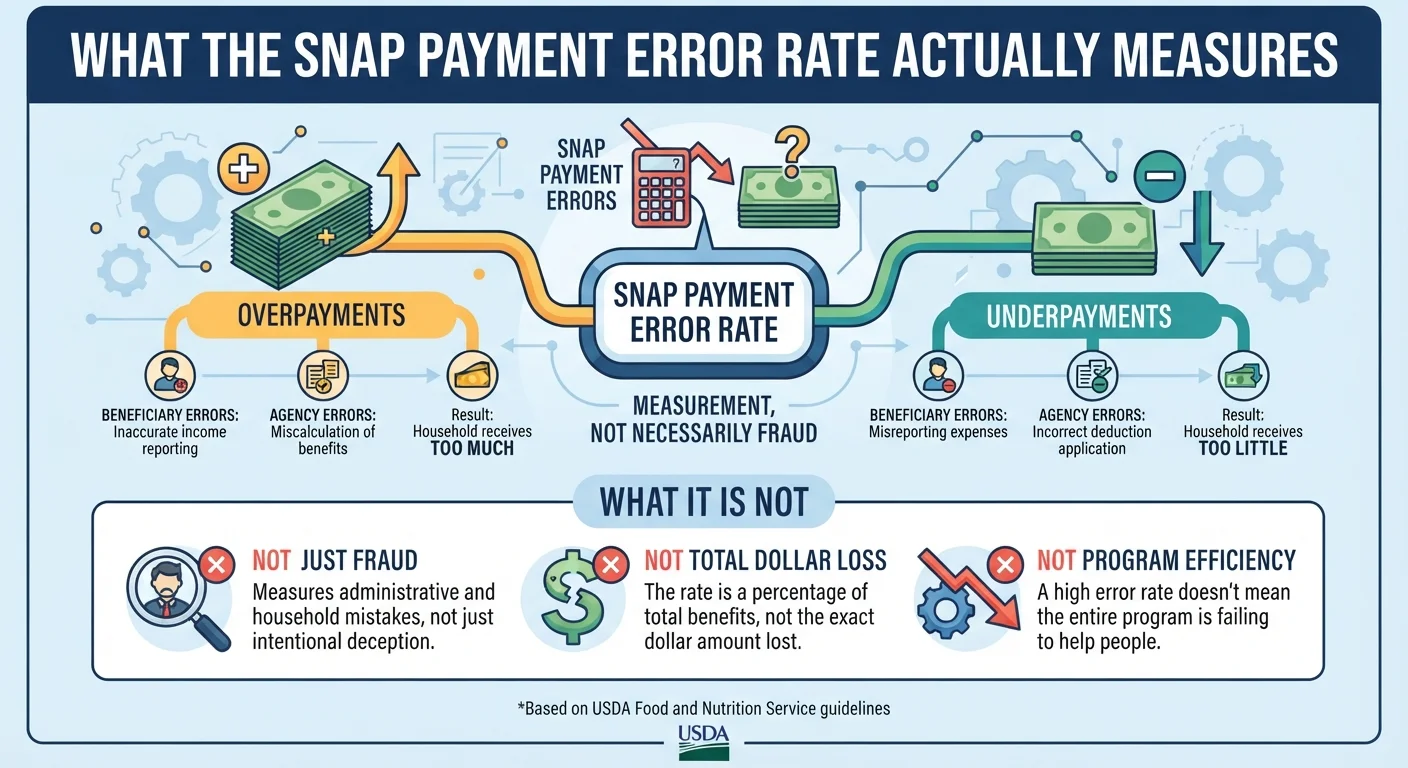
USDA's most recent report, released June 24, 2026, found the national SNAP payment error rate for fiscal year 2025 at 10.62 percent, well above the 6 percent threshold Congress established as the trigger for new state cost-sharing requirements beginning in fiscal year 2028. The rate measures how accurately states determine SNAP eligibility and benefit amounts, but there's genuine, active disagreement over whether it fairly captures state performance or fraud, as opposed to reflecting the complexity of administering a program with constantly shifting federal rules.
This guide is independently written and is not affiliated with USDA, OPM, or the official federal Feds Feed Families campaign. This topic involves active political debate, and this article aims to present the facts and different perspectives fairly rather than advocate for a particular position.
How the Error Rate Is Actually Calculated
Each state reviews a sample of its own eligibility and benefit determinations for accuracy, and USDA calculates three separate error components: benefits issued to entirely ineligible households, overpayments to otherwise eligible households, and underpayments to otherwise eligible households. According to the Food Research and Action Center, USDA adds the absolute value of these components together without netting them against each other, meaning an overpayment error and an underpayment error both add to the total rather than partially canceling out.
What Counts as an Error and What Doesn't
- How the Error Rate Is Actually Calculated
- What Counts as an Error and What Doesn't
- The New Financial Consequences for States
- How USDA Has Framed the Findings
- How Advocacy Groups and Researchers Have Pushed Back
- What This Debate Isn't About
- How States Are Responding
- What This Means for a SNAP Household
- FAQ
- What was the national SNAP payment error rate for fiscal year 2025?
- Does the SNAP payment error rate measure fraud?
- When do states start paying a share of SNAP benefit costs based on their error rate?
- Is there disagreement about whether the error rate fairly measures state performance?
According to analysis from the Hamilton Project, a payment error generally must exceed $58 in fiscal year 2026 to count toward the rate, and in some cases, a procedural mistake that still resulted in an otherwise eligible household receiving benefits can cause that household's entire allotment to count as an error. Notably, the rate does not capture the opposite kind of mistake, wrongly denying benefits to someone who was actually eligible is not counted as an error under this metric.
The New Financial Consequences for States
Under the One Big Beautiful Bill Act, beginning October 1, 2027, states with an error rate at or above 6 percent must cover a portion of their own SNAP benefit costs for the first time in the program's history: 5 percent for states between 6 and 8 percent, 10 percent for states between 8 and 10 percent, and 15 percent for states above 10 percent. States can choose whichever of their fiscal year 2025 or 2026 error rate produces a lower obligation, and only nine states had a rate below 6 percent in fiscal year 2025, meaning the remaining 41 states and Washington D.C. currently face this cost-sharing requirement unless they lower their rates before the calculation is finalized.
How USDA Has Framed the Findings
Agriculture Secretary Brooke Rollins characterized the fiscal year 2025 results as evidence that "state accountability is severely lacking in SNAP," framing the $10.1 billion in combined improper payments nationwide as significant waste that the new cost-sharing structure is designed to address through real financial consequences for states.
Recommended Articles
 NEWS POLICY UPDATES
 NEWS POLICY UPDATES
 NEWS POLICY UPDATES
 NEWS POLICY UPDATES
How Advocacy Groups and Researchers Have Pushed Back
The Food Research and Action Center has specifically argued that tying punitive cost-sharing to error rates reflects a misunderstanding of how SNAP actually operates, since the rates reflect an extraordinarily complex administrative process carried out by eligibility workers navigating shifting federal rules and constrained resources, not simply state mismanagement. Separately, an analysis from the Hamilton Project has raised a statistical concern: because each state's error rate is calculated from a relatively small sample, a state landing at 8.5 percent cannot, in a strict statistical sense, be reliably distinguished from a state at 7.1 percent or 10.9 percent, yet the specific tier a state's number falls into determines whether it owes millions or hundreds of millions of dollars.
What This Debate Isn't About
It's worth being precise here: advocacy groups and many state officials have specifically noted that error rates are not a direct measure of fraud, they capture administrative and systems-level mistakes, which is a distinct point from USDA's public framing of the results as reflecting "waste." Both characterizations describe the same underlying data but draw different conclusions about what it reveals and what response it justifies.
How States Are Responding
State officials have described actively working to reduce their error rates ahead of the 2027 deadline, with New Jersey's SNAP director testifying to the state legislature about new protocols and closer coordination with county offices, and New Mexico's income support division director describing error rate reduction as her division's top current priority.
What This Means for a SNAP Household
It's important to understand this policy debate concerns state-level funding and administrative accountability, not individual eligibility determinations, meaning a state's overall error rate doesn't directly affect whether a specific household qualifies for SNAP or how much they receive, though it could influence how a state chooses to invest in its administrative systems and staffing going forward.
Read More Articals
FAQ
What was the national SNAP payment error rate for fiscal year 2025?
10.62 percent, according to USDA's June 24, 2026 announcement, well above the 6 percent threshold that triggers new state cost-sharing requirements.
Does the SNAP payment error rate measure fraud?
No, according to advocacy groups and many state officials. It measures administrative and systems-level errors, including both overpayments and underpayments, not intentional fraud.
When do states start paying a share of SNAP benefit costs based on their error rate?
Beginning October 1, 2027, states with a rate at or above 6 percent must cover between 5 and 15 percent of their own SNAP benefit costs, depending on how high their rate is.
Is there disagreement about whether the error rate fairly measures state performance?
Yes, genuinely. USDA has framed high rates as evidence of state mismanagement, while research organizations have raised concerns about the metric's statistical reliability and whether it accurately captures administrative complexity rather than fraud or waste.
Sources: USDA Food and Nutrition Administration, Food Research and Action Center, The Hamilton Project, Ballotpedia.