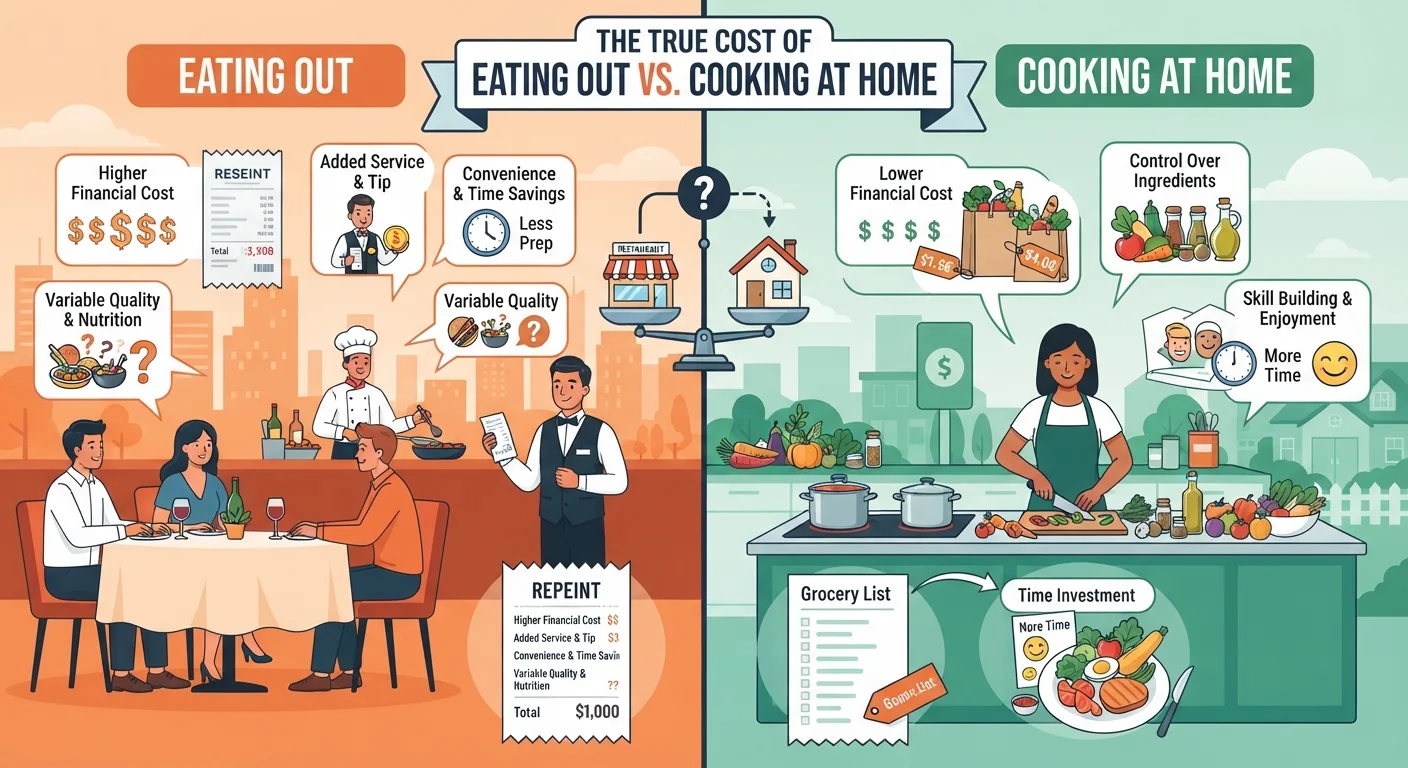
Based on USDA's own Cost of Food data, a home-cooked meal generally costs somewhere between roughly $3 and $6 per person depending on which of USDA's four food plans a household follows, while a 2026 study comparing restaurant menu prices against actual ingredient costs, using Bureau of Labor Statistics pricing data, found that dishes like lasagna and hamburgers cost several times more at a restaurant than the raw ingredients required to make them at home.
This guide is independently written and is not affiliated with USDA, OPM, or the official federal Feds Feed Families campaign.
What the More Rigorous Data Actually Shows
A study conducted by point-of-sale software company BLogic Systems and reported by Forbes in 2026 compared restaurant menu prices against the actual cost of ingredients needed to prepare the same dish at home, using primarily Bureau of Labor Statistics average price data for ingredient costs. The study found a hamburger cost several times more at a restaurant than the ingredients to make one at home, and lasagna showed an even larger gap between the restaurant price and the raw ingredient cost, illustrating that the markup on a restaurant meal reflects far more than just the cost of the food itself, it also covers labor, rent, and overhead.
USDA's Own Cost of Food Figures
- What the More Rigorous Data Actually Shows
- USDA's Own Cost of Food Figures
- Why Restaurant Cost Comparisons Vary So Widely Online
- What Restaurant Menu Prices Don't Show You
- Where Eating Out Genuinely Makes Sense
- How Cooking at Home Compounds Over Time
- How This Connects to a SNAP Budget
- FAQ
- How much cheaper is cooking at home than eating out, based on credible data?
- Why do online estimates of eating out versus cooking at home vary so much?
- Does the menu price at a restaurant reflect the full cost of eating there?
- Is it ever reasonable to eat out even on a tight budget?
USDA's Cost of Food data, which also forms the basis for calculating SNAP benefit amounts, estimates a home-cooked meal costs roughly $2.74 to $6.29 per person depending on which of the agency's four food plans, Thrifty, Low-Cost, Moderate, and Liberal, a household's spending most closely resembles. This range reflects genuinely home-cooked meals using groceries purchased and prepared at home, not a marketing estimate, and it's worth remembering that the Thrifty Food Plan specifically, the lowest of the four, forms the direct basis for SNAP's maximum benefit calculations.
Why Restaurant Cost Comparisons Vary So Widely Online
Searching this topic online turns up a wide range of claimed figures, from modest per-meal savings estimates to sweeping annual savings claims running into the tens of thousands of dollars, many from personal finance content sites without a clearly documented methodology behind the specific numbers. The more grounded comparisons, USDA's own food cost data and the BLS-sourced ingredient study, consistently point in the same direction, home cooking costs meaningfully less, but the exact multiplier varies significantly by dish, restaurant type, and region, so a specific claimed dollar figure should be treated as illustrative rather than a precise number for every household.
What Restaurant Menu Prices Don't Show You
The price on a restaurant menu isn't the full cost of the meal in most cases, since sales tax, tip, and any delivery or service fees for takeout or delivery orders add a meaningful amount on top of the listed price. A home-cooked meal's cost, by contrast, is close to the actual grocery total, with no additional service charge layered on top, which is part of why the gap between the two options tends to be even larger in practice than a simple menu-price comparison alone would suggest.
Recommended Articles
 BUDGETING MEAL PLANNING
 BUDGETING MEAL PLANNING
 BUDGETING MEAL PLANNING
 BUDGETING MEAL PLANNING
Where Eating Out Genuinely Makes Sense
The financial case for cooking at home doesn't mean eating out never makes sense. Time genuinely has value, and for someone working long hours or managing a demanding schedule, an occasional restaurant meal can be a reasonable trade-off rather than a budgeting failure. The most sustainable approach for most households combines routine home cooking with occasional, deliberate dining out, rather than treating either option as an absolute rule.
How Cooking at Home Compounds Over Time
Because the price gap between a home-cooked meal and a restaurant meal applies to every single meal, not just an occasional special dinner, small shifts, such as replacing one weekly takeout order with a home-cooked meal, tend to add up more meaningfully over a year than they might initially seem, even without needing to eliminate dining out entirely.
How This Connects to a SNAP Budget
For a household using SNAP, this cost gap is especially relevant, since SNAP benefits can only be used for groceries meant to be prepared at home, not for restaurant meals, with the narrow exception of the Restaurant Meals Program available to certain elderly, disabled, or homeless recipients in a small number of states. Understanding that home cooking genuinely is the lower-cost option, backed by credible data rather than marketing claims, can help reinforce that a SNAP-based grocery budget is a realistic way to feed a household, not an unreasonably tight constraint compared to eating out.
Read More Articals
FAQ
How much cheaper is cooking at home than eating out, based on credible data?
A 2026 study using Bureau of Labor Statistics ingredient pricing found some restaurant dishes, like lasagna and hamburgers, cost several times more than the ingredients to make them at home, and USDA's own food plan data puts a home-cooked meal at roughly $3 to $6 per person.
Why do online estimates of eating out versus cooking at home vary so much?
Many widely circulated figures come from personal finance content sites without a clearly documented methodology, so the specific dollar amounts should be treated as illustrative rather than precise for every household.
Does the menu price at a restaurant reflect the full cost of eating there?
No. Sales tax, tip, and any delivery or service fees add to the listed menu price, meaning the actual gap between eating out and cooking at home is often larger than a simple price comparison suggests.
Is it ever reasonable to eat out even on a tight budget?
Yes, occasionally. Time has real value, and an occasional restaurant meal can be a reasonable trade-off rather than a budgeting failure, particularly for someone managing a demanding schedule.
Sources: Forbes reporting on a BLogic Systems ingredient-cost study using Bureau of Labor Statistics data, Preplo analysis of USDA Cost of Food reports.