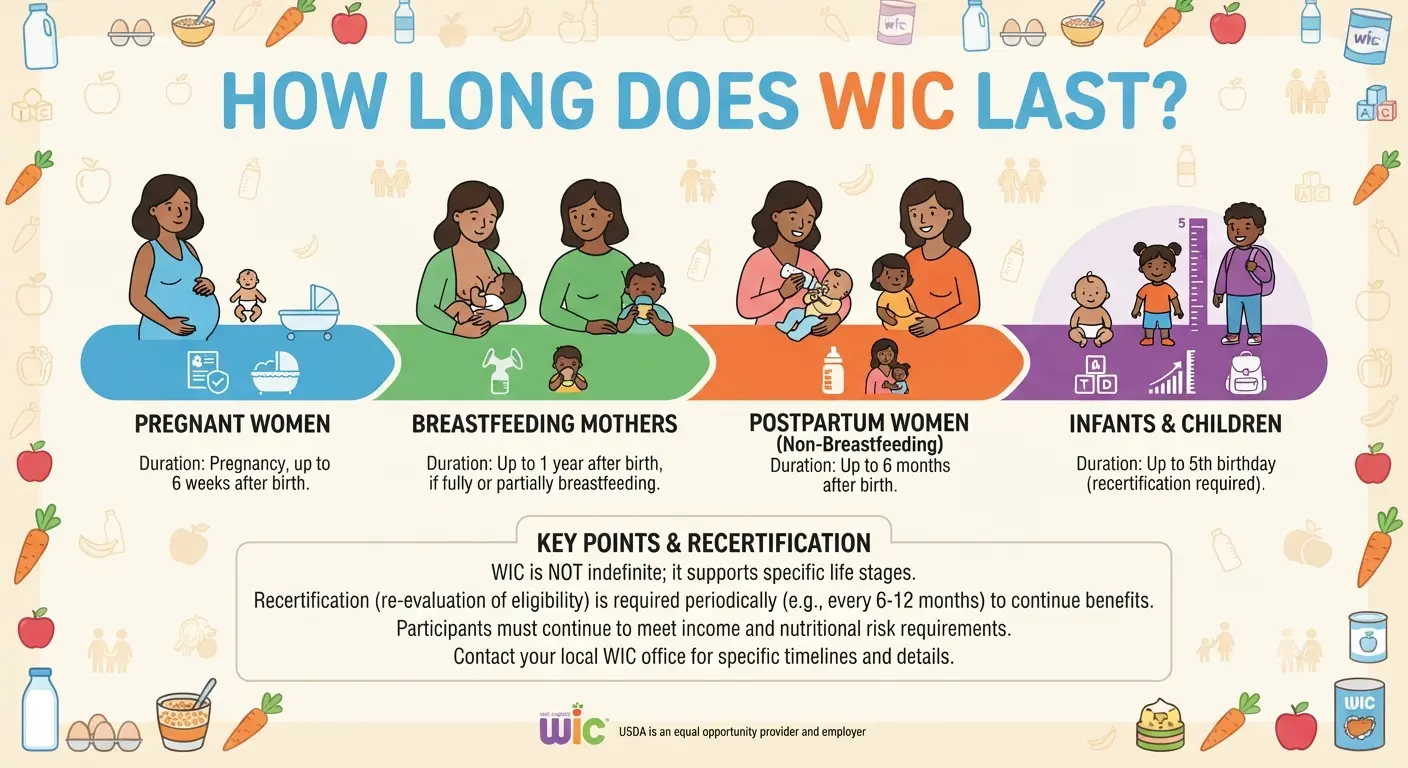
WIC eligibility windows vary significantly by participant category. Pregnant women are certified through the end of pregnancy plus six months postpartum, or up to a full year if breastfeeding, infants are certified until their first birthday, and children are certified annually from age 1 up to their fifth birthday, at which point WIC eligibility ends entirely regardless of household income.
This guide is independently written and is not affiliated with USDA, OPM, or the official federal Feds Feed Families campaign.
Certification Periods by Category
Each WIC participant category has its own certification length, set by federal regulation but implemented slightly differently by each state:
- Pregnant women are certified for the duration of the pregnancy plus a postpartum period afterward
- Postpartum, non-breastfeeding women remain eligible for up to six months after the pregnancy ends
- Breastfeeding women remain eligible for up to a full year after the birth
- Infants are certified from birth up to their first birthday, typically with a mid-certification check around six months
- Children are certified annually starting at age 1, continuing each year until they reach age 5
What Happens When a Child Turns 5
- Certification Periods by Category
- What Happens When a Child Turns 5
- The Infant to Child Transition at Age 1
- Recertification and Nutrition Education Visits
- What If You Miss Your Recertification Appointment
- Moving Between States
- FAQ
- How old can a child be and still qualify for WIC?
- How often do I need to recertify for WIC?
- What happens if I miss my WIC recertification appointment?
- Can I transfer my WIC benefits to a new state if I move?
A child's WIC certification ends on the last day of the month in which they turn 5, and there is no extension or exception based on income. Once a child ages out of WIC, the household can still be eligible for other food assistance programs, including SNAP, free or reduced-price school meals once the child starts school, and Summer EBT during school breaks, which is why many families transition smoothly from WIC into these other programs rather than experiencing a gap in support.
The Infant to Child Transition at Age 1
Turning 1 is a notable transition point within WIC itself, since it triggers both a recertification and a change in food package, moving a child from the infant formula and infant cereal package into the child food package built around whole milk, eggs, whole grains, and produce. This recertification cannot be completed before the child's first birthday, and local WIC agencies typically schedule it within two weeks of that milestone to avoid a gap in benefits.
Recertification and Nutrition Education Visits
Beyond the formal certification periods above, most WIC categories also require regular nutrition education appointments, often scheduled every two to three months, which participants must attend to continue receiving benefits without interruption. These shorter visits are separate from full recertification and typically involve a brief check-in and nutrition education session rather than a full eligibility review.
Recommended Articles
 WIC FAMILY NUTRITION
 WIC FAMILY NUTRITION
 WIC FAMILY NUTRITION
 WIC FAMILY NUTRITION
What If You Miss Your Recertification Appointment
Missing a scheduled recertification appointment does not automatically end your benefits immediately in most states. Many WIC agencies allow a grace period, commonly around 30 days before or after the certification period's expiration date, during which the appointment can still be completed without a lapse in benefits. However, this grace period is generally not meant to be used routinely, so it is best to reschedule as soon as possible if you miss your original appointment date, since food benefits can be interrupted if the grace period passes without a completed recertification.
Moving Between States
WIC certification does not automatically transfer when a family moves to a different state, but most states will honor an existing certification record from another state and can often complete a streamlined transfer rather than requiring a full recertification appointment from scratch. It is generally a good idea to request a Verification of Certification form from your current WIC clinic before moving, and to use any remaining benefit balance before your move, since your card will not work once you have left the issuing state.
Read More Articals
FAQ
How old can a child be and still qualify for WIC?
Children remain eligible for WIC until the last day of the month in which they turn 5. There is no extension past that age regardless of household income.
How often do I need to recertify for WIC?
This depends on your category. Infants are certified until their first birthday, children recertify annually from age 1 to 5, and pregnant or breastfeeding women have their own certification windows tied to pregnancy and postpartum timelines.
What happens if I miss my WIC recertification appointment?
Most states allow a grace period, often around 30 days, to complete a late recertification without losing benefits, though this should not be relied on routinely, and rescheduling promptly is the safest approach.
Can I transfer my WIC benefits to a new state if I move?
Your card itself will not work in a new state, but your certification record can often be used to streamline a new application. Requesting a Verification of Certification form from your current clinic before moving helps speed up the process.
Sources: USDA Food and Nutrition Administration WIC certification periods guidance, state WIC certification policy manuals including Kentucky, Massachusetts, and Louisiana WIC programs.