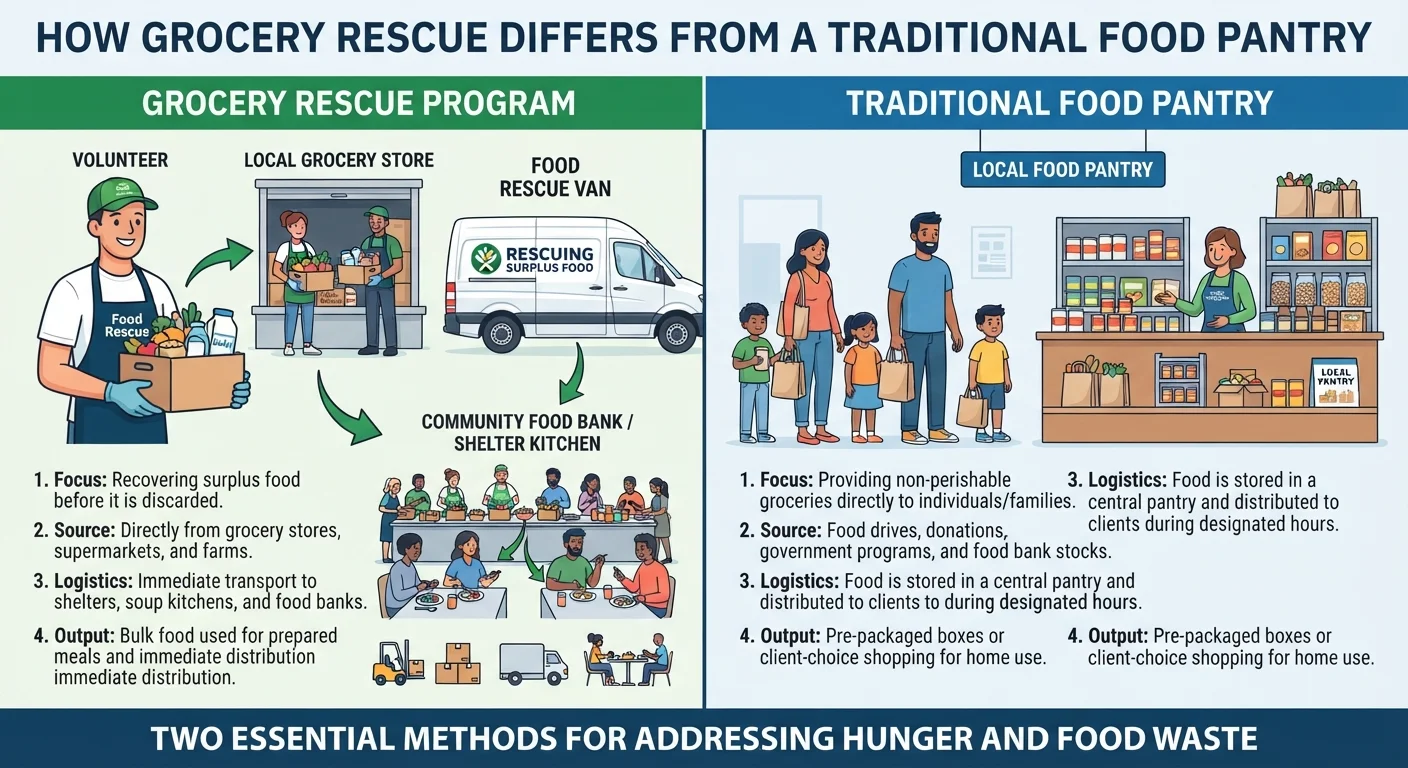
Rather than the traditional model where a food bank charges partner pantries for specific requested items, a grocery rescue approach builds direct partnerships with grocery stores, restaurants, cafes, wholesalers, dairies, and farms to collect surplus food at no cost to either the donor or the pantry, and this shift in sourcing is a major reason a growing number of food pantries nationwide are moving away from the pre-packed bag toward a genuine grocery-store-style shopping experience.
This guide is independently written and is not affiliated with USDA, OPM, or the official federal Feds Feed Families campaign.
The Traditional Model, and Why It's Being Rethought
A traditional food pantry commonly operates on a fixed schedule, distributing a pre-packed bag or box of groceries determined by staff rather than the recipient, in a model built around scarcity and standardized packages. Cities including New York and Newark are actively reexamining this approach, since a fixed-site, pre-packed model is straining against a level of need it was never designed to absorb.
What Grocery Rescue Actually Sources
- The Traditional Model, and Why It's Being Rethought
- What Grocery Rescue Actually Sources
- The Client-Choice Transformation
- Why the Choice Model Matters Beyond Convenience
- Scale of the Grocery Rescue Model
- Why This Matters for Food Waste, Not Just Food Access
- What This Means If You're Looking for Food Assistance
- FAQ
- What is grocery rescue?
- Why are some food pantries switching to a client-choice, grocery-store-style model?
- Does grocery rescue provide different types of food than a traditional pantry?
- How widespread is the grocery rescue model?
Grocery rescue partnerships collect food that's approaching its sell-by date, is ripe and ready to eat immediately, or requires refrigeration to stay fresh, categories that a traditional hub-and-spoke distribution model built around shelf-stable donations doesn't handle well. This means grocery rescue specifically brings fresh produce, dairy, and prepared foods into a pantry's offerings in a way that a canned-goods-focused donation model typically can't.
The Client-Choice Transformation
A concrete real-world example: a longtime Newark food pantry that previously required residents to wait in long lines for a take-it-or-leave-it bag of groceries has been transformed into what organizers now call The Market, with brightly lit aisles of fresh produce, frozen foods, and staples that people select themselves, free of charge. Organizers describe this model as treating people with meaningfully more respect and better meeting their actual dietary needs than the older grab-bag system.
Why the Choice Model Matters Beyond Convenience
A client-choice pantry, structured to feel like a genuine grocery store, lets a family select items that actually fit their household's specific needs, whether that's a dietary restriction, a cultural food preference, or simply what they know they'll use before it spoils, rather than receiving a standardized package that may include items that don't fit their situation at all.
Recommended Articles
 FOOD BANKS PANTRIES
 FOOD BANKS PANTRIES
 FOOD BANKS PANTRIES
 FOOD BANKS PANTRIES
Scale of the Grocery Rescue Model
Food Rescue Hero's volunteer-driven technology platform alone has facilitated more than one million individual food rescue trips across 25 partner organizations in North America, mobilizing tens of thousands of community volunteers to move surplus food from businesses directly to distribution partners, illustrating how significantly this sourcing model has scaled beyond a single city's pilot program.
Why This Matters for Food Waste, Not Just Food Access
An estimated 30 to 40 percent of all food produced in the United States never reaches someone's table, and grocery rescue specifically targets this gap, connecting surplus that would otherwise become waste directly to people facing food insecurity, addressing both problems through the same logistics chain rather than treating them as separate issues.
What This Means If You're Looking for Food Assistance
If your local food pantry has recently shifted to a client-choice or grocery-rescue-supplied model, you can generally expect a different experience than a standard pre-packed distribution, potentially including fresh produce and dairy you might not have found at a more traditional pantry, along with the ability to select items yourself rather than receiving a fixed bag. Asking your local pantry directly about their current model and what's typically available is worth doing, since this landscape is shifting relatively quickly across many communities.
Read More Articals
FAQ
What is grocery rescue?
A food sourcing model where food banks and pantries partner directly with grocery stores, restaurants, and other businesses to collect surplus food at no cost, rather than the traditional model of charging pantry partners for specific requested items.
Why are some food pantries switching to a client-choice, grocery-store-style model?
This approach lets people select food that fits their specific dietary needs and preferences, and organizers describe it as treating recipients with more dignity than a fixed, pre-packed bag system.
Does grocery rescue provide different types of food than a traditional pantry?
Yes, generally more fresh produce, dairy, and prepared foods, since these are the categories that don't move well through a traditional shelf-stable donation model but are exactly what grocery rescue partnerships specialize in sourcing.
How widespread is the grocery rescue model?
Significantly scaled in many regions. Food Rescue Hero's platform alone has facilitated over one million food rescue trips across 25 partner organizations in North America.
Sources: Forgotten Harvest newsletter, Gothamist reporting on Newark's Market at UCC, NYC Food Policy Center at Hunter College, Food Rescue Hero.