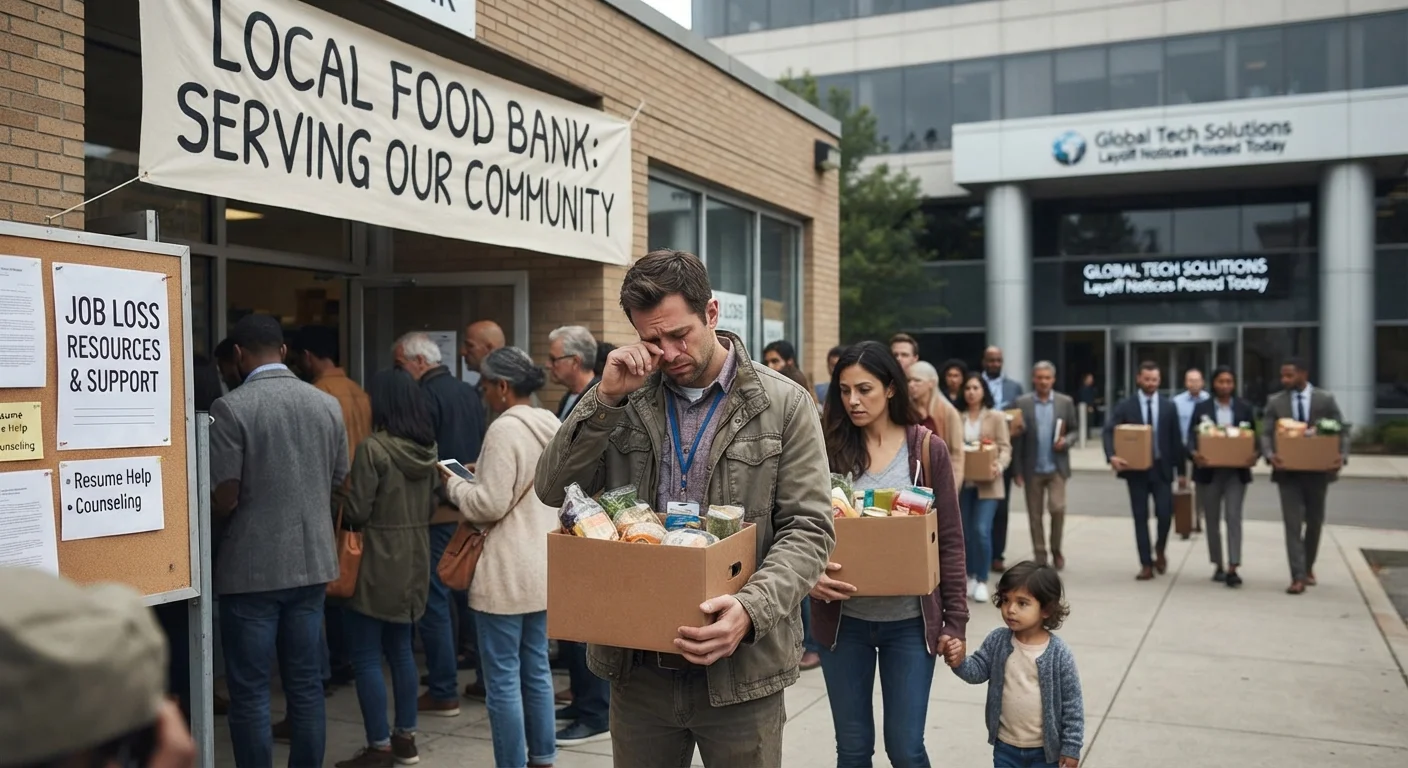
When a major employer announces layoffs, the effect on a community's food bank rarely shows up immediately or in a headline, it shows up gradually in rising call volume and website traffic from people newly seeking help, a pattern food banks across the country have documented repeatedly through 2025 and into 2026 as layoffs, persistent grocery inflation, and reduced federal support have combined to push demand toward levels last seen during the pandemic.
This guide is independently written and is not affiliated with USDA, OPM, or the official federal Feds Feed Families campaign.
A Real, Current Example: Atlanta's Emergency Response
The Atlanta Community Food Bank took the notable step of moving $5 million from its own financial reserves specifically to increase food assistance capacity in anticipation of rising demand tied to layoffs, ongoing inflation, and disruption from a recent government shutdown. Its president and CEO described already seeing a significant increase in the number of people calling and visiting the organization's website seeking help before the anticipated wave of need had even fully arrived.
Why Food Banks Try to Anticipate Demand Rather Than Just React
- A Real, Current Example: Atlanta's Emergency Response
- Why Food Banks Try to Anticipate Demand Rather Than Just React
- The Economic Multiplier Effect Behind a Single Layoff
- Mass Layoffs Hit Smaller Communities Disproportionately Hard
- Why Many Food Bank Clients Already Have Jobs
- The Combined Effect of Multiple Pressures at Once
- What This Means If a Local Employer Announces Layoffs
- Where to Turn If a Layoff Affects Your Household
- FAQ
- Do food banks actually prepare for layoffs before people start showing up for help?
- Does a single company's layoff really affect the broader local economy?
- Are food bank clients mostly unemployed?
- Do smaller communities recover from mass layoffs differently than larger cities?
Feeding America West Michigan's own 2026 forecast specifically anticipated that tighter SNAP eligibility rules taking effect that year would push the share of its 40-county service area needing help from roughly 1 in 7 people to 1 in 6, illustrating how food banks increasingly try to model and prepare for a coming demand increase rather than simply waiting to respond once people start showing up.
The Economic Multiplier Effect Behind a Single Layoff
Research on local employment spillovers has found that job losses ripple outward through a community's broader economy, not just affecting the specific people laid off. Established economic research shows that each high-skilled job supports several additional positions in a local area's nontradable service sector, restaurants, cleaning services, and similar businesses, meaning the reverse is also true: a significant layoff can generate broader negative spillovers well beyond the immediate workers affected.
Mass Layoffs Hit Smaller Communities Disproportionately Hard
Federal Reserve Bank of Kansas City research examining a real 2025-2026 meatpacking plant closure in Nebraska, which affected more than 3,200 workers in a single county, found that after sizeable layoffs in comparable communities, the local labor force shrank, employment declined further beyond the direct job losses, and out-migration increased, illustrating that smaller communities face disproportionately larger and longer-lasting consequences from a single major layoff event than a larger, more economically diverse metro area typically would.
Recommended Articles
 FOOD BANKS PANTRIES
 FOOD BANKS PANTRIES
 FOOD BANKS PANTRIES
 FOOD BANKS PANTRIES
Why Many Food Bank Clients Already Have Jobs
It's worth understanding that food bank demand isn't driven only by unemployment. Feeding America West Michigan has specifically noted that a majority of people who turn to food banks are working, often full-time, but still don't earn enough to cover basic living expenses or absorb an unplanned financial disruption, a population sometimes referred to using the acronym ALICE, for Asset Limited, Income Constrained, Employed.
The Combined Effect of Multiple Pressures at Once
What's made 2025 and 2026 particularly difficult for food banks specifically is the overlap of several pressures simultaneously: layoffs across sectors beyond just the traditionally cited tech industry, including logistics, retail, and consumer brands, persistent grocery price inflation, and reduced federal SNAP eligibility all landing around the same period, rather than any single factor acting in isolation.
What This Means If a Local Employer Announces Layoffs
If a major employer in your area announces layoffs, whether or not you're directly affected, it's worth understanding that local food banks may see increased demand in the following weeks and months as the effect ripples outward through the broader local economy, and organizations like those described here have shown a real willingness to move funds and expand capacity proactively in anticipation of exactly this kind of local disruption.
Where to Turn If a Layoff Affects Your Household
If you or someone in your household has been laid off, applying for unemployment benefits and checking your household's current SNAP eligibility, since income changes can newly qualify a household that didn't previously meet the threshold, alongside reaching out to a local food bank directly, are all reasonable, immediate steps rather than waiting to see how the broader situation develops.
Read More Articals
FAQ
Do food banks actually prepare for layoffs before people start showing up for help?
Yes, in documented cases. Feeding America West Michigan specifically forecast rising demand tied to SNAP eligibility changes, and the Atlanta Community Food Bank moved $5 million from reserves in anticipation of a demand increase.
Does a single company's layoff really affect the broader local economy?
Yes, according to established economic research on employment spillovers, since job losses ripple outward and affect local service-sector jobs beyond the specific workers directly laid off.
Are food bank clients mostly unemployed?
No, often not. Many food bank clients are working, sometimes full-time, but still don't earn enough to cover basic expenses, a population researchers sometimes describe using the acronym ALICE.
Do smaller communities recover from mass layoffs differently than larger cities?
Yes. Federal Reserve Bank of Kansas City research found smaller communities face disproportionately larger and longer-lasting negative effects, including labor force shrinkage and increased out-migration, than larger, more economically diverse areas.
Sources: Feeding America West Michigan, Yahoo News reporting on the Atlanta Community Food Bank, Federal Reserve Bank of Kansas City Economic Bulletin, Federal Reserve Bank of Richmond Economic Brief.