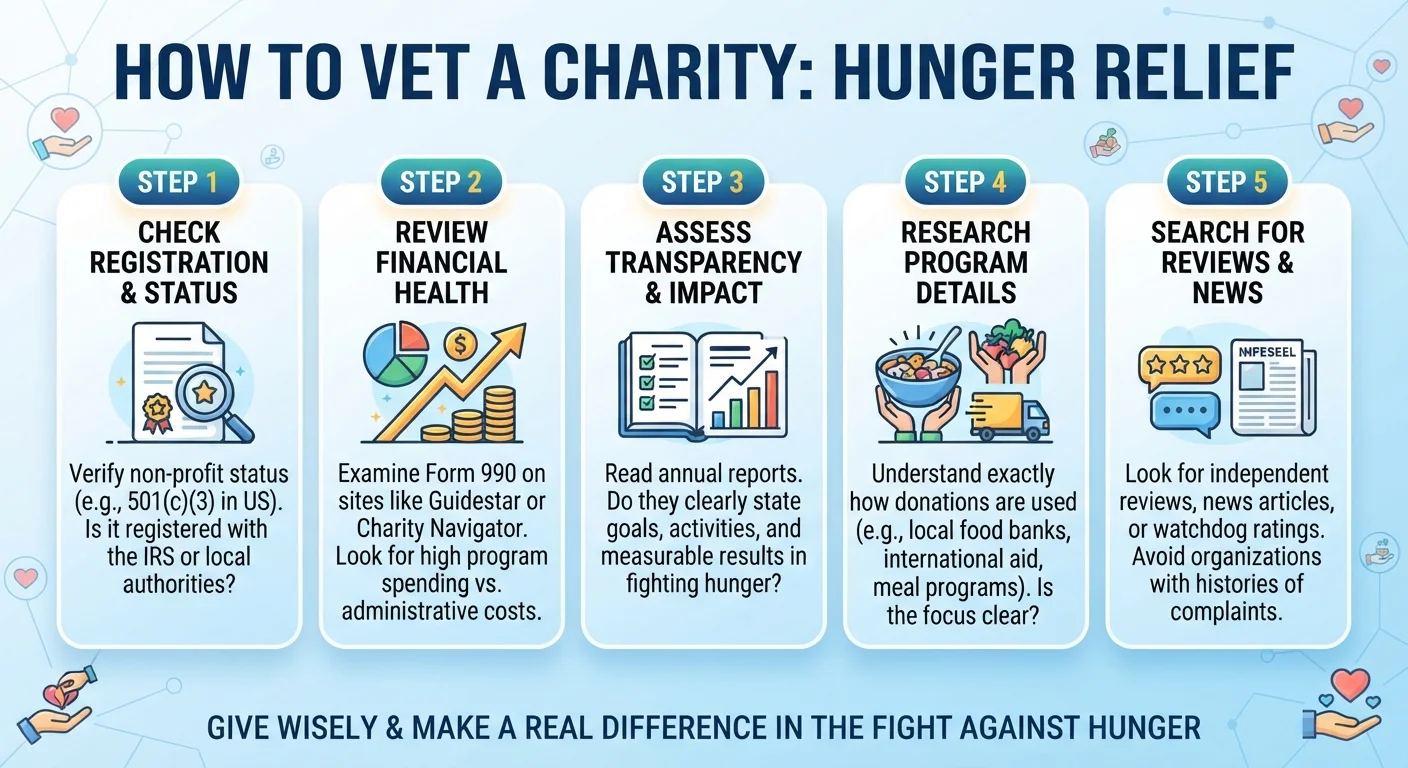
Before donating to any hunger relief organization, whether a large national network or a small local pantry, a handful of concrete checks genuinely take only a few minutes and can meaningfully affect where your donation actually ends up: confirming the organization's tax-exempt status, looking at how it actually spends its money, and checking whether an independent charity evaluator has reviewed it.
This guide is independently written and is not affiliated with USDA, OPM, or the official federal Feds Feed Families campaign.
Confirm It's a Legitimate Registered Nonprofit
The most basic check is confirming an organization is actually a registered 501(c)(3) nonprofit, which you can verify through the IRS's own online Tax Exempt Organization Search tool using the charity's name or Employer Identification Number. This matters both to ensure your donation is genuinely tax-deductible if you itemize, and as a basic signal that the organization has met the formal legal requirements to operate as a charity.
Look at How the Organization Spends Its Money
- Confirm It's a Legitimate Registered Nonprofit
- Look at How the Organization Spends Its Money
- Check Independent Charity Evaluators
- Understand That a High Overhead Ratio Isn't Automatically a Red Flag
- Ask Specifically How a Food Donation, Not Just a Cash Donation, Is Used
- Be Skeptical of High-Pressure Solicitation Tactics
- Check for a Recent, Specific Track Record
- Local, Smaller Organizations Deserve the Same Scrutiny, Just Different Tools
- Donating Doesn't Have to Be an All-or-Nothing Decision
- FAQ
- How do I check if a hunger relief charity is legitimate?
- What is a charity's Form 990 and why does it matter?
- Should I avoid a charity with a high administrative overhead percentage?
- What independent organizations can help evaluate a charity?
A charity's IRS Form 990, a required annual filing for most nonprofits, is publicly available and breaks down how much of its total spending goes toward actual program services, hunger relief and food distribution in this case, versus administrative overhead and fundraising costs. This document is generally accessible through the organization's own website or through a charity evaluator's database, and reviewing it gives a far more concrete picture than a charity's own marketing materials alone.
Check Independent Charity Evaluators
Organizations like Charity Navigator, GuideStar, and the Better Business Bureau's Wise Giving Alliance independently review nonprofits and publish ratings or reports covering financial health, accountability, and transparency, giving donors a third-party check beyond what an organization says about itself. Not every small, local hunger relief organization will have been reviewed by these evaluators, but checking is worth doing for any larger or national organization you're considering.
Understand That a High Overhead Ratio Isn't Automatically a Red Flag
It's worth being cautious about judging a charity purely on a single administrative overhead percentage, since a legitimate organization investing in infrastructure, cold storage, transportation, or technology to move food more efficiently may show a temporarily higher administrative cost that ultimately increases its long-term impact, rather than reflecting mismanagement. Looking at trends over several years, and reading the actual narrative explanation many organizations provide alongside their financial disclosures, gives more useful context than a single ratio in isolation.
Recommended Articles
 FOOD BANKS PANTRIES
 FOOD BANKS PANTRIES
 FOOD BANKS PANTRIES
 FOOD BANKS PANTRIES
Ask Specifically How a Food Donation, Not Just a Cash Donation, Is Used
If you're planning to donate food rather than cash, it's worth asking a specific hunger relief organization directly how donated food is actually distributed, whether it goes straight to individuals, through a network of partner pantries, or is sold to fund other programs, since the answer genuinely varies by organization and shapes how directly your specific donation reaches someone in need.
Be Skeptical of High-Pressure Solicitation Tactics
A legitimate hunger relief organization generally welcomes questions about how it operates and doesn't pressure a donor into giving immediately without time to consider the decision. If a solicitation, whether by phone, mail, or in person, uses urgent, high-pressure language discouraging you from doing any independent research first, that's worth treating as a caution sign rather than a reason to give more quickly.
Check for a Recent, Specific Track Record
Beyond financial ratios, looking for concrete, specific examples of an organization's recent work, a named partnership with a food rescue program, a documented response to a specific local disaster or economic disruption, or a transparent annual impact report, gives a more tangible sense of what a donation actually accomplishes than general mission statements alone.
Local, Smaller Organizations Deserve the Same Scrutiny, Just Different Tools
A small, local food pantry may not appear in a national charity evaluator's database at all, but you can still ask directly to see its most recent financial statement, ask how long it's been operating, and check whether it's listed with your state's charity regulator, since most states require charitable organizations soliciting donations to register.
Donating Doesn't Have to Be an All-or-Nothing Decision
If a specific organization's transparency or financial picture raises genuine questions you can't resolve, it's entirely reasonable to redirect your donation to a different, more thoroughly vetted hunger relief organization rather than feeling obligated to give to the first one you encountered.
Read More Articals
FAQ
How do I check if a hunger relief charity is legitimate?
Confirm its 501(c)(3) status through the IRS's Tax Exempt Organization Search tool, and check whether it's registered with your state's charity regulator if it's a smaller, local organization.
What is a charity's Form 990 and why does it matter?
A required annual public filing for most nonprofits, showing how much of the organization's spending goes toward actual programs versus administrative overhead and fundraising, giving a more concrete picture than marketing materials alone.
Should I avoid a charity with a high administrative overhead percentage?
Not automatically. A temporarily higher overhead cost tied to a genuine infrastructure investment can ultimately increase long-term impact, so looking at trends over time and the organization's own explanation gives more useful context than a single ratio.
What independent organizations can help evaluate a charity?
Charity Navigator, GuideStar, and the Better Business Bureau's Wise Giving Alliance all independently review nonprofits and publish ratings or reports on financial health and transparency.
Sources: Internal Revenue Service Tax Exempt Organization Search guidance, general nonprofit transparency and charity evaluation best practices.