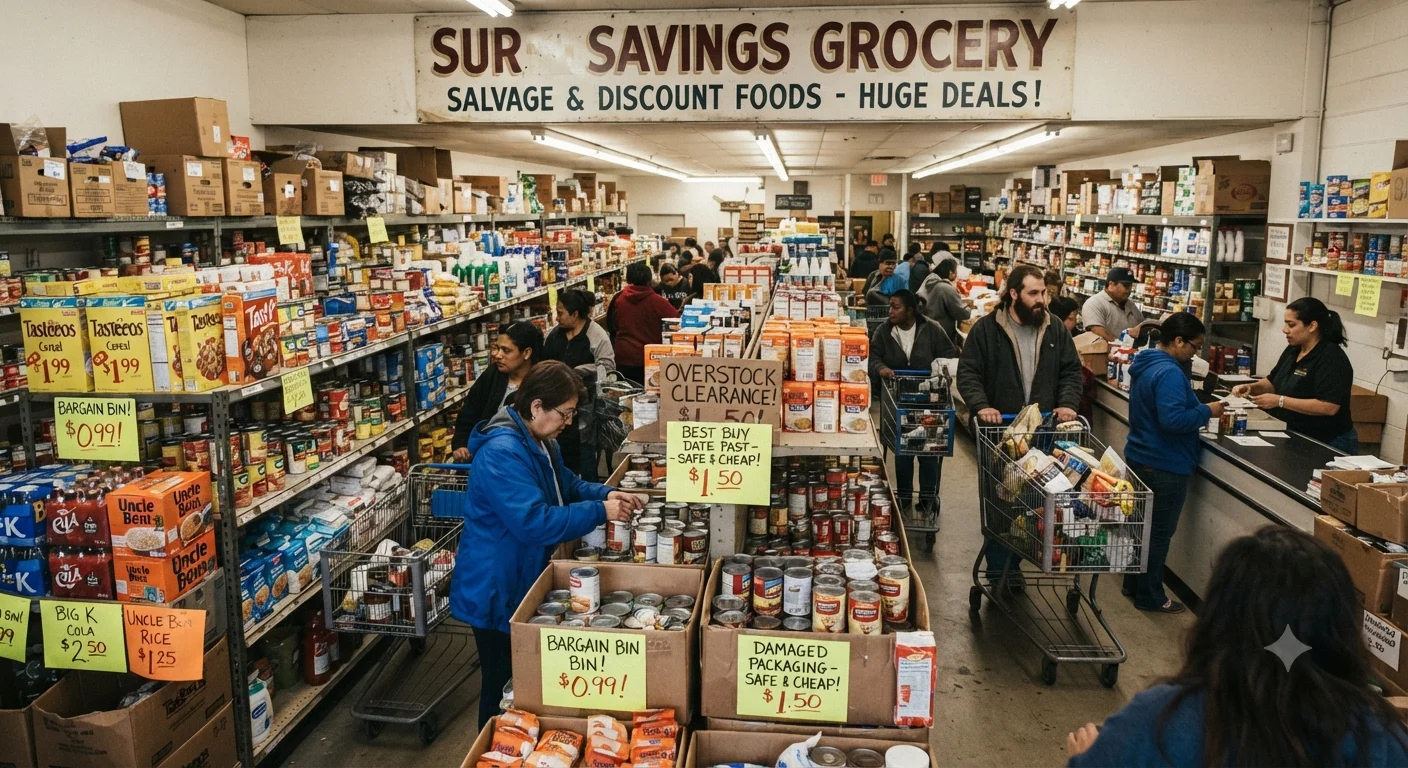
Salvage grocery stores, also called outlet or discount grocers, sell food that traditional supermarkets won't put on their own shelves, including dented cans, damaged packaging, discontinued products, and items nearing their sell-by date, typically at prices well below regular retail. Chains like Grocery Outlet and United Grocery Outlet operate hundreds of locations nationwide, alongside hundreds of smaller independent salvage stores across the country.
This guide is independently written and is not affiliated with USDA, OPM, or the official federal Feds Feed Families campaign.
What a Salvage Grocery Store Actually Sells
Salvage stores source inventory that manufacturers, distributors, or traditional retailers are eager to move but can't sell through normal channels, including closeout and discontinued products, overstocked seasonal items, products with recent packaging changes, and food nearing its printed sell-by or best-by date. Reporting from ABC News found many salvage stores actually stock relatively few dented cans compared to what people expect, with the bulk of inventory instead being close-dated or overstocked items in perfectly normal packaging.
How Much You Can Actually Save
- What a Salvage Grocery Store Actually Sells
- How Much You Can Actually Save
- Understanding "Best By" vs. "Expiration" Dates
- How to Safely Evaluate Dented Cans
- What Kinds of Products to Expect
- Does Salvage Store Inventory Rotate
- Do Salvage Stores Accept SNAP/EBT
- How to Find One Near You
- FAQ
- Is food from a salvage grocery store safe to eat?
- How much can I really save shopping at a salvage store?
- Do salvage stores accept SNAP/EBT?
- What's the difference between a "best by" date and an expiration date?
Reported savings vary by store and item, but comparisons have found meaningful gaps, including one example where a box of macaroni and cheese cost $2.49 at a salvage store versus $4.58 at a nearby regular grocery store. Individual shopper reports of finding items marked down 75 percent off the original price aren't unusual, particularly on the "scratch and dent" racks some traditional grocery stores maintain in addition to standalone salvage chains.
Understanding "Best By" vs. "Expiration" Dates
A large share of salvage store inventory is perfectly safe to eat despite carrying a passed or approaching date, because most food date labels indicate peak quality rather than safety. "Best by" and "sell by" dates are manufacturer estimates of when a product tastes its freshest, not a safety cutoff, and the vast majority of shelf-stable foods remain safe to eat for a considerable time afterward. True expiration dates, where the product genuinely shouldn't be consumed past the printed date, are legally required only on a narrow category of products, most notably infant formula.
How to Safely Evaluate Dented Cans
Not every dented can is a safety concern, but knowing the difference matters:
- Minor surface dings away from the seams are generally considered safe
- Deep dents, especially along a can's seams, can compromise the seal and potentially allow bacteria in, and these should be avoided
- Bulging, leaking, or rusted cans should never be purchased or consumed, regardless of the discount, since these are signs of a genuine safety risk
- Crumpled outer boxes around a sealed inner bag, such as a cereal box, are generally not a safety concern, since the actual food inside remains protected
What Kinds of Products to Expect
Salvage stores commonly carry canned goods, dry goods, snacks, beverages, and household basics, and many also stock frozen foods, dairy, imperfect produce, and even specialty or higher-end items that ended up in the surplus channel for reasons unrelated to quality. Inventory can vary significantly week to week, since it depends entirely on what surplus becomes available, which is part of why regular visits tend to turn up better selection than a single one-time trip.
Recommended Articles
 BUDGETING MEAL PLANNING
 BUDGETING MEAL PLANNING
 BUDGETING MEAL PLANNING
 BUDGETING MEAL PLANNING
Does Salvage Store Inventory Rotate
Because inventory depends on unpredictable surplus availability, shopping consistency matters. Visiting mid-week, when new shipments have often just arrived and shelves are freshly stocked, tends to offer better selection than weekends, when popular items are frequently already picked over by the time a shopper arrives.
Do Salvage Stores Accept SNAP/EBT
Many salvage grocery stores do accept SNAP/EBT for eligible food items, though this varies by individual store rather than being guaranteed chain-wide, so it's worth calling ahead or checking a specific location's policy before planning a trip around using SNAP benefits there.
How to Find One Near You
Searching "salvage grocery store" or "outlet grocery" along with your city or region is the most direct way to find a location, since most salvage stores are independently owned and don't appear in standard grocery store searches. Larger regional chains like Grocery Outlet and United Grocery Outlet maintain store locators on their own websites as well.
Read More Articals
FAQ
Is food from a salvage grocery store safe to eat?
Generally yes. Most items are safe despite a passed "best by" date, since that date reflects peak quality rather than safety. Avoid cans with deep dents on the seams, bulging, leaking, or rust, regardless of price.
How much can I really save shopping at a salvage store?
Reported savings vary, but comparisons have found discounts of 40 to 70 percent below regular retail on some items, with individual finds sometimes marked down as much as 75 percent.
Do salvage stores accept SNAP/EBT?
Many do, but this varies by individual store, so it's worth calling ahead or checking with a specific location before your trip.
What's the difference between a "best by" date and an expiration date?
"Best by" indicates peak quality, not safety, and most foods remain safe well past this date. True legally required expiration dates apply only to a narrow category of products, most notably infant formula.
Sources: AARP, ABC News and Good Morning America consumer reporting, Taste of Home.