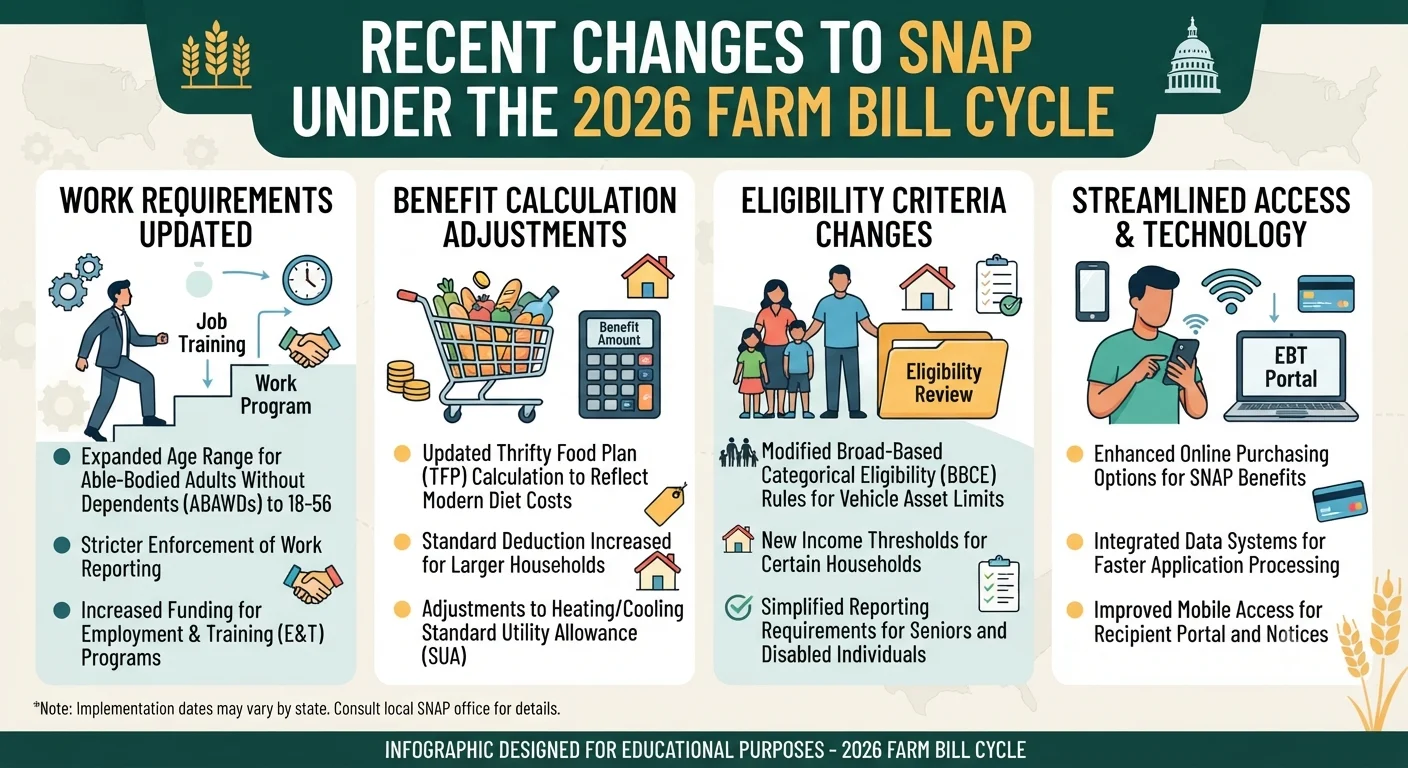
Most of the significant SNAP changes affecting households in 2026 originated not from a traditional farm bill, but from the One Big Beautiful Bill Act, signed into law on July 4, 2025, which expanded work requirements, tightened certain eligibility exemptions, and began shifting a greater share of SNAP costs onto individual states. Separately, Congress has been negotiating a new farm bill throughout 2026, though as of mid-2026 that legislation had not been finalized and neither the House nor Senate draft versions have proposed reversing the SNAP changes already made under the earlier law.
This guide is independently written and is not affiliated with USDA, OPM, or the official federal Feds Feed Families campaign. This topic involves active political debate, and this article aims to present the facts and different perspectives fairly rather than advocate for a particular position.
Understanding the Difference Between OBBBA and the Farm Bill
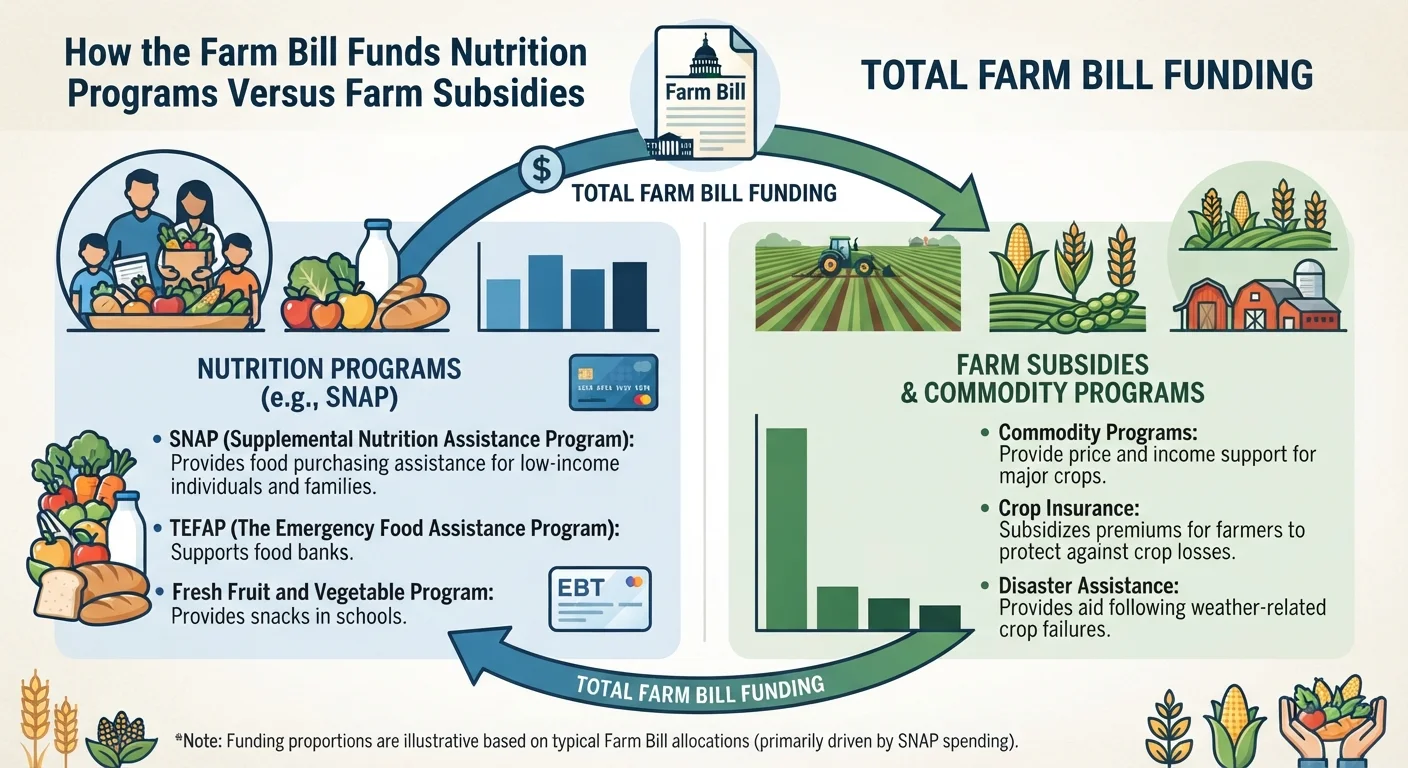
It's worth separating two distinct pieces of legislation that are often discussed together. The One Big Beautiful Bill Act, a broad tax and spending reconciliation bill, was signed into law in July 2025 and included major SNAP provisions on its own, independent of the traditional farm bill process. The farm bill, historically a comprehensive five-year agricultural and nutrition policy package last fully reauthorized in 2018, has not been passed as a complete package since then, and as of mid-2026 remains under negotiation as the Agricultural Act of 2026, with House and Senate versions still being reconciled.
Key SNAP Changes From the One Big Beautiful Bill Act
- Understanding the Difference Between OBBBA and the Farm Bill
- Key SNAP Changes From the One Big Beautiful Bill Act
- How State Cost-Sharing Works
- The Ongoing Farm Bill Debate
- What Households Should Actually Watch For
- FAQ
- Did the 2026 farm bill cut SNAP benefits?
- What is SNAP state cost-sharing?
- Did work requirements change under the One Big Beautiful Bill Act?
- Is the farm bill finalized as of mid-2026?
The law made several changes to SNAP that took effect through late 2025 and into 2026, including:
- Expanding the ABAWD work requirement age range from 18 to 54, up to 18 to 64
- Narrowing the caregiver exemption from covering any child under 18 to only children under 14
- Removing automatic work requirement exemptions that had previously applied to veterans, people experiencing homelessness, and former foster youth
- A re-evaluation provision affecting how the Thrifty Food Plan is calculated going forward
- New state cost-sharing requirements, phasing in a requirement that states with higher SNAP payment error rates cover a percentage of benefit costs previously funded entirely by the federal government
How State Cost-Sharing Works
Beginning in fiscal year 2027, states with a SNAP payment error rate, a measure of how often benefit amounts are calculated incorrectly, above certain thresholds will be required to cover a percentage of their state's total SNAP benefit costs, ranging up to 15 percent depending on how high the error rate is. Alabama, for example, was found to have a fiscal year 2025 error rate of 9.52 percent, meaning that if the rate remains similar, the state would owe roughly 10 percent of its total SNAP benefit costs starting in fiscal year 2027, an amount some state officials have said would be difficult to absorb within existing state budgets.
Recommended Articles
 NEWS POLICY UPDATES
 NEWS POLICY UPDATES
 NEWS POLICY UPDATES
 NEWS POLICY UPDATES
The Ongoing Farm Bill Debate
The House passed its version of the 2026 farm bill, formally titled the Farm, Food, and National Security Act, in April 2026 by a 224-200 vote. The Senate Agriculture Committee released its own draft, the Agricultural Act of 2026, in June 2026. Neither version reverses the SNAP-related changes made under the One Big Beautiful Bill Act. A group of Democratic state attorneys general sent a letter to the Senate specifically urging restoration of the earlier SNAP eligibility and funding protections, while supporters of the current approach have argued that state cost-sharing improves program accountability and that the overall legislation is not, in their framing, a direct cut to individual SNAP benefit amounts. As of mid-2026, the farm bill had not been finalized, and its ultimate provisions, along with whether any SNAP-related changes are included, remained subject to ongoing negotiation.
What Households Should Actually Watch For
Because these changes are complex and continue to be implemented in phases through 2026 and 2027, individual SNAP households are most directly affected by two things in the near term: whether they're newly subject to expanded work requirements under the age and exemption changes, and how their state responds to new cost-sharing obligations, which could influence state-level administrative decisions, though it does not directly reduce an individual household's monthly benefit calculation. Checking directly with your state SNAP agency for how these federal changes are being implemented locally is the most reliable way to understand your specific situation.
Read More Articals
FAQ
Did the 2026 farm bill cut SNAP benefits?
The most significant recent SNAP changes came from the One Big Beautiful Bill Act, signed in July 2025, not the farm bill itself. As of mid-2026, farm bill drafts in both the House and Senate have kept those earlier changes in place rather than reversing them, though the farm bill had not yet been finalized.
What is SNAP state cost-sharing?
A provision requiring states with SNAP payment error rates above certain thresholds to cover a percentage, up to 15 percent, of their state's total SNAP benefit costs starting in fiscal year 2027, a cost previously covered entirely by the federal government.
Did work requirements change under the One Big Beautiful Bill Act?
Yes. The law expanded the ABAWD work requirement age range from 18 through 54 up to 18 through 64, and narrowed several exemptions, including the caregiver exemption and automatic exemptions previously covering veterans and people experiencing homelessness.
Is the farm bill finalized as of mid-2026?
No. As of mid-2026, the House had passed its version in April, and the Senate Agriculture Committee released a draft in June, but the two chambers had not reconciled a final version, and negotiations were ongoing.
Sources: USDA Food and Nutrition Administration, Farm Aid farm bill tracking, National Sustainable Agriculture Coalition, Alabama Reflector state cost-sharing reporting, CSG South farm bill reauthorization summary.