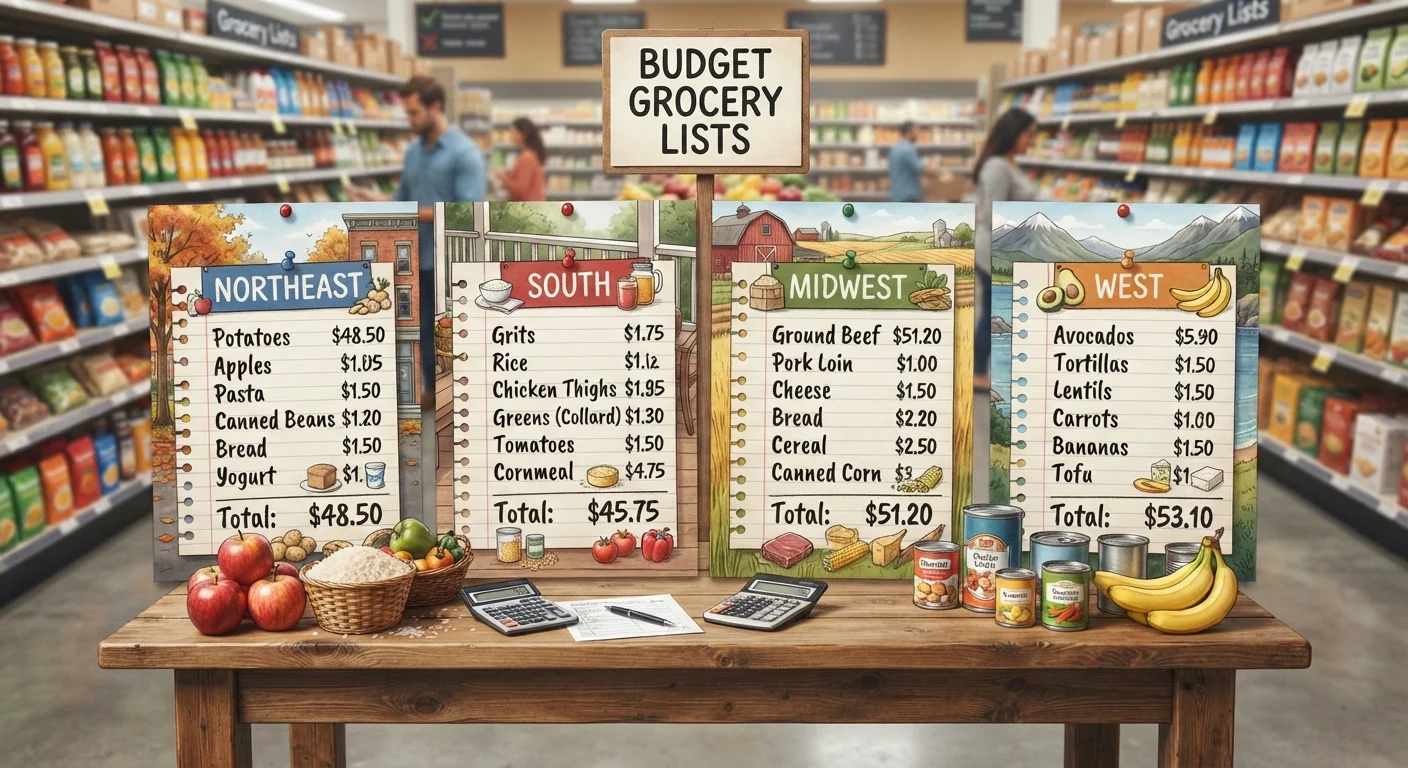
According to USDA's Economic Research Service, grocery prices rose 2.7 percent nationally in the year through July 2026, but that single national figure masks real, meaningful regional variation, since food prices tend to run higher in the Northeast and West, largely tied to income levels, population density, and how much local competition exists between grocery chains in a given market.
This guide is independently written and is not affiliated with USDA, OPM, or the official federal Feds Feed Families campaign.
Why Regional Prices Diverge
According to economist commentary reported by ConsumerAffairs, higher average salaries in a region generally make it easier for stores to sustain higher prices, which is part of why food costs tend to run higher in the Northeast and West. Grocery industry analysts have also pointed to differences in regional supply chain and overhead costs as a factor that's often difficult to trace to a single clear cause, since the same product can face different transportation and distribution expenses depending on the region.
Why Density Doesn't Automatically Mean Higher Prices
- Why Regional Prices Diverge
- Why Density Doesn't Automatically Mean Higher Prices
- Why Remote and Import-Dependent States Cost More
- State Grocery Sales Tax Adds Another Layer
- What Households Can Actually Control
- Using Local Prices to Set a Realistic Budget
- How This Connects to SNAP
- FAQ
- Do grocery prices really vary that much by region?
- Why don't densely populated cities always have the highest grocery prices?
- Do all states tax groceries?
- Does SNAP account for regional price differences?
It's worth noting that dense, populous cities don't automatically have the highest grocery inflation, since more stores competing for the same customer base within a dense area can actually counteract the effect of higher local incomes, keeping prices closer to average. Retailers actively track competitive pricing in their specific market and adjust accordingly, meaning the level of local competition is one of the most influential factors in a specific area's grocery prices, arguably more so than income alone.
Why Remote and Import-Dependent States Cost More
States that rely heavily on shipped or flown-in food, most notably Hawaii, consistently show the highest grocery costs in the country, since the added transportation expense gets passed directly to the shopper. States closer to major agricultural regions, by contrast, tend to see somewhat lower average grocery costs, reflecting shorter supply chains for many staple foods.
State Grocery Sales Tax Adds Another Layer
A number of states still apply a sales tax specifically to groceries, though this list has been shrinking, with several states eliminating their grocery tax in recent years while a handful of others, including Mississippi, South Dakota, Tennessee, and Hawaii, continue applying one. Checking whether your specific state taxes groceries, and at what rate, is worth doing when comparing your own grocery spending against a general national figure, since this tax is a real, additional cost some households face that others don't.
Recommended Articles
 BUDGETING MEAL PLANNING
 BUDGETING MEAL PLANNING
 BUDGETING MEAL PLANNING
 BUDGETING MEAL PLANNING
What Households Can Actually Control
While a region's underlying price level is largely outside an individual household's control, the choice of what to actually buy is not, and a household in a higher-cost state that leans heavily on affordable staples like beans, rice, and seasonal produce can genuinely land closer to a lower-cost state's overall grocery spending than a household in a cheaper state that buys mostly premium, convenience-oriented food.
Using Local Prices to Set a Realistic Budget
Rather than assuming a national average budget figure applies directly to your household, tracking your own actual grocery spending for a few weeks gives a far more accurate, locally relevant number to budget around than any general national or state-level estimate can provide, since even city-level variation within the same state can be significant.
How This Connects to SNAP
It's worth understanding that SNAP's maximum benefit amounts are set nationally, using the same federal maximum allotment table across the 48 contiguous states, with the notable exception of Alaska, Hawaii, Guam, and the U.S. Virgin Islands, which use separately calculated, higher allotments specifically to account for their meaningfully higher local food costs.
Read More Articals
FAQ
Do grocery prices really vary that much by region?
Yes, genuinely. Food prices tend to run higher in the Northeast and West, driven by income levels and local supply chain and overhead costs, with remote, import-dependent states like Hawaii showing the most extreme difference.
Why don't densely populated cities always have the highest grocery prices?
More stores competing for the same customers in a dense area can counteract the effect of higher local incomes, since competition is one of the most influential factors retailers use to set local pricing.
Do all states tax groceries?
No. A number of states have eliminated grocery sales tax in recent years, while others, including Mississippi, South Dakota, Tennessee, and Hawaii, continue to apply one, so it's worth checking your specific state's rate.
Does SNAP account for regional price differences?
Partially. SNAP uses the same maximum allotment table for the 48 contiguous states, with Alaska, Hawaii, Guam, and the U.S. Virgin Islands using separately calculated, higher allotments to reflect their significantly higher local food costs.
Sources: USDA Economic Research Service Food Price Outlook, ConsumerAffairs regional grocery cost reporting with economist commentary.