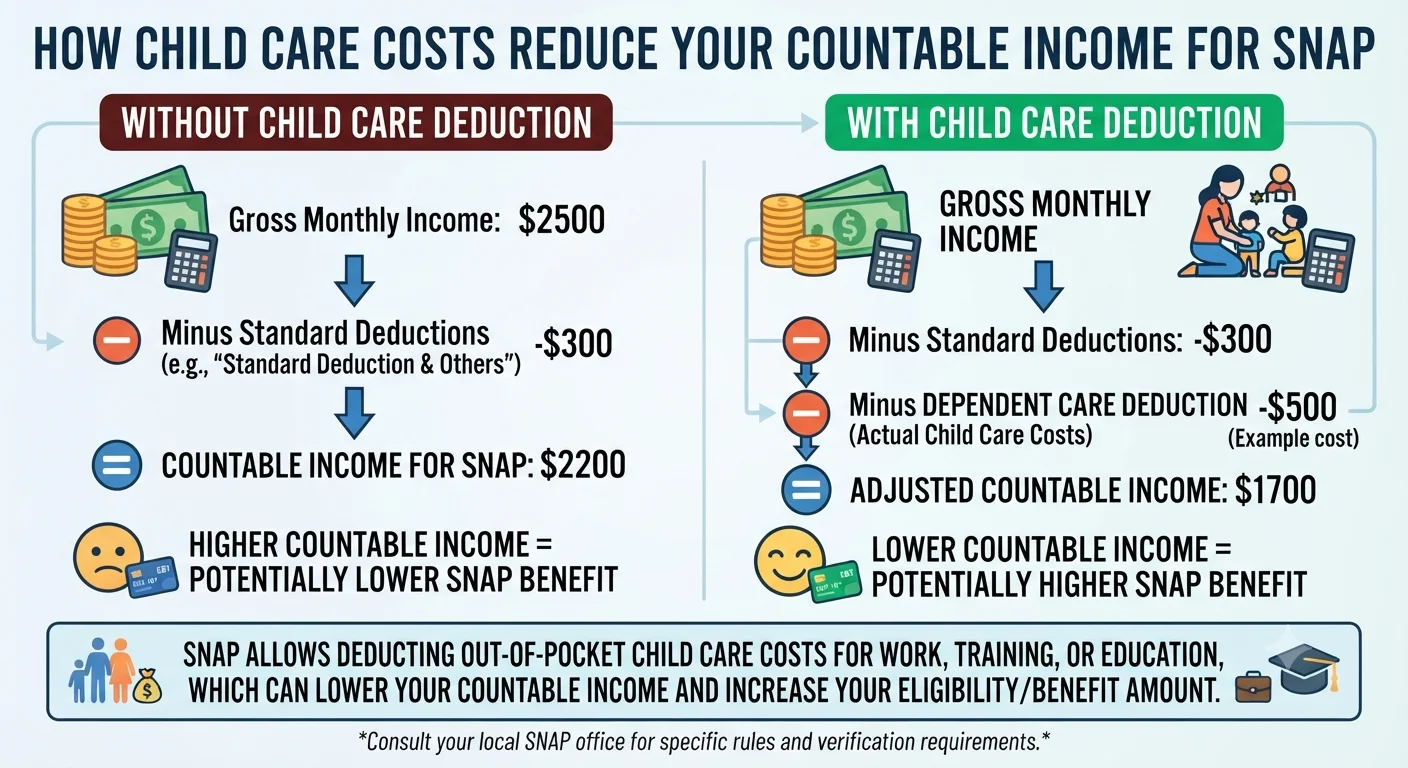
SNAP's dependent care deduction allows households to subtract the full cost of child care or other dependent care needed to work, look for work, or attend school or job training, with no federal cap on the deductible amount, unlike several of SNAP's other deductions. For a working parent paying a significant monthly child care bill, this deduction can meaningfully lower countable income and increase the household's SNAP benefit.
This guide is independently written and is not affiliated with USDA, OPM, or the official federal Feds Feed Families campaign.
What the Dependent Care Deduction Covers
This deduction applies to the actual cost paid for care of a child or another dependent household member, when that care is necessary for a household member to work, actively search for work, or attend school or an approved training program. It's not limited to formal daycare centers, in-home care, care by a relative who charges for the service, and before or after-school programs can all potentially qualify, as long as a genuine cost is being paid.
Why There's No Cap on This Deduction
- What the Dependent Care Deduction Covers
- Why There's No Cap on This Deduction
- What Documentation Is Typically Needed
- Care Must Be Tied to Work, Job Search, or Training
- How This Interacts With Other Deductions
- A Worked Example
- Reporting Changes in Child Care Costs
- FAQ
- Is there a limit on how much child care cost I can deduct for SNAP?
- Does informal child care, like paying a family member, qualify for this deduction?
- What documentation do I need for the child care deduction?
- Can I claim both the dependent care deduction and the shelter deduction?
Unlike the excess shelter deduction, which is capped for most households unless a member is elderly or disabled, the dependent care deduction has no federal maximum, reflecting the reality that child care costs can be substantial and genuinely reduce the amount of income actually available for food, regardless of how high the specific dollar figure runs. A household paying $1,200 a month for full-time infant care, for example, can deduct the full amount, not a capped portion of it.
What Documentation Is Typically Needed
Caseworkers generally ask for proof of the actual amount paid, such as a receipt from a licensed provider, a statement from an informal caregiver documenting the arrangement and payment, or bank or payment records showing the recurring cost. Because the deduction is based on actual costs rather than a standard estimate, documentation genuinely matters here, and a household paying informally, such as to a family member, should still keep some record of the payment to support the deduction if asked.
Care Must Be Tied to Work, Job Search, or Training
The core requirement is that the dependent care expense enables a household member to work, actively look for work, or attend school or an approved training program, rather than simply being general child care unrelated to employment or education. If a household is paying for child care purely for reasons unrelated to work or school, that specific cost generally wouldn't qualify for this particular deduction, though it's worth discussing the specific circumstances with a caseworker if there's any ambiguity.
Recommended Articles
 SNAP EBT
 SNAP EBT
 SNAP EBT
 SNAP EBT
How This Interacts With Other Deductions
The dependent care deduction is applied alongside SNAP's other deductions, the standard deduction, the 20 percent earned income deduction, and the excess shelter deduction, all working together to reduce gross income down to the final net income figure used to calculate the benefit. A working parent with both significant child care costs and high housing costs can potentially claim both deductions simultaneously, since they address different categories of expense.
A Worked Example
Consider a single parent with $2,400 in gross monthly income who pays $600 a month for after-school care so they can maintain full-time employment. After the 20 percent earned income deduction ($480) and the standard deduction, the $600 dependent care deduction is also subtracted from countable income, which can meaningfully lower net income and increase the resulting SNAP benefit compared to a household with the same income but no dependent care costs.
Reporting Changes in Child Care Costs
If your child care costs change significantly, whether they increase due to a new provider, decrease because a child starts school, or stop entirely, reporting this change to your SNAP office helps ensure your benefit accurately reflects your current situation, since both an increase and a decrease in this deduction can affect your monthly benefit amount.
Read More Articals
FAQ
Is there a limit on how much child care cost I can deduct for SNAP?
No. Unlike several other SNAP deductions, the dependent care deduction has no federal cap, and the full documented cost can generally be deducted.
Does informal child care, like paying a family member, qualify for this deduction?
It can, as long as there's a genuine cost being paid and the care enables work, job search, or school or training attendance, and some documentation of the payment is generally still needed.
What documentation do I need for the child care deduction?
Proof of the actual amount paid, such as a receipt from a licensed provider or a statement and payment record from an informal caregiver.
Can I claim both the dependent care deduction and the shelter deduction?
Yes. These address different categories of expense and can generally both be applied when calculating a household's net income for SNAP.
Sources: USDA Food and Nutrition Administration SNAP deductions guidance, New York State SNAP Eligibility Prescreening Guide.