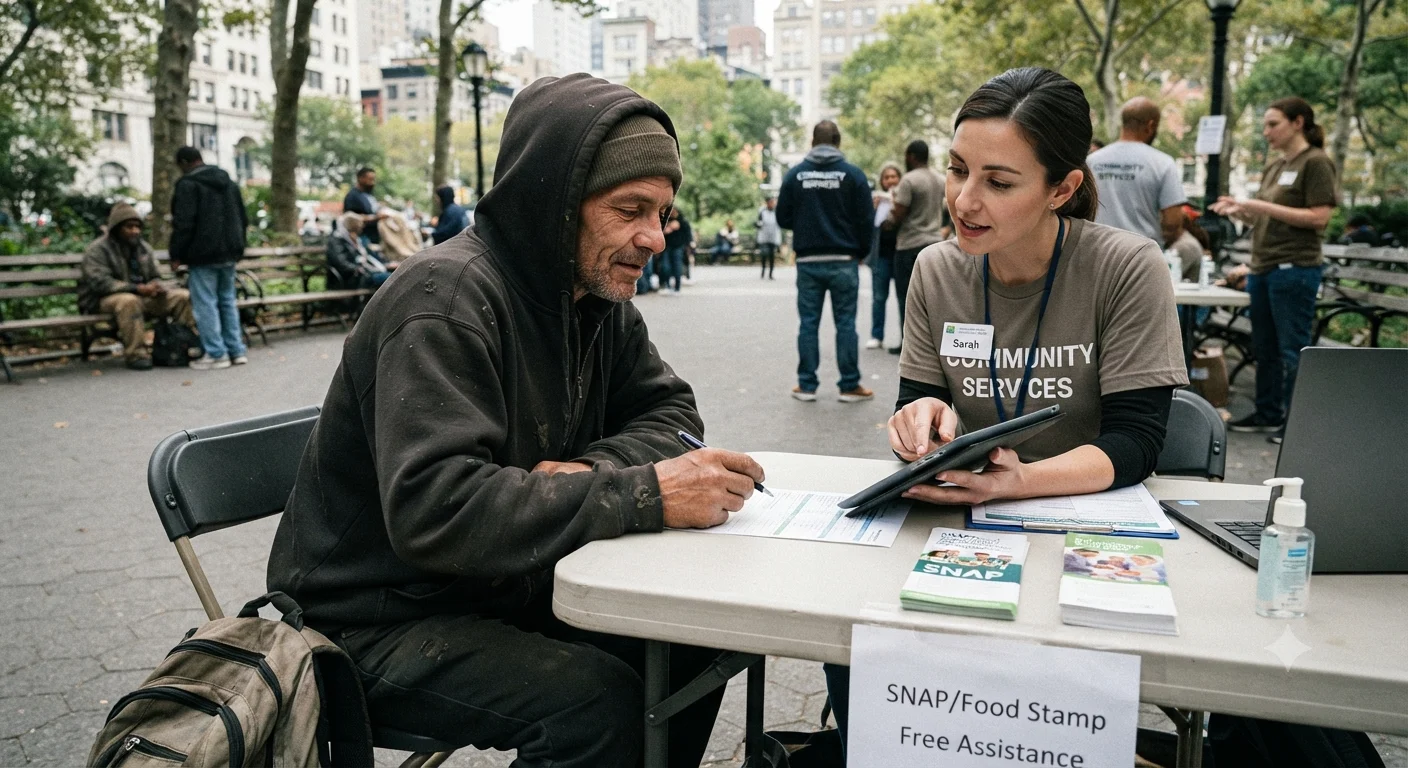
Experiencing homelessness does not disqualify someone from SNAP, and there's no requirement to have a permanent address, cooking facilities, or a regular place to live in order to apply and receive benefits. Many states also offer a standard homeless shelter deduction, a flat monthly amount subtracted from countable income to reflect real costs like laundry, phone calls, and storage lockers that people without stable housing still face.
This guide is independently written and is not affiliated with USDA, OPM, or the official federal Feds Feed Families campaign.
You Can Apply Without a Fixed Address
Federal SNAP rules do not require a permanent address to apply or receive benefits. If you don't have a reliable address for mail, you can generally ask your state agency to send correspondence to a shelter, social services agency, or a U.S. Post Office box instead, and many states also offer online case access through a smartphone or computer, letting you check notices and case status without needing physical mail delivery at all.
Homeless Shelter Residents Are Eligible
- You Can Apply Without a Fixed Address
- Homeless Shelter Residents Are Eligible
- The Homeless Shelter Deduction
- You Generally Can't Combine the Homeless Deduction With Other Shelter Deductions
- Not Every State Offers This Deduction
- Expedited SNAP Often Applies
- A Worked Example
- FAQ
- Can someone without a permanent address get SNAP?
- What is the homeless shelter deduction?
- Do all states offer the homeless shelter deduction?
- Can someone living in a homeless shelter receive SNAP?
People whose primary nighttime residence is a supervised public or private nonprofit shelter, or a halfway house, are specifically eligible for SNAP under federal regulation, and cannot be denied simply for residing in a shelter that provides meals, since shelter residency alone doesn't disqualify someone the way residing in certain other institutions might. Homeless shelter residents must meet the same underlying eligibility criteria as any other applicant, just without the address barrier that might otherwise complicate the process.
The Homeless Shelter Deduction
Federal regulation allows states to offer a standard homeless shelter deduction, a flat monthly amount, commonly in the range of $143 to $199 depending on the specific state, subtracted from net income for households where all members are homeless but not receiving completely free shelter throughout the month. This deduction exists to recognize genuine costs, like laundry, phone access, and storage, that homeless individuals face even without a traditional rent or mortgage payment, and importantly, it doesn't require the same detailed documentation that a standard shelter deduction would.
You Generally Can't Combine the Homeless Deduction With Other Shelter Deductions
If you receive the homeless shelter deduction, you generally cannot also claim the standard excess shelter deduction based on actual rent or housing costs, since the two are structured as alternatives rather than combinable deductions. If you're temporarily staying somewhere and contributing to actual shelter costs, such as paying a friend or family member for a place to stay, the standard shelter deduction based on that real contribution may actually provide a larger benefit than the flat homeless deduction, so it's worth discussing your specific situation with a caseworker.
Recommended Articles
 SNAP EBT
 SNAP EBT
 SNAP EBT
 SNAP EBT
Not Every State Offers This Deduction
Because the homeless shelter deduction is a state option rather than a federal mandate, not every state has adopted it, and among states that have, awareness and actual usage of the deduction has historically been lower than it could be. If you're experiencing homelessness and applying for SNAP, specifically asking your caseworker whether your state offers this deduction, and making sure your case is properly coded as homeless, is worth doing to ensure you receive it if it's available.
Expedited SNAP Often Applies
Given that many people experiencing homelessness have very limited income and minimal cash resources, expedited SNAP processing, which guarantees benefits within 7 days rather than the standard 30, frequently applies. It's worth telling your caseworker explicitly about your housing situation and financial circumstances so they can assess whether expedited processing fits your case.
A Worked Example
Consider a homeless veteran receiving $500 a month in veterans benefits, staying at a shelter some nights and sleeping outside on others. After the standard deduction and the homeless shelter deduction are applied, his net monthly income might come down to under $100, resulting in a SNAP benefit close to the maximum allotment for a one-person household, illustrating how meaningfully these deductions can affect the final benefit for someone in this situation.
Read More Articals
FAQ
Can someone without a permanent address get SNAP?
Yes. There's no requirement to have a fixed address, cooking facilities, or stable housing to apply for and receive SNAP benefits.
What is the homeless shelter deduction?
A flat monthly deduction, commonly $143 to $199 depending on the state, that some states offer to homeless households instead of a standard shelter deduction based on actual housing costs.
Do all states offer the homeless shelter deduction?
No. It's a state option rather than a federal requirement, so it's worth asking your specific state's SNAP office whether it's available.
Can someone living in a homeless shelter receive SNAP?
Yes. Federal regulation specifically allows homeless shelter residents to be eligible for SNAP, and shelter residency alone cannot be used to deny an application.
Sources: eCFR Title 7, Part 273.9, Massachusetts Legal Help, Georgia Department of Human Services PAMMS SNAP policy manual, Center on Budget and Policy Priorities.