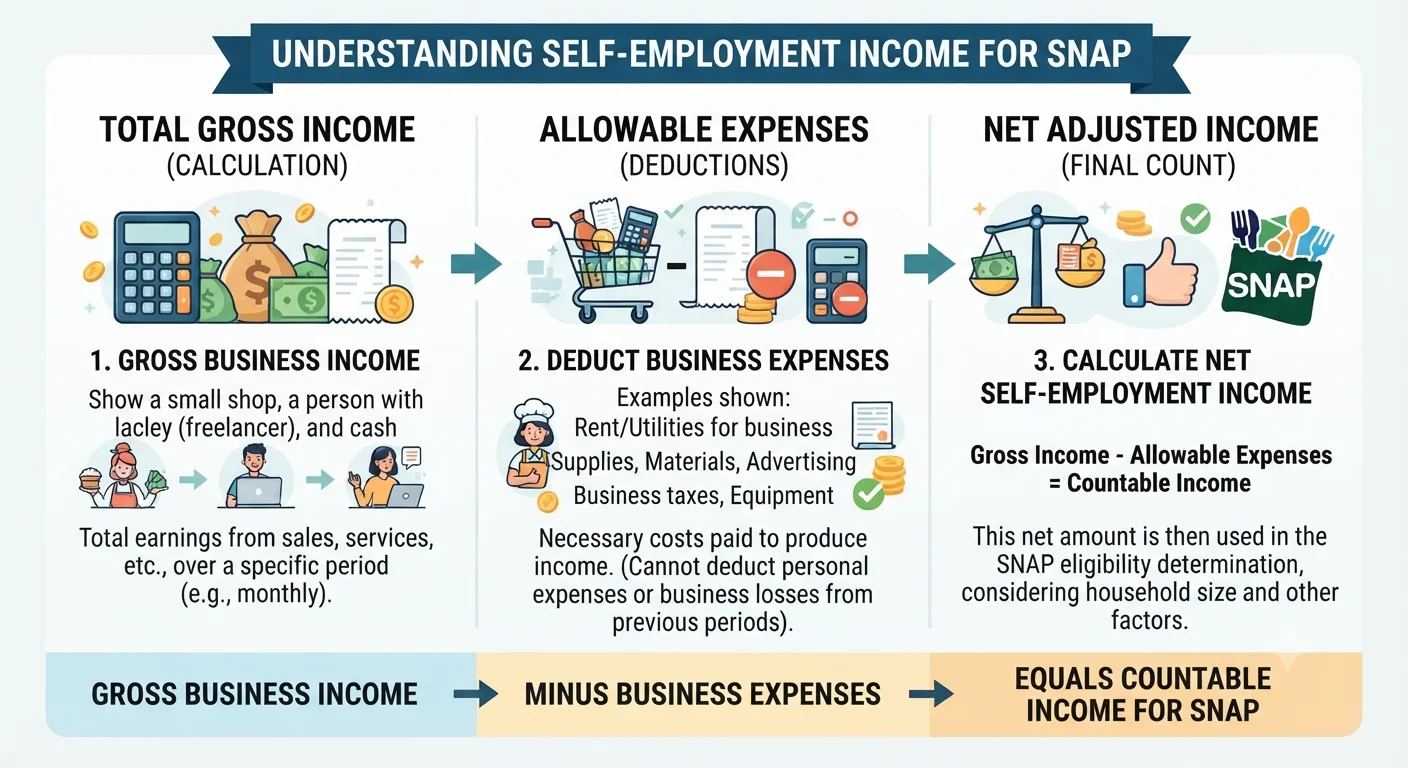
SNAP allows self-employed applicants to deduct business expenses before counting their income, similar to how a tax return separates gross business revenue from net profit, which means a self-employed person's SNAP-countable income is often meaningfully lower than their total gross business revenue might suggest. States use somewhat different methods for calculating this deduction, but the underlying principle, that the actual cost of doing business isn't counted as available income for buying food, is consistent nationwide.
This guide is independently written and is not affiliated with USDA, OPM, or the official federal Feds Feed Families campaign.
Why Self-Employment Income Is Calculated Differently
Unlike a wage-earning job, where gross pay closely reflects what's actually available to a household, self-employment income requires subtracting real business costs, inventory, supplies, equipment, or a portion of home utilities used for the business, before arriving at a figure that actually reflects what the applicant has available to spend. Self-employed applicants often underreport these costs simply because they're not thinking of them as deductible business expenses, which can result in a lower SNAP benefit than they're actually entitled to.
Two General Approaches States Use
- Why Self-Employment Income Is Calculated Differently
- Two General Approaches States Use
- What Counts as a Documentable Business Expense
- What Documentation Is Typically Required
- Averaging Income Over Time
- A Worked Example
- Why This Matters for Eligibility
- FAQ
- Does SNAP count my total business revenue or my actual profit?
- What documentation do I need for self-employment income?
- Do all states calculate the self-employment deduction the same way?
- Does fluctuating self-employment income get averaged for SNAP?
States generally use one of two methods to calculate the self-employment expense deduction:
- Actual documented expenses: Some states, including Massachusetts, allow applicants to itemize and document their actual business costs, such as supplies, mileage, advertising, licensing fees, and a proportional share of home utilities for a home-based business, subtracting the total from gross self-employment income before applying the standard 20 percent earned income deduction on top.
- A flat percentage deduction: Other states, including Georgia at 40 percent and several states using a 50 percent standard, apply a flat percentage deduction to gross self-employment income to account for business costs, without requiring detailed documentation of every individual expense.
Because this varies by state, it's worth asking your specific state's SNAP office directly which method applies, since the approach affects both how much documentation you need to provide and how the final calculation is structured.
What Counts as a Documentable Business Expense
In states using the actual-expense method, common deductible costs include the cost of goods or materials purchased for resale, advertising and marketing costs, business phone or website expenses, a proportional share of home utility costs for a home-based business, business licensing fees, and vehicle or equipment costs directly tied to the business. It's worth noting that expenses set aside for income tax or personal retirement savings are generally not deductible as business expenses, since these are treated as already covered by the standard 20 percent earned income deduction.
Recommended Articles
 SNAP EBT
 SNAP EBT
 SNAP EBT
 SNAP EBT
What Documentation Is Typically Required
Caseworkers commonly ask for a recent tax return, specifically a Schedule C for a sole proprietorship, or a monthly log of income and expenses if the business is too new to have a full year of tax filings. For a genuinely new business without tax records, a written statement or informal ledger documenting monthly income and costs is often accepted as a starting point, with the case reviewed and updated as more complete records become available.
Averaging Income Over Time
Self-employment income often fluctuates month to month, particularly for seasonal work or a business still building a steady client base. Caseworkers generally average this income over an appropriate period, often the past year if the business has been operating that long and the income is representative of current circumstances, or over a shorter, more recent period if the business is newer or income has recently changed significantly.
A Worked Example
Consider a self-employed taxi driver who netted $10,000 over the past year after business expenses like insurance, gas, and vehicle maintenance. Averaged over 12 months, that's roughly $833 per month in pre-deduction earned income. After the standard 20 percent earned income deduction is applied on top of the already-net business figure, countable income drops to approximately $667 per month, a meaningful difference from the driver's total gross fares before any expenses were subtracted.
Why This Matters for Eligibility
Because self-employed applicants often start with a gross revenue figure that looks too high for SNAP eligibility, properly documenting and applying business expense deductions can be the difference between qualifying and not qualifying, or between a smaller and a meaningfully larger benefit. Taking the time to identify every applicable business cost, rather than reporting only the most obvious ones, is worth the extra effort during the application process.
Read More Articals
FAQ
Does SNAP count my total business revenue or my actual profit?
SNAP counts income after business expenses are deducted, similar to net profit, not total gross revenue, though the specific method for calculating this deduction varies by state.
What documentation do I need for self-employment income?
A recent Schedule C tax filing is commonly requested, or a monthly log of income and expenses if the business is too new to have complete tax records.
Do all states calculate the self-employment deduction the same way?
No. Some states allow itemized actual business expenses, while others apply a flat percentage deduction, commonly 40 to 50 percent, to gross self-employment income instead.
Does fluctuating self-employment income get averaged for SNAP?
Generally yes, typically averaged over the past year if representative of current circumstances, or over a shorter recent period for a newer business or recently changed income.
Sources: Massachusetts Legal Help SNAP Advocacy Guide, Georgia Department of Human Services PAMMS SNAP policy manual, Montana Department of Public Health and Human Services SNAP manual.