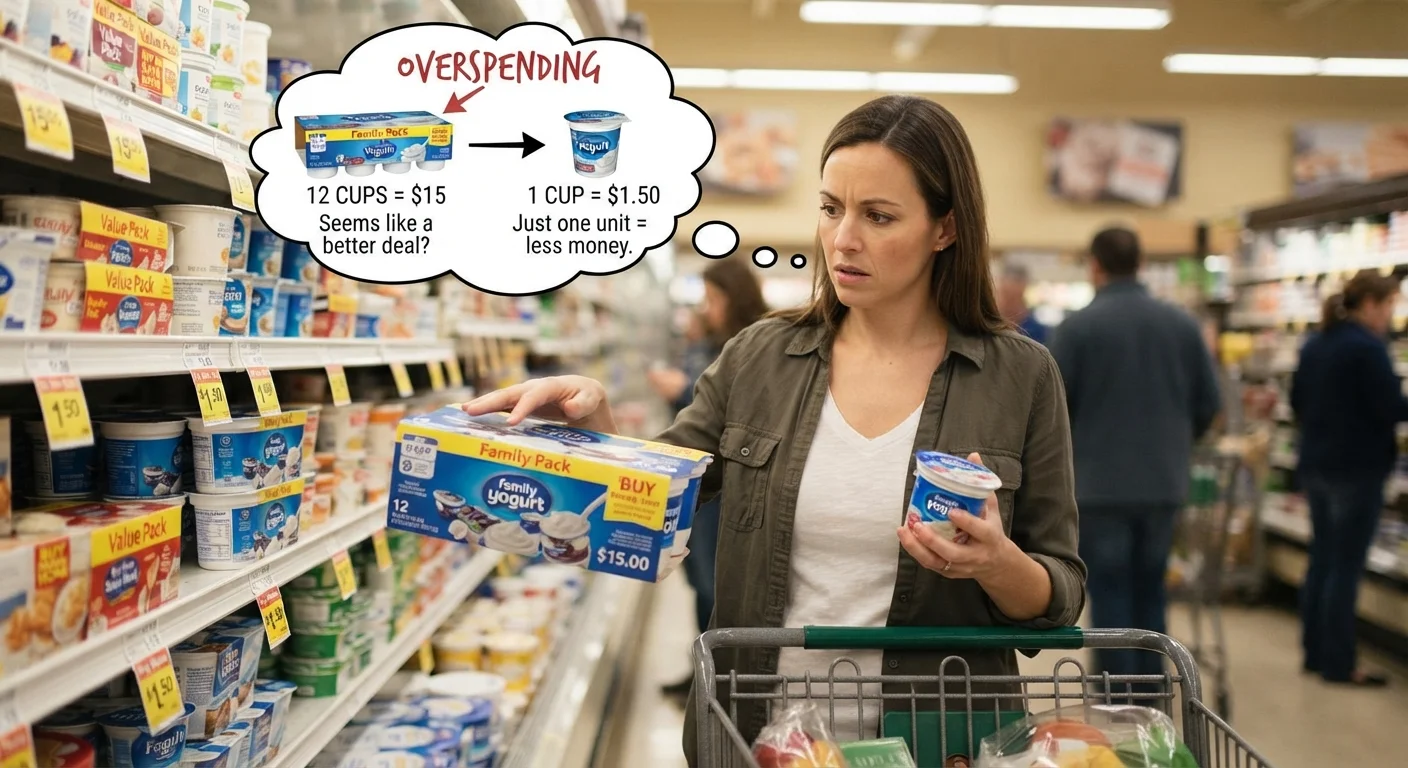
Unit bias is a documented psychological effect, first formally studied by researchers Andrew Geier, Paul Rozin, and Gheorghe Doros and published in the journal Psychological Science, describing the tendency to treat a single served or packaged unit of food, regardless of its actual size, as the appropriate and default amount to buy or eat. The same bias that leads someone to finish an oversized muffin simply because it's "one muffin" also quietly shapes grocery spending, since a bigger single package can feel like the "normal" purchase even when it's genuinely more food or money than the household needs.
This guide is independently written and is not affiliated with USDA, OPM, or the official federal Feds Feed Families campaign.
What the Original Research Actually Found
In the foundational unit bias studies, researchers set out bowls of M&M's, pretzels, and Tootsie Rolls with either a small or a large serving scoop attached, and found that people consistently took and consumed more when the available scoop was larger, treating "one scoopful" as the natural unit regardless of how much that scoop actually held. The effect wasn't about hunger or taste, it was about the size of the unit itself functioning as an unconscious guide for what counted as a normal, complete portion.
How This Extends to Grocery Purchasing
- What the Original Research Actually Found
- How This Extends to Grocery Purchasing
- Why Manufacturers Lean Into This
- The Segmentation Effect: A Useful Countermeasure
- How to Apply This When Shopping
- Why This Matters for a Tight Budget
- This Isn't About Willpower
- FAQ
- What is unit bias?
- Does unit bias only affect how much food someone eats?
- How can breaking food into smaller units help counteract unit bias?
- Is falling for unit bias a sign of poor self-control?
The same underlying tendency to treat a single unit as the default appropriate amount plays out at the grocery store: a family-sized bag of chips, a jumbo box of cereal, or a large multi-pack can feel like the standard, normal purchase simply because it's presented and marketed as one unit, even when a smaller size would genuinely better match what the household will use before it spoils or before preferences shift.
Why Manufacturers Lean Into This
Food industry researchers have long understood that portion and package sizing directly shapes consumption and purchasing behavior, and pricing a larger package only marginally higher than a smaller one, while the actual production cost difference is minimal, creates a strong incentive for a shopper to default to the bigger size, reinforcing exactly the unit bias effect the research describes.
The Segmentation Effect: A Useful Countermeasure
Follow-up research on this topic found that breaking a larger amount of food into multiple smaller, visually distinct units, rather than one large single unit, tends to reduce how much people actually consume, since each smaller unit still registers as a "complete" portion on its own. This same principle can be applied deliberately when grocery shopping: choosing a package that's already divided into individual portions, or manually portioning a large purchase into smaller containers immediately after buying it, can counteract the pull toward treating an oversized unit as the automatic norm.
Recommended Articles
 BUDGETING MEAL PLANNING
 BUDGETING MEAL PLANNING
 BUDGETING MEAL PLANNING
 BUDGETING MEAL PLANNING
How to Apply This When Shopping
- Pause before defaulting to the largest available size, and ask specifically whether your household will realistically use that full amount before it spoils or loses appeal
- Compare the actual unit price, cost per ounce or pound, rather than assuming the larger package is automatically the better value simply because it's the "standard" option on the shelf
- Portion a large purchase into smaller containers immediately after a shopping trip, rather than leaving one giant unit in the pantry or fridge, which can reduce both overconsumption and the temptation to overbuy the same size again next time
Why This Matters for a Tight Budget
Unit bias doesn't just affect how much gets eaten in one sitting, it affects the size of purchase a shopper defaults to buying in the first place, and a household regularly buying an oversized "default" unit that goes partially unused is quietly spending more per actual serving consumed than the shelf price alone suggests. Recognizing this pattern is a genuinely useful, research-backed addition to standard grocery budgeting advice, distinct from simply "buying in bulk to save money."
This Isn't About Willpower
It's worth understanding that unit bias operates below conscious awareness in the original research, meaning falling into this pattern isn't a personal failing or a lack of discipline, it's a well-documented, near-universal psychological tendency. Building small, deliberate habits, like checking the unit price or portioning food immediately after a purchase, works with this bias rather than requiring a constant, exhausting fight against it.
Read More Articals
FAQ
What is unit bias?
A documented psychological effect where people treat a single served or packaged unit of food as the appropriate default amount to buy or eat, regardless of its actual size, first formally studied by researchers Geier, Rozin, and Doros.
Does unit bias only affect how much food someone eats?
No, it also shapes purchasing decisions, since a larger package can feel like the "normal" default purchase simply because of how it's sized and marketed, independent of what a household actually needs.
How can breaking food into smaller units help counteract unit bias?
Research on the "segmentation effect" found that dividing a larger amount into multiple smaller, distinct units reduces overconsumption, since each smaller unit still registers as a complete portion on its own.
Is falling for unit bias a sign of poor self-control?
No. The original research shows this effect operates largely below conscious awareness and is a near-universal tendency, not a personal failing, which is why small structural habits work better than willpower alone.
Sources: Geier, Rozin, and Doros, "Unit Bias," Psychological Science (2006), University of Pennsylvania Department of Psychology, follow-up segmentation effect research published in Health Psychology.